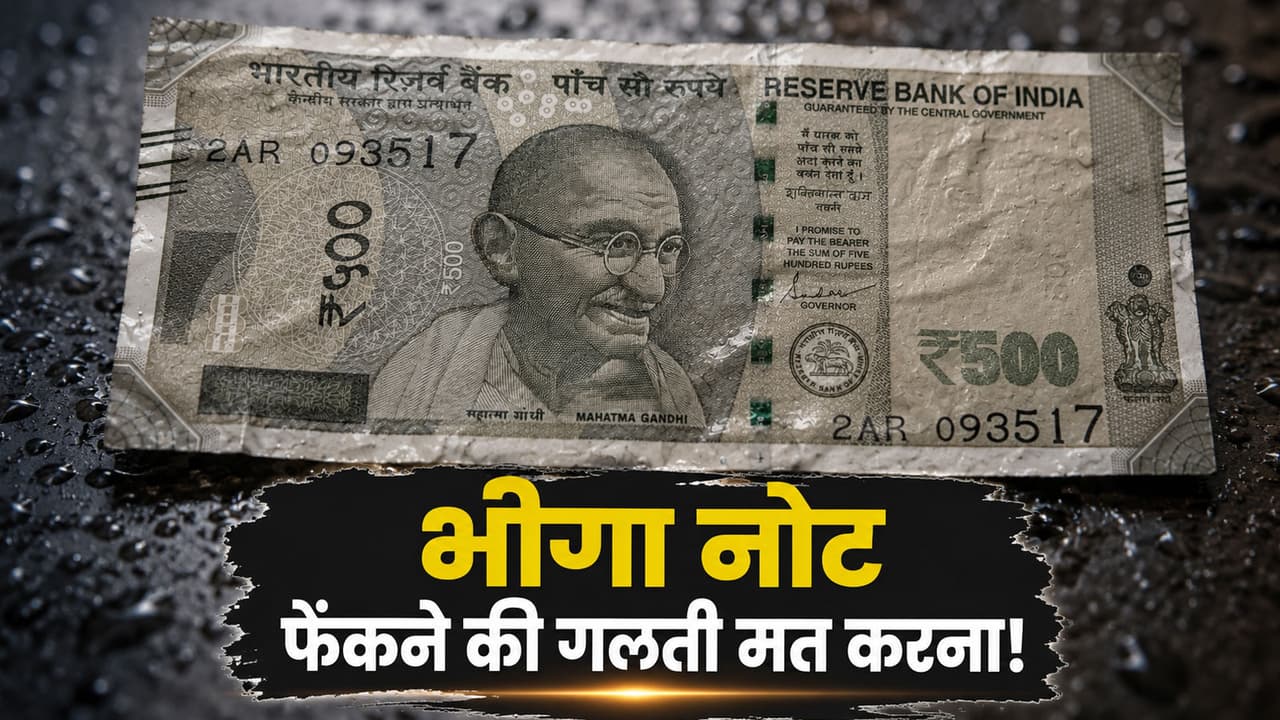
RBI Note Refund Rules: Don’t panic if your ₹500 note gets melted or torn in the rain. You can get your entire money back as per RBI rules. Know what you should do…
Torn Note Exchange Rule: It is raining heavily in most of the states of the country. Suppose you have gone somewhere and suddenly it starts raining heavily. You reached home drenched, took a sigh of relief, but as soon as you put your hand in your pocket… your heart sank. The crisp ₹ 500 note kept in the pocket has melted or torn due to water. Now the first thought that comes to mind is, ‘₹500 has gone down the drain!’ No one will take it now. If you also feel this way, then there is absolutely no need to take tension. There is a rule of the country’s central bank i.e. Reserve Bank of India (RBI), under which the bank will not only have to take your mutilated note, but will also have to give you the full amount in exchange. Let us know what you have to do at such a time…
What does RBI rule say regarding notes?
According to RBI rules (RBI Note Refund Rules), no bank can refuse to accept such notes which have become dirty, torn or melted due to getting wet in water. This rule applies to every branch of every bank, whether it is a government bank or a private one. All you have to do is go to your nearest bank, whether you have an account there or not.
Which notes can be exchanged and when will the full amount be received?
There is a scale for exchanging notes in a bank. Bank officials see how much of your torn or crumpled note is left safe. Talking about ₹ 500 note, if 80% or more of your ₹ 500 note is intact, then the bank will give you a new note of entire ₹ 500 in exchange. If the note is badly damaged and only 40% to 80% of it remains intact, you will get back half of the total value of the note i.e. ₹250.
When will not a single rupee be recovered from the torn notes?
If less than 40% of the ₹500 note you have is left or the note has turned into ash or pulp and is difficult to identify, then the bank will not accept it and you will not get a single rupee.
How to change notes in bank? Step-by-step method
- If the note gets wet and torn, do not make the mistake of throwing away its pieces. Dry them and keep them together safely, because it is necessary to show the entire note in the bank.
- After this, go to any commercial bank branch near your home. For this, it is not necessary to go to the same bank where you have your account.
- Go to the cash counter of the bank and show the note to the officer. They will check the condition of the note and its size.
- If the note is found to be within the norms, the bank officer will immediately give you a new note or the money will be transferred to your account.
Is there a fee for exchanging notes and how many notes can be exchanged?
- Not a single rupee can be charged from you as commission or fee for exchanging mutilated or mutilated notes in the bank. This service is absolutely free.
- If you go to exchange more than 20 notes at a time or the total value is more than ₹5,000, the bank may keep them instead of exchanging them immediately and the money can be credited to your account later.
- If the note is badly burnt or stuck together, local banks are not able to replace it. Such notes have to be sent directly to the issue office of RBI.
What to do if bank refuses to exchange notes?
If any bank officer refuses to exchange your legitimate note, then you can complain directly to the manager of that bank. Action can be taken against the bank for violation of rules.
Disclaimer: The information given in this article is only for awareness and general informational purposes. The rules for exchanging rain-wet, torn or mutilated notes are based on the official guidelines of the Reserve Bank of India (RBI). The final decision on exchanging the note or the amount to be received in exchange is taken by the concerned bank officer only after looking at the actual condition of the note. In case of any dispute or confusion, the official rules of RBI should be considered final.