share market
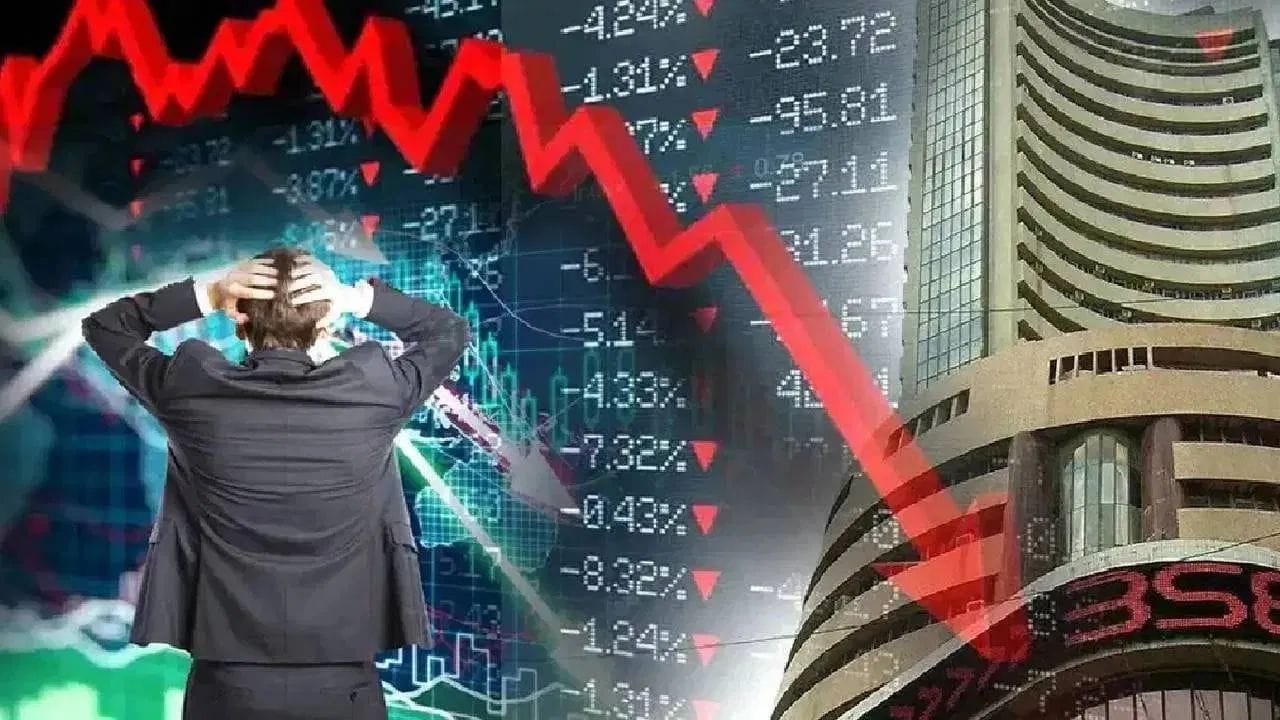
There was a huge fall in the Indian stock market on Tuesday. Both Sensex and Nifty fell by more than 0.5%. The renewed tension over the war between Iran and America and continuous selling by FIIs scared investors. By 9.16 am, the Sensex fell more than 452 points to 73,815.12, while the Nifty fell 50,153 points to 23,229. The fall came as the India VIX, which measures market volatility, fell 2.5 per cent to 16.13.
Bajaj Finance shares fell the most in the index, falling by about 3 per cent. This was followed by Bharat Electronics (BEL), Bajaj Finserv, Trent, NTPC, Power Grid, UltraTech Cement and L&T, which fell by 1-2 per cent. In contrast, IT stocks like Infosys, TCS, Tech Mahindra and HCL Tech saw a gain of 1-3 per cent.
Broader lagged behind market benchmarks. Both Nifty Smallcap 100 and Nifty Midcap 100 indices fell by around 1% each. Sectorally, Nifty Auto, Nifty Realty, Nifty Consumer Durables and some other indices fell by more than 1%. In contrast, Nifty IT gained almost 2%. About 887 shares gained on the NSE, while 1,650 shares declined and 97 shares remained unchanged.
The special thing is that due to this fall, stock market investors lost Rs 3.75 lakh crore within a minute of the market opening. Recently news has come that South Korea’s market Kospi has overtaken India at 6th position in terms of market cap. This means that India has now become the 7th largest market in the world at present. A few days ago, India was the 5th largest market in the world. Which was earlier left behind by the Taiwanese market.
Uncertainties of Iran-America War
Iran and the US launched attacks on each other, while Israel ordered troops deeper into Lebanon in its fight with the Tehran-backed Hezbollah militant group. Tensions have risen again in the Middle East after Washington hosted Israel-Lebanon peace talks on Friday. This has reduced the hope that America and Iran can soon announce an extension of their ceasefire, which is becoming increasingly weak.
Meanwhile, US President Donald Trump wrote on ‘Truth Social’ on Monday evening that he convinced Prime Minister Benjamin Netanyahu to cancel the attack on Beirut, after which the Israeli leader “withdrew his troops”. “Today (Monday) I had a conversation with Bibi Netanyahu, in which I urged him not to launch any major attack on Beirut, Lebanon. He withdrew his troops. Thank you Bibi. Here he addressed the Israeli Prime Minister by his popular nickname.
Trump said on Friday that he would soon decide on a proposed agreement to extend the ceasefire declared in early April. Israel would have a key role in any such agreement, and Iran has repeatedly said it should also include Hezbollah and Lebanon. On Sunday, a US official said that the US has proposed a plan to “gradually reduce tensions”.
surge in oil prices
Due to the recent increase in tensions, Brent crude futures reached near $95 per barrel, while WTI crude futures reached near $92 per barrel. It came as Brent and WTI crude fell 19 per cent and 17 per cent in May, their biggest monthly declines in absolute terms since March 2020 – when the Covid-19 pandemic severely slashed energy demand.
Increasing military attacks in the geopolitically unstable Middle East have raised concerns about the long-term closure of the Strait of Hormuz. It is a narrow 33 kilometer waterway that connects the Persian Gulf to the Gulf of Oman, and through which 20 percent of the world’s daily oil and gas shipments pass.
FII selling continues
Foreign investors remained net sellers of Indian equities. On Monday, he sold shares worth about Rs 3,912 crore on Dalal Street. This happened after huge selling of Rs 22,102 crore in just one session on May 29. The special thing is that in the current year, foreign investors have withdrawn Rs 2.47 lakh crore from the stock market. It was only the month of January when stock market investors invested money in the market.
What do experts say?
VK Vijayakumar, Chief Investment Strategist, Geojit Investments, said that the continuous AI trade, new records being made in the markets of America, South Korea and Taiwan, continuous selling of FPIs in India and India lagging behind in the market – all these trends are still continuing and there are no signs of any immediate change in them. Adding to India’s problems, due to the energy crisis, India’s GDP growth forecast for this financial year has been reduced and inflation estimates have been increased. Now we have another threat from IMD, which has released a new estimate of monsoon rains. According to this, rainfall will be only 90 percent of the long-term average, which will have a negative impact on growth and inflation.