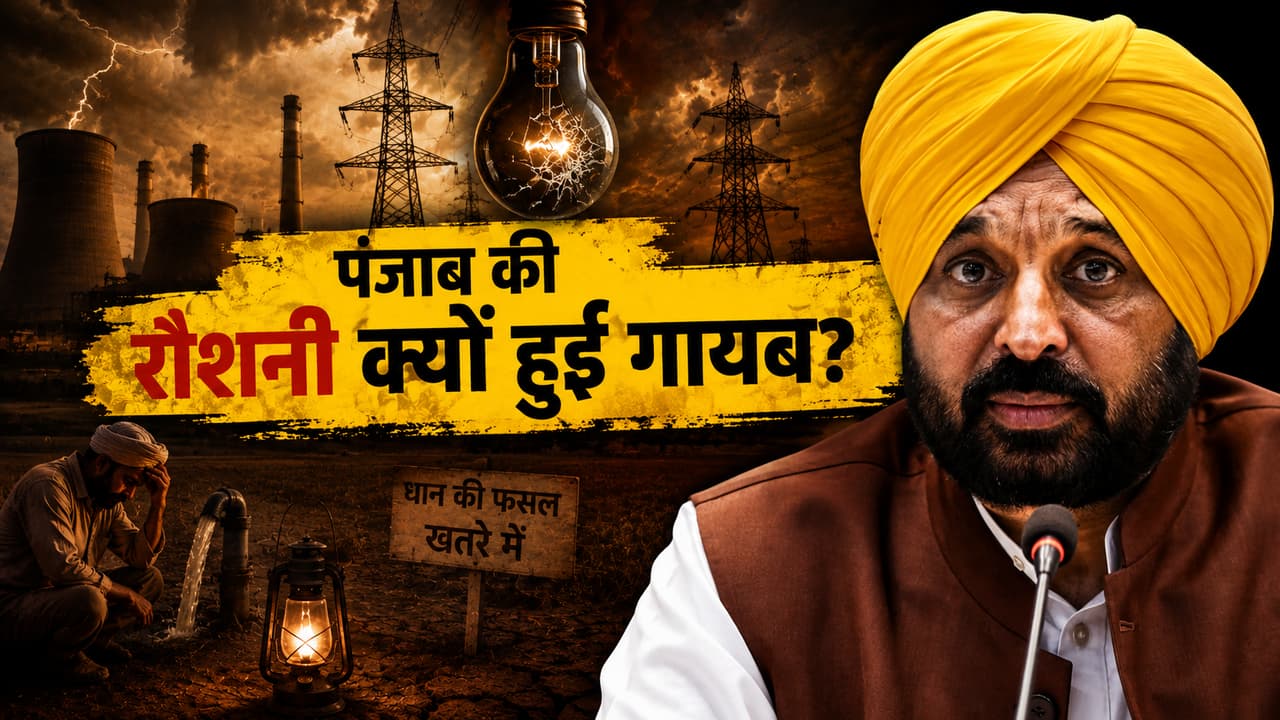
Punjab electricity crisis deepens! After closure of 6 power plants, production decreased, farmers and industries in danger, PSPCL forced to buy expensive electricity, impact on farmers, industries and economy increased, who is ultimately responsible?
Chandigarh: Punjab, which led India’s ‘Green Revolution’ for decades and fed the entire country, is today itself standing on the brink of an unprecedented and historic crisis. The state’s biggest development engine i.e. its electricity system has completely collapsed. In the scorching heat and in this all-important paddy transplantation season, when farmers need round-the-clock electricity, Punjab’s power grid is completely gasping. This is not a normal technical failure, rather it is a systematic failure of the system that has been ignored for years, which has created havoc everywhere, from industries to farms.
Demand on the floor, supply on the floor: When 6 thermal units sat together!
The biggest and fatal blow to the power system of Punjab came when 6 big units of state-run thermal power plants suddenly went out of service. This directly led to a huge decline in the state’s total power generation capacity by more than 1,800 MW.
That ‘expensive’ truth of Rs 10 per unit
To meet this historic shortfall, Punjab State Power Corporation Limited (PSPCL) had to purchase emergency power from the National Electricity Exchange. To prevent the grid from crashing, the corporation was on some occasions forced to purchase power at exorbitant and record-breaking expensive rates of Rs 10 per unit, which has broken the financial back of the already debt-ridden corporation.
Lehra: That ‘mysterious crisis’ of love which extinguished the lamps
Guru Hargobind Thermal Plant with 920 MW capacity located at Lehra Mohabbat became the biggest center of this entire power crisis. All four units of this most reliable and biggest government factory of the state were suddenly closed simultaneously. Government reports attributed this to excessive accumulation of ‘fly ash’ and serious technical irregularities. But the story is not just about machines breaking down. As per Central Electricity Authority (CEA) norms, the lifespan of these sub-critical power plants is 25 years, while many units like Ropar were languishing for more than 30 years without any major modernisation. Today the entire Punjab is suffering the consequences of the laxity of the previous governments and the current operational lapses. On top of that, the ongoing strike by around 1,852 outsourced workers over regularization added fuel to the fire and the repair work came to a complete halt.
Punjab vs Haryana: Two neighbors who started their journey together, then why this gap?
This crisis has raised a very uncomfortable and bitter question before the policy makers of Punjab. Punjab seems to be lagging behind in comparison to neighboring state Haryana which has geographically and socially similar conditions. While Punjab spends its entire administrative energy every summer just on crisis management, Haryana has strengthened its transmission network and created big industrial hubs like Gurugram, Faridabad and Panipat.
According to official PIB data, this gap is not just in electricity but directly in economic prosperity:
| state per capita | Net State Domestic Product (NSDP – 2022-23) |
| Punjab | Rs 1,73,873 |
| Haryana | Rs 2,96,685 |
This shocking difference clearly proves that electricity is not just for lighting homes, but is the real backbone of employment, per capita income and industrial revolution.
Crisis looms on paddy cultivation
This entire incident has happened at a time when paddy plantation in Punjab is at its most important phase. Irrigation for farmers is completely dependent on electricity. Complaints of irregular power supply and cuts were reported from many districts. If the power crisis prolongs, it may have a direct impact on crop production, groundwater irrigation and farmers’ income.
Has Devbhoomi fallen victim to political claims and election promises?
The current Aam Aadmi Party (AAP) government came to power in Punjab with big promises of better governance, efficient management and 24-hour uninterrupted electricity. Although it is true that he has inherited a dilapidated infrastructure and a loss-making department, but after 4 years in office, today the public is demanding direct accountability. Tired of expensive electricity and tripping, industrialists are thinking of moving to other states, MSMEs are on the verge of closure and farmers are crying tears of blood seeing the crops drying up in the fields. In the upcoming elections, this power crisis is not just a political issue but is going to become the biggest factor in deciding the key to power.
Is only the present government responsible?
The political aspect of the power crisis is also under discussion. The current Aam Aadmi Party government certainly has the responsibility of operation and management, but experts believe that this crisis is also the result of structural deficiencies that have been going on for many years. Modernization of old plants, financial reforms and expected investment in infrastructure could not happen during the previous governments. The present government was expected to improve the situation through administrative efficiency and better management.
Will Punjab again become the center of energy and development?
The challenge before Punjab today is not just to provide electricity in summer, but to make the entire energy infrastructure modern and sustainable. If modernization of old plants, expansion of transmission network, financial reforms and better management of human resources are not done in time, the power crisis can have a long-term impact on agriculture, industry and economic development of the state. In the coming times, this issue may become the biggest test not only of electricity but of the future of Punjab and its development model.