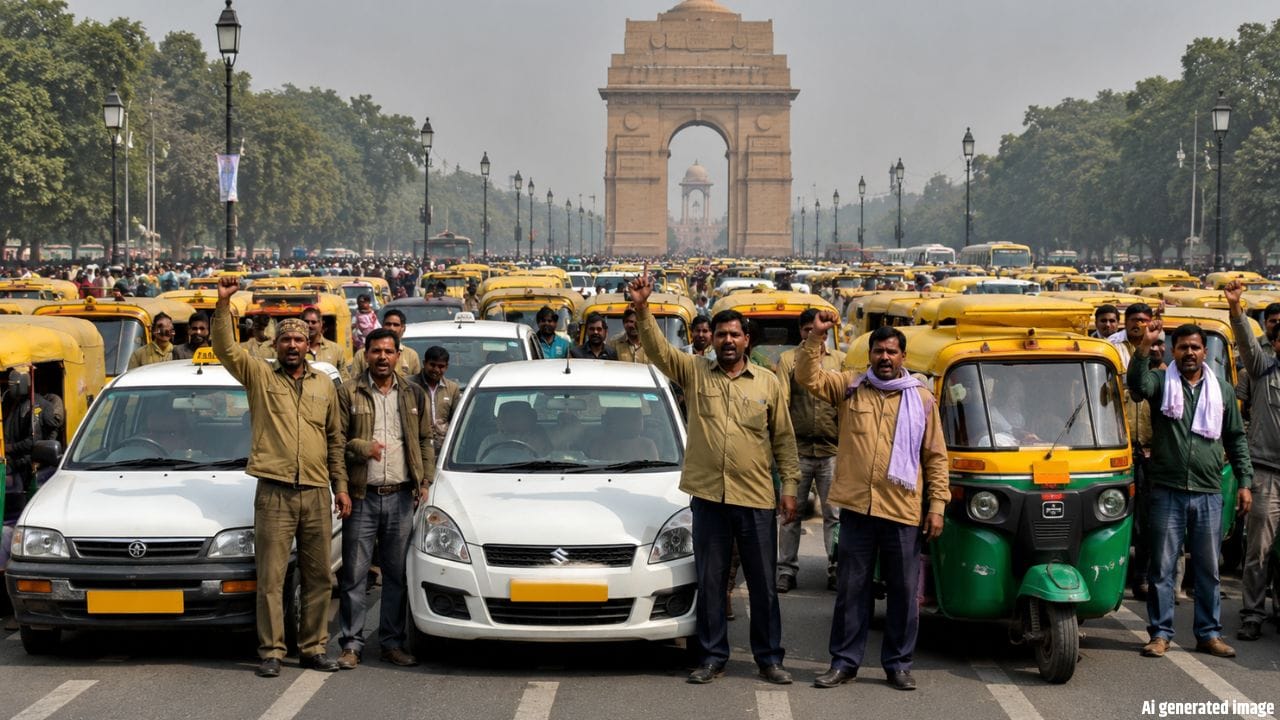
Auto drivers will remain on strike for 3 daysImage Credit source: ai generated
The next few days can be very troublesome for people living or employed in the capital Delhi. If you also travel by cab or auto for office or any important work, then make concrete planning of your journey before leaving home from 21st to 23rd May. The ever increasing cost of CNG, petrol and diesel is now going to directly impact the journey of the common man. Commercial vehicle unions have announced a three-day chakka jam demanding increase in fares.
Silence on the streets of Delhi from 21 to 23 May
All India Motor Transport Congress has expressed its concerns regarding this entire matter by writing a letter to Delhi Lieutenant Governor Taranjit Singh Sandhu and Chief Minister Rekha Gupta. The union has a clear demand that the fares of commercial vehicles should also be revised in proportion to the speed at which fuel prices are increasing. Anuj Kumar Rathore, Vice President of Driver Shakti Union, has made it clear that in this era of inflation, it is becoming almost impossible for the drivers to feed their families. Due to this economic pressure, a decision has been taken in collaboration with other organizations of Delhi to hold a complete chakka jam on 21, 22 and 23 May. A strict appeal has been made to all commercial drivers not to drive during these three days.
If demands are not accepted then big movement is decided
The union seems to be in no mood to stop by giving just three days’ warning. Transport organizations have given a strict ultimatum to the administration that if the official notification of revised fare is not issued within the next one or two weeks, then the movement will take the form of a violent demonstration. Drivers clearly say that their income has become limited, while the cost of driving is increasing every day. He has also advocated for the government to make such strict policies so that financial exploitation of taxi drivers can be stopped. Organizations have warned that if the situation worsens, the entire responsibility will be directly on the Delhi government.
Mathematics from Iran war to your pocket
The root of this entire controversy is the fuel inflation, which has increased unexpectedly in the last few days. On Tuesday itself, the price of petrol and diesel increased by about 90 paise per liter. After this new increase, the price of petrol in New Delhi has jumped from Rs 97.77 to Rs 98.64 per liter. There has also been a jump in the prices of diesel, which has increased from Rs 90.67 to Rs 91.58 per liter. The thing to note is that this is the second major blow to the common man in less than a week. Just before this, on Friday, there was a huge increase of three rupees per liter in oil prices. This was the biggest increase in the last four years.
Crude oil prices spoil the domestic budget
Global geopolitics has a direct hand in this huge increase. Due to the Iran war that started in February, the supply chain of crude oil has been affected at the international level, due to which there has been a tremendous rise in prices. During the assembly elections held in some states including West Bengal, the government retail petroleum companies had kept the prices stable, but now they are compensating their increasing losses from the pockets of the customers. As a result of this international crisis, commercial vehicle drivers in Delhi have been forced to go on strike, the ultimate consequences of which will now be borne by the common passengers of the city.