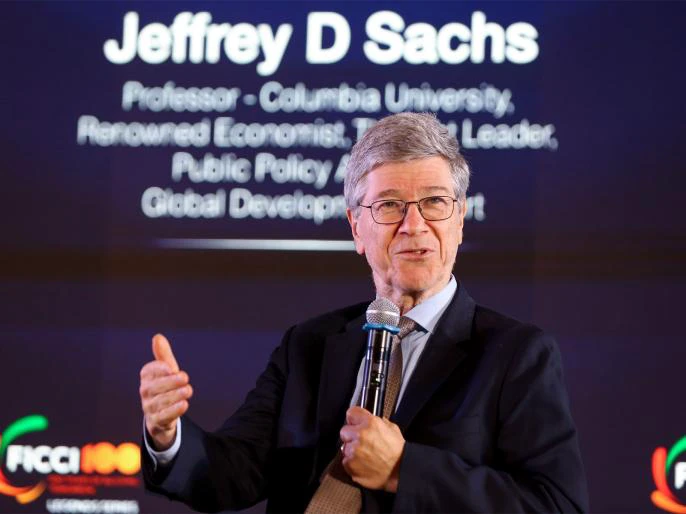
Renowned economist Jeffrey Sachs on Wednesday issued a stark warning that the global economy is teetering on the edge of a “terrible crisis,” primarily driven by the escalating geopolitical tensions in West Asia and the resulting surge in crude oil prices.
“The world economy will suffer a terrible crisis,” Sachs said while addressing FICCI Legend Series, cautioning that sustained disruption in oil and gas supplies could trigger widespread economic instability.
He said the current situation reflects a fragile equilibrium in global energy markets that could worsen if supply disruptions persist. “The betting is that somehow that shortage will be alleviated… but if it isn’t, the price will continue to rise,” Sachs said, indicating that expectations of stabilisation may not hold.
Sachs also warned that the risks are not limited to prices alone but extend to the broader trajectory of the global economy. “If we continue this way, we have a dire crisis or an outbreak catastrophe, depending on how things evolve,” he said, underscoring the uncertainty and potential severity of the ongoing situation.
Sachs explicitly stated that if the ongoing conflict involving the US, Israel, and Iran continues to destabilise the region, oil prices will likely soar well above $100 per barrel. He argued that the world is unprepared for the “trillions of dollars in economic losses” that would follow such a prolonged spike.
He noted that crude prices are already under pressure, with “Brent crude… at $114 a barrel late this afternoon, last time I checked,” adding that “it will continue to rise if this so-called status quo… continues.” He further warned, “The price will continue to rise inextricably because there’s a significant shortage of oil and gas supplies at this price.”
Sachs said the situation could worsen sharply if geopolitical tensions escalate further. “At some point, a shooting war could easily start again… we would be in a catastrophe,” he said, adding that energy disruptions could have long-lasting consequences for the global economy.
Highlighting the risks to critical infrastructure, he said, “Iran has incredible deterrence in the form of being able to blow up critical infrastructure in the Gulf in a very short period of time… oil fields, refineries, pipelines and ports.” He warned that such a scenario could lead to “a catastrophic long-term situation… for years there could be no recovery of the energy supplies.”
Turning to oil market dynamics, Sachs described the UAE’s decision to exit OPEC as misguided. “If there is no OPEC, the price of oil will collapse… that will be fine for India… but it does not mean that you should then depend on low oil and gas for the future of energy… It’s a huge strategic mistake,” he said.
He explained that coordinated supply management remains crucial, especially as the world transitions away from fossil fuels. “The world will move away from oil and gas in the next quarter century faster than we know now,” Sachs said, attributing the shift to intensifying climate risks.
Describing the transition as unavoidable, he added, “This is a truth that will be felt around the world… even the politicians can’t stop that reality.” He emphasised that energy producers must adapt to this shift while managing current supply conditions.
Sachs suggested that oil-producing nations should maintain higher prices during the transition period to support investments in clean energy. “We are going to hold the price up even as the world demand continues to fall… to shift to non-fossil fuel-based energy,” he said, outlining what he sees as a more sustainable strategy.
He noted that while a potential fall in oil prices due to weakening coordination could benefit importing countries like India in the short term, it would not alter the long-term trajectory. “That will be fine for India… but it does not mean that you should depend on low oil and gas for the future of energy,” he reiterated.
On the ongoing US-Iran tensions, Sachs was sharply critical, calling the conflict unnecessary. “This was not a necessary war… I would call it a war of whim,” he said, urging restraint to avoid further escalation.
He added that the situation could still be reversed. “The United States should just stop what it’s doing… and just stop what a disastrous mistake was,” Sachs said, warning that failure to de-escalate could push the global economy deeper into crisis.