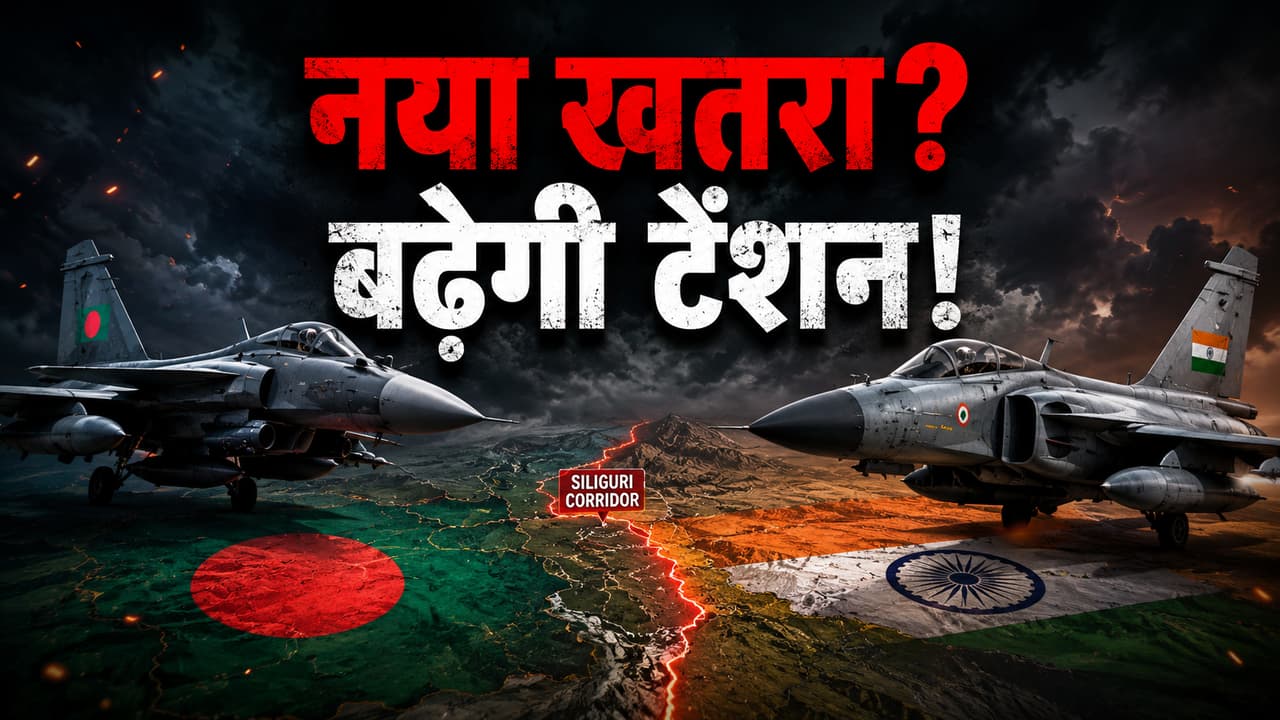
Bangladesh’s J-10CE fighter jet deal has increased India’s concern. What is the new strategic equation being formed between China, Lalmonirhat Airbase and Siliguri Corridor? Signals of changing balance of air power in South Asia.
New Delhi/Dhaka: A new and very sensitive movement has started on the geopolitical map of South Asia. There are preparations to change the strategic balance from the Bay of Bengal to the Siliguri Corridor. According to reports, India’s neighboring country Bangladesh has decided to give final approval to the ambitious plan to buy 24 advanced J-10CE multirole fighter jets from China.
How important this deal is can be gauged from the fact that Bangladesh Prime Minister Tariq Rahman will meet face to face with Chinese Premier Li on June 25 and President Xi Jinping on June 26 during his upcoming visit to China. According to sources, the biggest and shocking outcome of this high-profile meeting is going to be the fighter jet deal. This major upheaval in the defense sector has intensified the turmoil in India’s strategic corridors.
Why is J-10CE so special?
The J-10CE, developed by China’s Chengdu Aerospace, is an advanced multirole fighter designed for modern warfare. The aircraft is said to be equipped with long-range “Beyond Visual Range” (BVR) engagement, fast response capability and modern electronic warfare systems. Defense experts believe that this aircraft will not only enhance the capabilities of Bangladesh Air Force, but can also have an impact on the regional balance of power. Each aircraft is estimated to cost around $40 million, making it a relatively affordable option compared to Western fighters.
What is the real reason for India’s concern?
India’s biggest concern is about the possible deployment of these state-of-the-art fighter aircraft after this deal. Bangladesh has recently announced plans to reactivate its Lalmonirhat Air Base (BAF Station Lalmonirhat). This ‘Allied Airfield’ dating back to the Second World War is located in northern Bangladesh, just 12-15 kilometers from the Indian border. The most sensitive thing is that this airbase is very close to the strategic Siliguri Corridor (Chicken Neck), which is called the backbone of India. There are discussions that China is directly helping in modernizing this airbase and building new fighter aircraft hangars there. Becoming a base for Chinese aircraft so close to the border is no less than an alarm bell for New Delhi, because in the event of a war, this could be a well-planned Chinese move to put pressure on the Siliguri corridor.
‘Dual-front air dynamic’ and the Pakistan connection
Security experts believe that this step of Bangladesh can create a new and dangerous ‘dual-front air dynamic’ (air challenge on two fronts) against India. In fact, India’s another neighboring country Pakistan is already using a fleet of 36 Chengdu J-10CE fighter jets made in China. The dangerous thing is that according to reports, Pakistan had tried to use these aircraft against India during ‘Operation Sindoor’, which was foiled by the Indian Air Force (IAF). Now if Bangladesh also gets equipped with this deadly weapon, then India will have to face the challenge of Chinese weapons on both the east and west borders, due to which China’s regional influence will increase manifold.
40 million dollar ‘killer machine’ and the changing mood of Asia
Chengdu J-10C is considered by defense experts to be a very agile, powerful and economical fighter jet. This aircraft specializes in the technique of ‘Beyond-Visual-Range’ (BVR) combat i.e. the technique of killing the enemy by going beyond the visual range. J-10CE is the export version of this advanced jet. Reports suggest that each aircraft involved in the deal could be worth around $40 million, and Dhaka hopes to finalize the purchase by August 2026. Interestingly, not only Bangladesh, but other countries in South-East Asia like Indonesia are now turning to China to reduce their dependence on Russia and America. Indonesia has also expressed interest in purchasing at least 42 Chengdu J-10 fighter jets.
India’s keen eye and ‘Plan-B’ ready
The Government of India is keeping a very careful eye on this entire incident. In the Lok Sabha, Minister of State for External Affairs Kirti Vardhan Singh had earlier assured the House that the Government of India keeps a close watch on all activities impacting national security. However, the Bangladesh Army’s Director of Military Operations had claimed in a press briefing that at present there are no plans to use Lalmonirhat Airfield for any military purpose, but in the world of diplomacy and defence, ‘preparations’ are believed more than ‘claims’.
China is trying to surround India from all sides under its ‘String of Pearls’ policy. In such a situation, increasing cooperation of Bangladesh with China in defence, infrastructure and trade can completely change the balance of air-power in South Asia. India is taking all necessary steps to ensure the sovereignty of its borders, as New Delhi’s ‘third eye’ is deployed round the clock on every move of the dragon.
Pakistan connection increases uneasiness
Interestingly, Pakistan Air Force already operates 36 J-10CE fighter jets. In such a situation, if Bangladesh also adopts the same platform, then India may have the same type of air capability in two different directions. Defense experts see this as a potential “dual-front air dynamic”. While this does not imply an immediate military threat, it is a scenario that cannot be ignored for Indian strategic planners.
Changing balance of power in South Asia
This deal is not just a matter of purchasing the aircraft. Behind this lies the story of growing defense relations between China and Bangladesh, politics of regional influence and increasing competition in the Indian Ocean region. If this agreement is finalized by August 2026, a new chapter can be added to the security equations from the Bay of Bengal to the eastern borders of India. At present the question is not whether Bangladesh will buy J-10CE or not, but in which direction the deployment of these aircraft and China’s role will turn the future of South Asia. And this is the question for which New Delhi is closely searching for the answer.