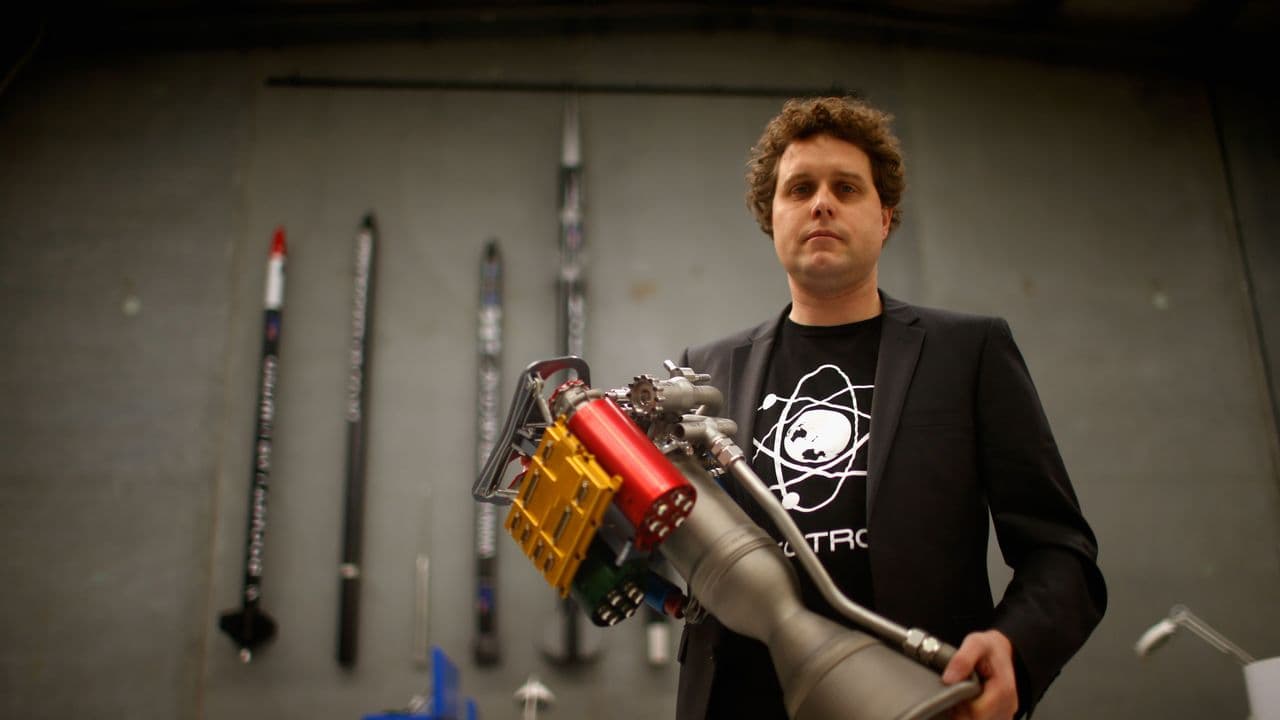
Electron offers a scaling blueprint, with 93 launches completed and Rocket Lab’s quarterly cadence and launch revenue growing sharply since 2021.
- CEO Peter Beck urged investors to focus less on Neutron’s debut and more on how quickly Rocket Lab can reach its 10th launch.
- Neutron’s earliest launch has slipped to Q4 2026 after repeated delays, including a first-stage tank rupture during testing.
- SpaceX’s eventual Falcon wind-down could create an opening for Neutron, provided Rocket Lab brings it into service and scales quickly.
Shares of Rocket Lab (RKLB) have shed nearly half their value over the past three months as investors await the debut of Neutron, the reusable medium-lift rocket expected to unlock larger commercial, constellation and national-security missions.
RKLB shares have closed lower for five consecutive sessions, their longest losing streak since late June. The stock is now down 2% for the year, although it remains 54% higher over the past 12 months.
CEO Looks Beyond Neutron’s Debut
Rocket Lab expects Neutron’s first-stage tank to reach its Virginia launch complex in the fourth quarter, but CEO Peter Beck acknowledged on the company’s latest earnings call that “the window for an end-of-year launch is narrowing.”
Reaching the pad is not the same as launching. Integrated testing, a wet-dress rehearsal, and a first-stage static fire must still follow. In a new interview, however, Beck offered investors another way to evaluate the program: stop fixating on Neutron’s first flight and ask about its 10th.
“The question that investors and analysts should be asking me is like, Pete, when’s the 10th rocket going to be on the pad?” Beck said. “How quick[ly] can we get the 10th rocket on the pad?”
A maiden flight would show that Neutron can reach orbit. Its 10th mission would suggest Rocket Lab has mastered repeatable manufacturing, reusability, and high-cadence operations. “By the time you get to rocket 10, your reusability’s sorted, all your production’s sorted, you’re banging out whole stages, and, you know, all the launch infrastructure is just cranking,” Beck said.
Rocket Lab wants to avoid flying once and then spending years redesigning or requalifying the vehicle. “It would really be bad if, like, we put the first rocket on the pad, and then it was like two years before we went and put the next one on the pad,” he said. “I just don’t want to be there.”
Neutron’s timeline has already slipped repeatedly. Rocket Lab announced the vehicle in March 2021 with a 2024 debut target. That moved to mid-2025 and then late 2025.
By November 2025, the company expected Neutron to reach the pad in early 2026. But in January, its first-stage tank ruptured during a hydrostatic pressure test due to a manufacturing defect in a critical joint. The launch subsequently moved to no earlier than the fourth quarter of 2026. When asked why rocket schedules keep slipping, Beck said: “I think every rocket CEO is probably inflicted with the same, you know, optimism then reality.”
Electron Offers Neutron A Blueprint
Neutron is not Rocket Lab’s first rocket. The company already operates Electron, a small orbital vehicle used for dedicated and rideshare satellite missions. Its suborbital derivative, HASTE, is used for hypersonic testing. Rocket Lab completed Electron’s 93rd launch on Thursday, deploying a satellite for Japanese Earth-imaging company iQPS. It also booked nine additional dedicated missions through 2030.
According to Fiscal.ai, Rocket Lab’s quarterly cadence rose from two vehicles in the fourth quarter of 2021 to six in the second quarter of 2026, logging a 200% increase. The company went from one to three launches per quarter in 2021 and 2022 to regularly flying five, six, or seven missions from late 2024 onwards.
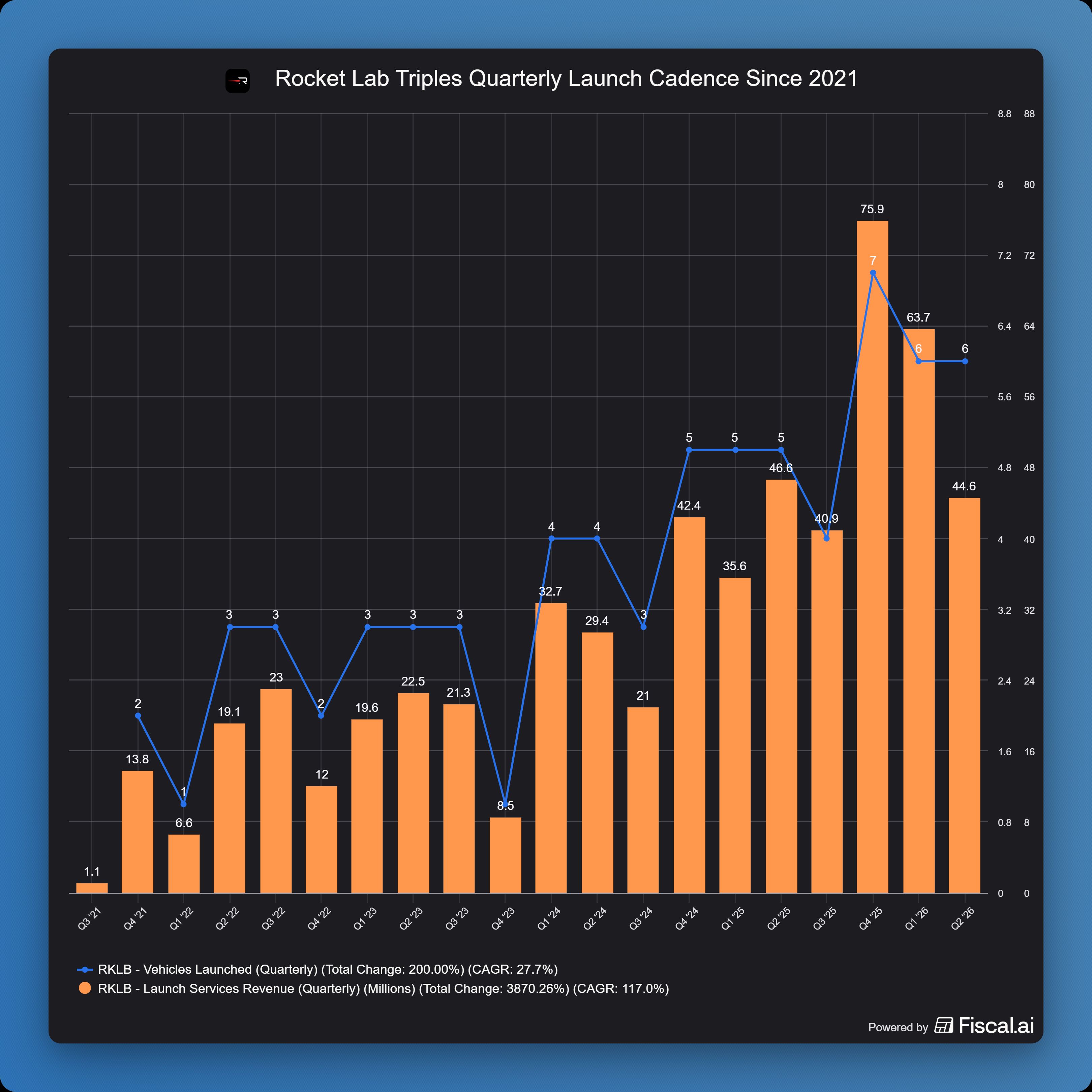
Launch-services revenue rose from $13.8 million to $44.6 million over the same period, marking an increase of about 223%. A record seven launches generated $75.9 million in late 2025. However, revenue does not move perfectly with flight volume: Rocket Lab flew six vehicles in each of the first two quarters of 2026, but launch revenue fell from $63.7 million to $44.6 million.
“How late was Electron to the market? I don’t know,” Beck said. “Nobody knows, because it doesn’t matter. It was late too.”
Rocket Lab’s ‘Win Twice’ Defense Strategy
Rocket Lab reported record second-quarter revenue of $234 million, up 62% from a year ago, and a record backlog of $2.36 billion. More than $437 million in recent launch contracts expanded its manifest beyond 90 missions. Its government pipeline also includes a $981 million Space Force NITE-STAR award, $12 million in Space Data Network orders, a $266 million launch contract and a $397 million satellite-manufacturing deal.
Beck says Rocket Lab’s roles as both a prime contractor and component supplier allow it to benefit even when a competitor wins. “Even if we lose, we still win,” he said. “And when we win, we win twice.” He said an $800 million Space Development Agency award became an opportunity worth more than $1 billion after other winning primes ordered Rocket Lab hardware.
A SpaceX Falcon Wind-Down Could Open The Door For Neutron
Neutron could gain a neat opening as SpaceX shifts resources from Falcon 9 toward its fully reusable Starship system. SpaceX CEO Elon Musk recently said that SpaceX would eventually wind down Falcon once Starship is launching several times a week reliably. SpaceX has also reportedly stopped accepting most new dedicated Falcon 9 and rideshare bookings beyond late 2028, potentially tightening an already constrained global launch market.
This could leave more commercial and government missions available for Neutron, provided Rocket Lab can bring it into service and scale quickly. SpaceX still needs to prove Starship’s reliability and rapid-reuse economics, with its first upper-stage tower catch expected in the coming months and its first Starship reflight targeted for late 2026 or early 2027.
While Neutron will compete for missions currently served by Falcon 9, Beck does not intend to challenge SpaceX in every market. “I think it would be very difficult to go and play in the broadband market,” he said, pointing to the enormous capital behind Starlink.
Instead, Rocket Lab is targeting defense communications through its proposed $8 billion acquisition of Iridium. “If you ignore broadband because, you know, two really well-capitalized people are taking care of that, what’s the next logical thing to do in comms?” Beck asked. “It’s like, you know, safety-critical, defense-critical services. That is Iridium.”
Iridium Makes Rocket Lab Its Own Customer
Iridium would give Rocket Lab an operational constellation, L-band spectrum, established customers and recurring subscription revenue, turning it into an end-to-end company spanning spacecraft, launch and orbital services. “We don’t come with hopes and dreams and bore a big hole in the P&L,” Beck said. “Iridium adds profitability to the entity straight away.”
Rocket Lab’s latest merger filing from late Monday said that the deal could eliminate Iridium’s third-party launch costs, capture margins internally and guarantee access to orbit as capacity tightens. The deal is expected to boost earnings per share, operating cash flow and free cash flow in 2027 and become “highly accretive” over time. The filing also detailed the $8 billion acquisition structure: $27 in cash per Iridium share plus Rocket Lab stock.
The two companies generated $1.47 billion in combined 2025 revenue on a pro forma basis. The filing preliminarily valued Iridium’s spectrum at about $3.32 billion. Notably, Iridium would make Rocket Lab its own Neutron customer, echoing the internal launch demand SpaceX receives from Starlink. “I’m now my own user of launch for Iridium,” Beck said. “I need launch too. So I’m like my harshest customer.”
Iridium shareholders will vote on the deal on Sept.24. Beck is already looking beyond it, teasing “a series of, like, transformational things” over the coming years.
How Do Retail Traders Feel About RKLB?
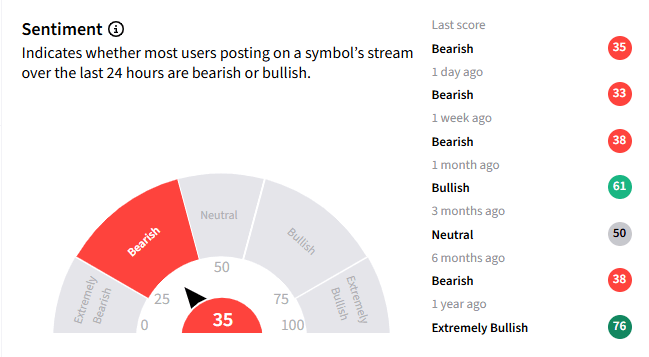
On Stocktwits, retail sentiment for RKLB has been ‘bearish’ over the past week, with its score falling to 36 out of 100 — just above the record low of 30 — as message volume has plunged nearly 60% over the past three months.
One user urged Rocket Lab to “go all in” on Neutron and orbital AI data centers, arguing that launches and satellites alone would not be the primary revenue drivers. Another user quipped that China would have “their own Neutron” before Rocket Lab produces and tests its first vehicle. A third called RKLB “one of the worst stocks in the worst sector” on the Nasdaq and warned that another Neutron delay could drive the shares down by at least 30%.
View this Stocktwits post
View this Stocktwits post
For updates and corrections, email newsroom[at]stocktwits[dot]com.<