
Buying a used car isn’t about choosing from the biggest inventory—it’s about finding the right match. Here’s why detailed filters, inspection-backed listings, and transparent pricing matter more than the total number of cars available.
A large used-car inventory may look impressive at first glance, but for any individual buyer, only a small percentage of those cars will actually fit their requirements. Budget, preferred model, variant, manufacturing year, kilometres driven, fuel type, transmission, ownership history, and city all narrow the search considerably. That is why the quality of the match matters far more than the size of the catalogue.
Platforms such as Cars24 increasingly focus on helping buyers identify well-matched vehicles through detailed filters, inspection-backed listings, and transparent vehicle information, allowing them to spend less time scrolling through unsuitable options and more time evaluating cars that genuinely fit their needs.
Why Inventory Size Became a Popular Metric
For years, larger catalogues have been associated with better shopping experiences. In e-commerce, thousands of products often translate into more choice and a greater chance of finding exactly what you want. Used cars, however, are fundamentally different.
Every used car is unique. Two vehicles of the same make, model, and year can differ significantly because of their variant, ownership history, accident repairs, maintenance record, kilometres driven, registration state, insurance status, and overall condition. Unlike buying a new smartphone or television, no two used cars are truly identical.
As a result, a platform’s total inventory tells only part of the story. What actually matters is how many cars remain after you apply your real buying criteria: your budget, preferred body style, fuel type, transmission, manufacturing year, mileage preference, ownership comfort, and city. For most buyers, that shortlist represents only a small fraction of the headline inventory.
What ‘Match Quality’ Actually Means
Match quality is the ability of a platform to consistently surface vehicles that closely align with what a buyer is actually looking for. It depends on three key elements.
1. Filter Precision
Effective filters eliminate irrelevant listings before you begin comparing cars. Instead of filtering only by model or price, buyers should be able to refine results using multiple parameters simultaneously, including:
- Variant (for example, Sigma, Delta, Zeta, or Alpha)
- Budget range
- Manufacturing year
- Kilometres driven
- Fuel type
- Transmission
- Ownership history
- Body style
- City or location
Without detailed filtering, buyers often spend more time browsing unsuitable listings than evaluating realistic options.
2. Listing Completeness
Even the best filters lose value if listings lack important information. Comprehensive listings allow buyers to compare vehicles confidently before scheduling a test drive.
A complete used-car listing should ideally include:
- Full variant name
- Manufacturing year and registration year
- Exact kilometres driven
- Ownership history
- Insurance type and validity
- RC status
- Inspection summary or condition report
- Service history where available
- Warranty eligibility
- Financing availability
3. Price Explanation
Perhaps the most overlooked aspect of match quality is helping buyers understand why two similar-looking cars have different prices.
A transparent listing should explain the factors influencing value, including:
- Variant level
- Transmission type
- Ownership history
- Vehicle condition
- Inspection findings
- Service history
- Registration location
- Insurance validity
- Warranty coverage where applicable
When pricing is explained rather than simply displayed, buyers spend less time guessing and more time making informed decisions.
Why Inspection Quality Matters More Than Inventory Size
Inventory size tells you how many cars are available. Inspection quality tells you how much you can trust the information about those cars.
Imagine comparing two platforms. One lists 500 vehicles but provides only photographs, basic specifications, and an asking price. Another lists 150 vehicles, but each one includes a detailed inspection report, ownership information, condition assessment, and transparent pricing rationale. For most buyers, the second experience is far more useful because it reduces uncertainty before a test drive.
This is where inspection-backed marketplaces create meaningful value. A structured inspection helps identify factors that cannot be judged accurately from photographs alone, such as engine health, structural repairs, suspension condition, tyre wear, electrical systems, or evidence of previous accident damage.
Used cars on Cars24, for instance, undergo a 300+ point inspection, allowing buyers to evaluate not just whether a car matches their preferred model and budget, but also whether its overall condition justifies its asking price. Instead of relying solely on seller descriptions, buyers can compare inspection-backed information alongside ownership history, kilometres driven, manufacturing year, and available warranty.
Why Two Similar Maruti Swifts Can Be Very Differently Priced
Consider two 2019 Maruti Swift hatchbacks in the same city. Both are white, both have approximately 35,000 kilometres on the odometer, and both appear similar in photographs. One is listed at ₹5.4 lakh, while the other costs ₹6.8 lakh. At first glance, the cheaper car may seem like the obvious bargain. In reality, several legitimate factors could explain the difference.
The lower-priced car might be the Sigma base variant with fewer convenience and safety features, while the higher-priced vehicle could be a Zeta or ZXI variant equipped with a touchscreen infotainment system, alloy wheels, rear parking camera, automatic climate control, or automatic transmission.
Beyond features, condition also matters. The more expensive vehicle may have a cleaner inspection report, fewer signs of wear, a stronger service history, newer tyres, a lower ownership count, valid comprehensive insurance, or warranty coverage. Registration state and RTO-related factors can also influence pricing depending on local taxes and buyer demand.
This is why comparing only the asking price rarely tells the full story. Buyers should evaluate the complete picture, including the variant, inspection findings, ownership history, manufacturing year, service records, warranty eligibility, and overall condition before deciding whether a car offers good value. Platforms that present this information clearly make it significantly easier to understand whether a higher price reflects additional value or simply a higher asking price.
Match Quality vs Inventory Size: What Actually Helps Buyers?
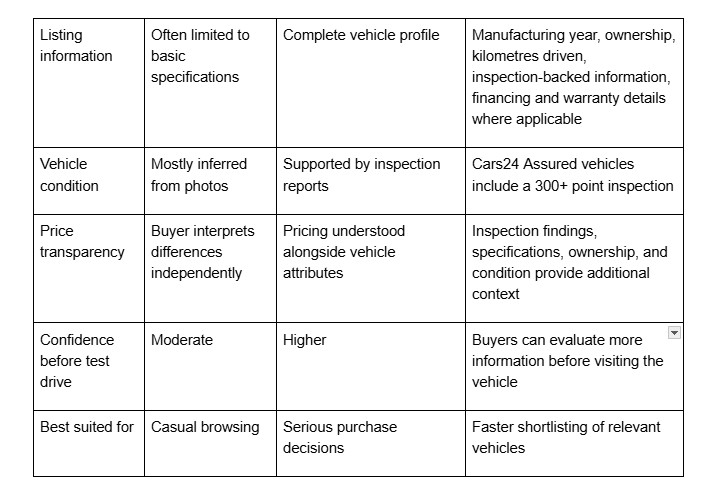
How Cars24 Helps Buyers Find Better-Matched Used Cars
Finding the right used car is rarely about seeing the maximum number of listings. It is about reducing hundreds of possibilities to a shortlist that matches your priorities.
Cars24 approaches this by combining broad inventory with detailed discovery tools. Buyers can refine listings using filters such as budget, body type, fuel type, transmission, manufacturing year, kilometres driven, ownership history, and city. This makes it easier to compare vehicles that genuinely fit their requirements instead of manually sorting through unsuitable listings.
Cars24 Assured vehicles also include a 300+ point inspection, giving buyers greater visibility into a vehicle’s condition before scheduling a test drive. Along with inspection-backed information, listings may include ownership details, manufacturing year, kilometres driven, warranty eligibility, financing options, and other important vehicle information. Together, these details help buyers evaluate value rather than relying only on price or photographs.
Questions Every Buyer Should Ask Before Shortlisting a Used Car
Before adding a vehicle to your shortlist, verify whether the listing answers these important questions:
- Can I filter by variant, not just by model?
- Is the manufacturing year shown separately from the registration year?
- Are the exact kilometres driven displayed instead of a broad range?
- Is the ownership history clearly mentioned?
- Is the insurance type and validity visible?
- Does the platform explain why similar-looking cars have different prices?
- Can I review an inspection report before booking a test drive?
- Is the availability of warranty, return policy, and financing clearly mentioned where applicable?
If several of these questions remain unanswered, buyers often end up spending additional time verifying information that could have been presented upfront.
A Simple Shortlisting Routine That Works Better Than Browsing Hundreds of Listings
Most buyers eventually purchase one car after comparing only a few serious contenders. Rather than scrolling endlessly, follow a structured approach:
- Set clear filters for your budget, body type, fuel type, manufacturing year, kilometres driven, transmission, and city.
- Sort shortlisted cars by manufacturing year and kilometres driven before comparing prices.
- Open only three to five listings that closely match your requirements.
- Compare the variant, ownership history, inspection summary, manufacturing year, insurance validity, and warranty eligibility for each vehicle.
- Schedule test drives for the two or three cars with the most complete information rather than simply the lowest asking price.
- Compare driving experience, vehicle condition, documentation, and ownership confidence before making your final decision.
A focused shortlist supported by detailed information is usually far easier to evaluate than dozens of incomplete listings.
Bringing Home the Used Car You Love
Inventory size can help buyers discover more options, but it should never be the deciding factor when choosing where to buy a used car. The better question is whether a platform consistently helps you find vehicles that match your budget, preferences, and expectations without requiring hours of manual comparison.
Detailed filters, comprehensive listings, inspection-backed reports, transparent pricing, and clear ownership information all contribute to better match quality. These features allow buyers to spend less time searching and more time evaluating the cars that genuinely deserve consideration.
Platforms such as Cars24 combine these elements with inspection-backed listings, financing support, warranty options on eligible vehicles, and post-purchase assistance to help simplify the buying journey. Ultimately, the best used-car platform is not necessarily the one with the biggest inventory. It is the one that helps you confidently identify the right car from the inventory that matters to you.
FAQs
Does a bigger used-car inventory always mean better choices?
Not necessarily. While a larger inventory increases the number of available vehicles, most buyers only consider cars that fit their budget, preferred model, manufacturing year, fuel type, ownership history, and city. Detailed filters and complete listings often matter more than the total inventory count.
How many used cars should I shortlist before buying?
Shortlisting three to five well-matched cars is generally more effective than comparing dozens of listings. Focus on vehicles with complete information, inspection details, and transparent pricing before booking test drives.
Why are two similar used cars priced so differently?
Price differences often result from variations in the vehicle’s variant, transmission, ownership history, manufacturing year, service records, inspection findings, insurance validity, warranty coverage, and overall condition. Looking beyond the asking price helps buyers understand the true value of each vehicle.
Is the most expensive listing always the car in the best condition?
No. Higher prices may reflect a higher variant, automatic transmission, additional features, warranty coverage, or stronger service history rather than superior condition alone. Comparing inspection-backed information alongside specifications provides a more accurate picture.
Why do inspection reports matter when buying a used car?
Inspection reports provide information that photographs alone cannot reveal, including structural condition, engine health, suspension, brakes, tyres, electrical systems, and other mechanical components. They help buyers evaluate a vehicle’s condition before committing to a test drive.