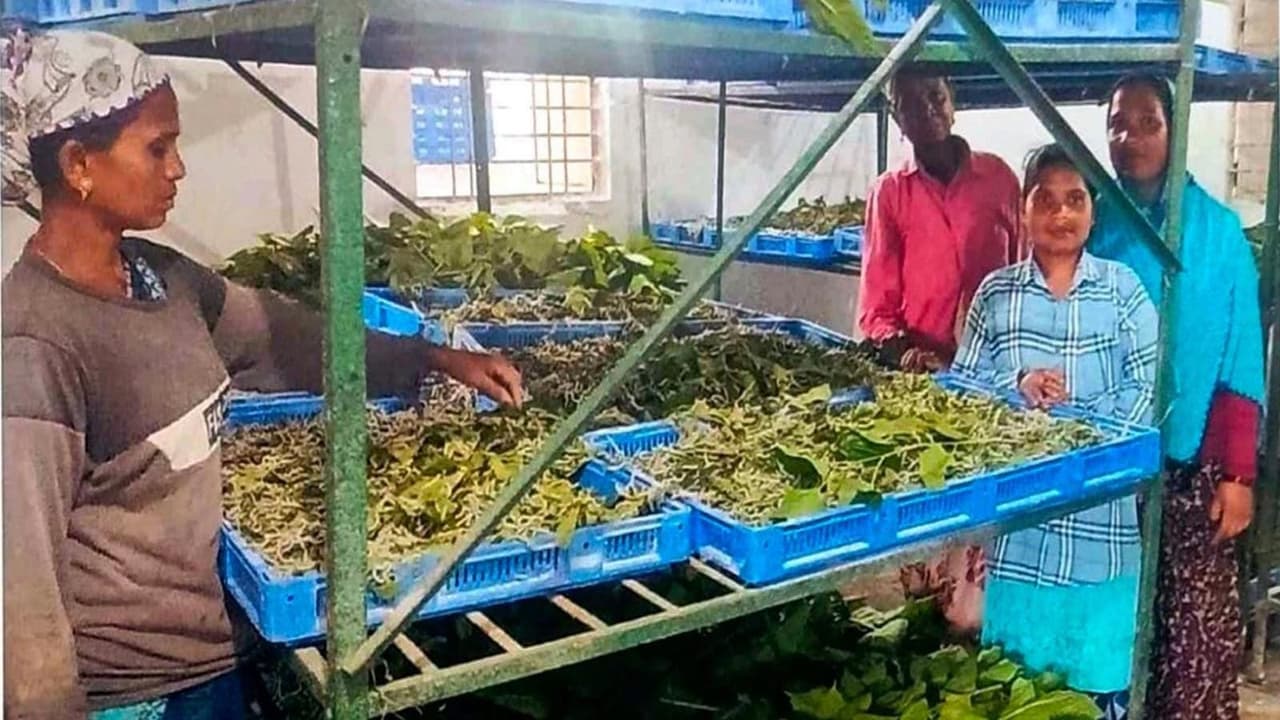
Mulberry and Tussar silk schemes in Narayanpur, Chhattisgarh provided employment to women and villagers. With production exceeding the target, income worth lakhs of rupees reached directly into the accounts.
Raipur. Sericulture development and extension schemes are bringing a big change in the lives of villagers in Narayanpur, Vananchal district of Chhattisgarh. The Mulberry and Tussar Silk Projects, operated under the guidance of the District Administration and Collector, have created new employment and income opportunities for the local people. The biggest benefits of these schemes are being given to women and youth, who are getting respectable employment in their own villages. Today, sericulture in Narayanpur is no longer just an agriculture-based activity, but has emerged as a successful model towards women empowerment, rural economic development and self-reliance.
Mulberry Sericulture: Increased income of women groups from Mulberry silk
Plantation has been done in an area of about 22.5 acres in two Mulberry Silk Centers established in Narayanpur and Kusaratrai. Here women self-help groups are doing silkworm rearing with the help of modern technologies. A target of 4,400 kg cocoon production was set in the financial year 2025-26, against which 4,180 kg production was achieved. An amount of more than Rs 7.72 lakh was directly transferred to the bank accounts of 47 beneficiaries associated with this work. Apart from vermiculture, villagers also got employment throughout the year in works like plant care, weeding and conservation.
Tasar Silk Farming: Tasar silk production exceeded the target and set a new record.
Tussar vermiculture is being done in an area of 62 hectares in four major tussar silk centers located at Narayanpur, Kusaratrai, Gotajunhari and Edka in the district. The target of production of 8.52 lakh Kosaphal was set in the year 2025-26, but farmers and beneficiaries performed better and produced more than 9.73 lakh Kosaphal. This was an achievement well beyond the target. Due to this success, 64 beneficiaries associated with the scheme received direct income of approximately Rs 36.97 lakh.
Silk Training Program: Increasing quality and production through technical training
The Silk Department is not only providing resources to the villagers, but is also providing training in modern techniques from time to time. Experts are continuously providing technical guidance to protect silk worms from diseases, prepare quality cocoons and increase production. Due to this, there has also been a significant improvement in the quality of production.
Direct Benefit Transfer: Income reaching bank accounts directly
The entire process of payment under the scheme has been kept transparent. The production is being paid directly into the bank accounts of the beneficiaries, thereby eliminating the role of middlemen and increasing the confidence of the villagers. Women self-help groups have played an important role in this entire process. The women of these groups not only increased their income but also strengthened the economic condition of their families.
Narayanpur Sericulture Model: Successful example of self-reliant rural development
The silk development model of Narayanpur proves that if proper utilization of local resources, administrative cooperation and hard work of the villagers come together, then a new example of development can be set even in remote forest areas. By increasing the scope of these schemes in the coming years, more rural families will get employment. Also, Narayanpur will establish its own identity as a major silk production center of the state.