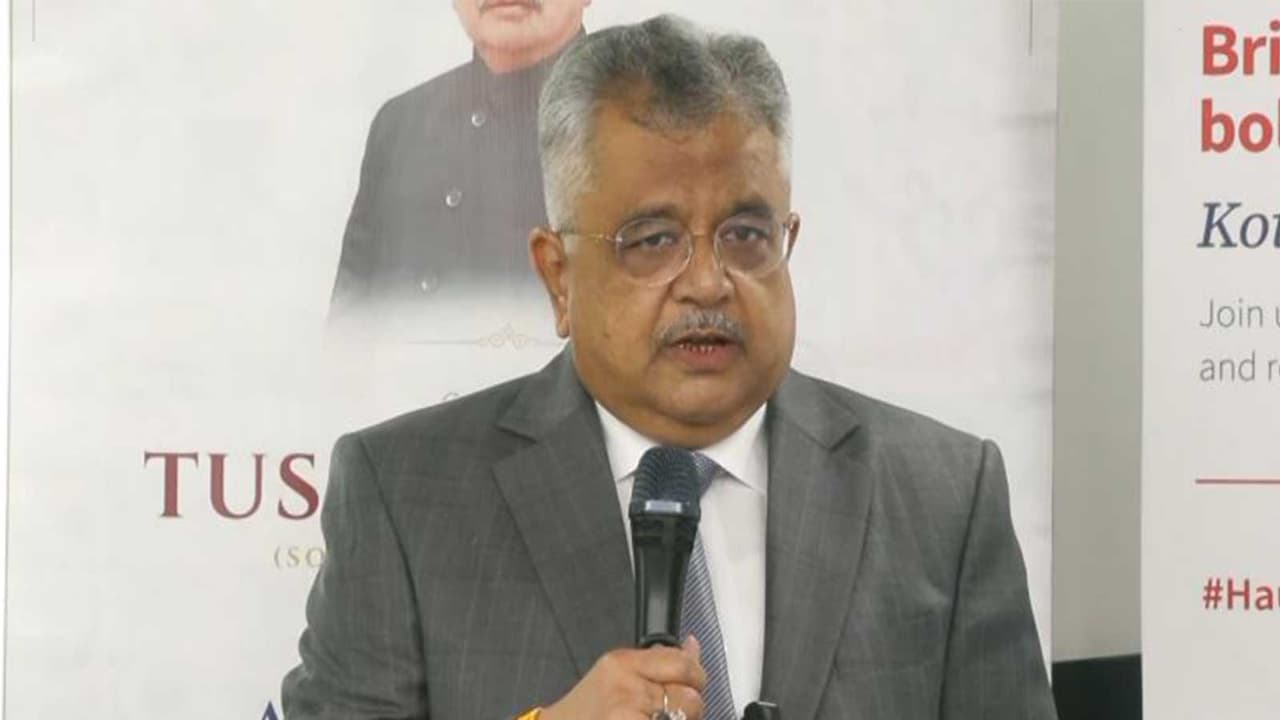
Solicitor General Tushar Mehta said that the Vedas are a storehouse of knowledge, but the main source of Hindu law is the Smritis. Explaining the difference between Mitakshara and Dayabhaga schools, he said that Hindu law is not based only on Manu Smriti.
Smritis, not Vedas, are the source of Hindu law.
Solicitor General of India Tushar Mehta on Saturday said the Vedas are not a direct source of law but serve as the oldest written storehouse of knowledge, giving guidance to live in harmony with one’s surroundings and conscience.
Delivering a lecture on the relationship between ancient scriptures and modern law, SG Mehta said that Hindu law derives primarily from the Smritis, which include Yajnavalkya Smriti, Manu Smriti, Narada Smriti and Parashara Smriti. He described these as legal commentaries written by ancient scholars who specialized in law.
Two major schools of Hindu law
Highlighting the evolution of Hindu jurisprudence, the Solicitor General said that two major schools of Hindu law, Mitakshara and Dayabhaga, have existed in India since ancient times, dating back to at least 700 AD.
According to Mehta, the Mitakshara school, developed by the scholar Vijnaneshwar, is based on the Yajnavalkya Smriti and not the Manu Smriti, which he described as a common misconception. He said that the Mitakshara school has historically been followed in most parts of India, while the Dayabhaga school based on Manu Smriti was prevalent in the then Bengal and Assam regions.
He stressed that the claim that Hindu law is based entirely on Manu Smriti is factually incorrect, as the Mitakshara school remains the dominant tradition throughout the country.
Difference in inheritance rules
Explaining the difference between the two schools, Mehta said that in the Dayabhaga system inheritance was linked to the ability to perform Pind Daan, which is the practice of offering lumps of rice to ancestors during Shraddha ceremonies, making the concept comparatively restrictive. In contrast, he said, the Mitakshara school adopted a broader and more dynamic interpretation by recognizing rights of inheritance by birth.
He said that although the word “DNA” was not used in ancient texts, the concept behind Pinda refers to biological ancestry. He further said that this principle is present in modern Hindu law through the concept of coparcenary rights acquired by birth.
Flexibility of Hindu legal traditions
The Solicitor General also said that Hindu legal traditions show an openness and flexibility in the interpretation of religious legal texts, which, according to him, is not found in other religious texts. Referring to the concept of adoption (dataka), he said that the multiple interpretations of the relevant texts reflect the dynamic nature of Hindu legal principles.
He also praised the creators of ancient legal texts for introducing the concept of prohibited degrees of relationship governing marriage. According to Mehta, these principles, formulated around 700 AD, are also recognized in contemporary statutory law made by Parliament.
Criminal Law: From the Colonial Period to the Indian Judicial Code
Concluding his address, Mehta said that many branches of law evolved over time, but India’s criminal law framework remained largely rooted in colonial legislation. He said that the British had created criminal laws for their “subjects”, which continued after independence in the form of the Indian Penal Code.
He further said that the enactment of the Indian Judicial Code (Bharatiya Nyaya Sanhita) in 2023 marks a shift towards a criminal code designed for the “citizens” of the country, the provisions of which have been recast to reflect the priorities of a sovereign democratic republic. (ANI)
(Except for the headline, this story has not been edited by the Asianetnews editorial team and is published from a syndicated feed.)