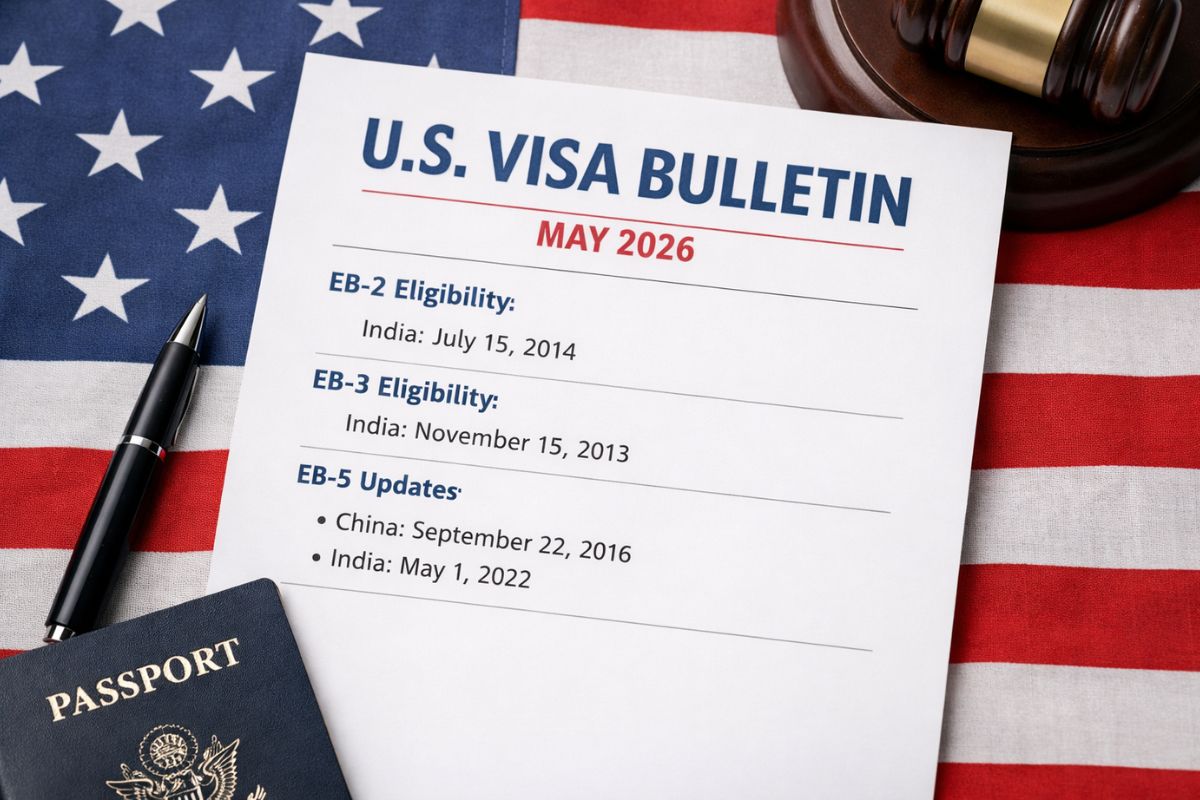
The latest US Visa Bulletin for May 2026 brings very little change for employment-based green card applicants, especially those from India. Most priority dates remain stuck, showing that long waiting times are likely to continue.
The U.S. Department of State confirmed that USCIS will accept Adjustment of Status applications based on Final Action Dates in May 2026. This means applicants can only move forward if their priority date is earlier than the listed cutoff.
Here is a simple breakdown of what has changed and what it means.
EB-1: No Movement for India and China
The EB-1 Visa category, often used by executives, researchers, and individuals with extraordinary ability, remains unchanged.
- India: April 1, 2023
- China: April 1, 2023
- All other countries: Current
Applicants from most countries can continue applying without delay, but India and China still face waiting periods.
EB-2: Long Waiting Period Continues for Indian Applicants
The EB-2 visa, commonly used by professionals with advanced degrees, remains heavily backlogged for India.
- India: July 15, 2014
- China: September 1, 2021
- All other countries: Current
For Indian applicants, this means the wait for a green card can still take many years.
EB-3: Limited Progress for Skilled Workers
The EB-3 category covers skilled workers and professionals. Priority dates show little change.
Professionals and Skilled Workers
- India: November 15, 2013
- China: June 15, 2021
- Philippines: August 1, 2023
- All other countries: June 1, 2024
Other Workers
- India: November 15, 2013
- China: February 1, 2019
- Philippines: November 1, 2021
- All other countries: February 1, 2022
Indian applicants continue to face one of the longest backlogs in this category.
EB-4: Cutoff Date Remains the Same
The EB-4 category, used by special immigrants such as religious workers, also remains unchanged.
- All countries: July 15, 2022
EB-5 Investor Visa: Slight Movement for China
The EB-5 immigrant investor visa shows little progress for China, while India remains unchanged.
Unreserved EB-5 category
- China: September 22, 2016
- India: May 1, 2022
- All other countries: Current
EB-5 Set-Aside categories
- Rural projects: Current
- High unemployment areas: Current
- Infrastructure projects: Current
These set-aside categories continue to remain current, offering faster options for investors.
USCIS Confirms Use of Final Action Dates in May 2026
USCIS has confirmed that it will use the Final Action Dates chart in May. Applicants can only file for an adjustment of Status if their priority date is earlier than the listed cutoff.
In simple terms, if your priority date is not current yet, you will need to wait longer before moving forward with the green card process.
Why Priority Dates Are Moving Slowly
The State Department noted that recent visa movements were influenced by lower immigrant visa processing levels and policy actions affecting several countries.
Officials also warned that dates could move backwards later in the fiscal year if demand increases. This is known as retrogression and often happens when visa limits are close to being reached.
There is also a possibility that the EB-5 category for India could face retrogression if applications continue to rise.
What This Means for Applicants
For most applicants, especially those from India, the May 2026 Visa Bulletin shows that progress remains slow. Key takeaways:
- EB-2 and EB-3 backlogs for India remain very long
- EB-1 shows no change
- EB-5 set-aside categories remain current
- USCIS will follow Final Action Dates for May filings
- Retrogression is still possible later in FY 2026
Travellers planning long-term relocation to the United States through employment should continue tracking monthly Visa Bulletins closely, as even small movements can impact application timelines.
Follow and connect with us on Facebook, Twitter, LinkedIn, Instagram and Google News for the latest travel news and updates!