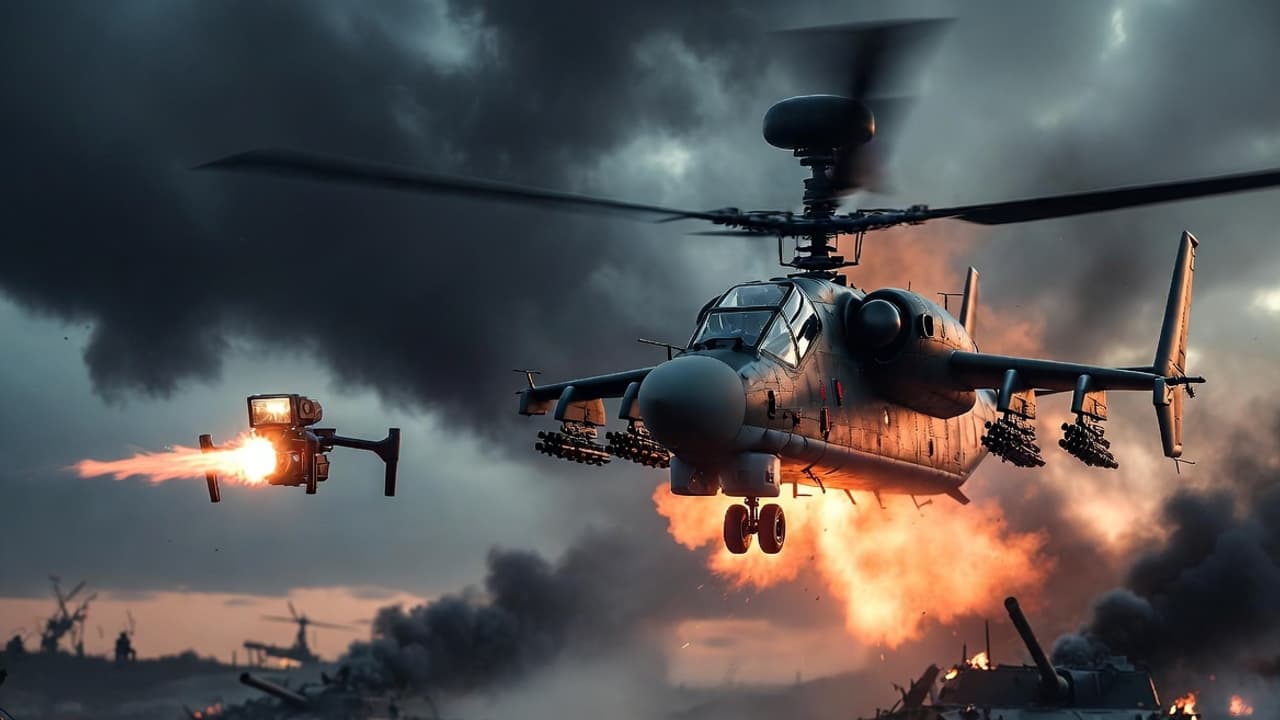
A Ukrainian FPV drone downs a Russian Ka-52 helicopter, exposing a new battlefield reality. Are cheap drones making billion-dollar attack helicopters obsolete in modern warfare?
On March 20, 2026, something happened in Ukraine that has shaken military experts around the world. A small Ukrainian drone unit managed to bring down a powerful Russian attack helicopter using just an FPV drone. The incident took place in the Donetsk region, where the damaged Ka-52 “Alligator” helicopter was forced to make an emergency landing.
Now, you may be wondering — what is an FPV drone? In simple words, FPV means First-Person-View. It is a drone where the operator wears special goggles or watches a screen and sees exactly what the drone is seeing in real time. It feels like the person himself is sitting inside the drone and flying it. This gives very accurate control, which is perfect for combat use.
This incident was a happy moment for Ukrainian forces, but it has also become a serious warning for helicopter pilots and armies worldwide. Helicopters were already facing dangers from guns, missiles, and rocket launchers. Now, a new and much cheaper threat — drones — has joined the list. So the big question is — are we seeing the end of attack helicopters as we know them?
The fall of a legend
The drone strike was carried out by Ukraine’s “Predators of the Heights” battalion from the 59th Separate Assault Brigade. The hit did not fully destroy the Ka-52, but caused enough damage that the pilot had to land immediately. The Ka-52 is one of Russia’s main attack helicopters, used since around 2008 to destroy tanks and enemy troops. Each helicopter costs around $16 million, can fly at 315 km/h, and has a range of 545 km.
The video of the attack starts from the drone’s camera view, showing it moving towards the low-flying helicopter and aiming at its side weapon mount, before suddenly cutting off at the moment of impact. As reported by *Interesting Engineering*, this was actually the second such operation by this brigade, and the total number of Russian helicopters destroyed by Ukraine has now reached around 350 since the war began.
Why helicopters were always special
Before drones, attack helicopters were among the few flying machines that could hover in one place, hide behind hills or trees, and give very accurate fire support to ground soldiers. They can stay over the battlefield for long periods, watching and supporting troops — this is called “loitering”. They are also very flexible and used for anti-tank attacks, medical evacuation, escort duties, and transport.
That is why machines like the Boeing AH-64 Apache are still considered highly important even today.
Nothing new under the sun
Honestly, helicopters being shot down is not new. They have been hit by simple guns in city fighting, by MANPADS (shoulder-fired missiles) in Afghanistan and Iraq, and by RPGs in places like Mogadishu. But the difference now is that drones are cheap, easy to use, and can come from any direction without warning. MANPADS need trained operators and are limited in number. Drones, on the other hand, can be used in swarms by anyone with basic training.
Down but not out
But it is not all bad news for helicopters. They are very adaptable machines and can change with the times. One new role they may take up is becoming “drone-hunters”. Surprisingly, their slow speed and low flying height — usually seen as weaknesses — can actually become strengths when chasing down small drones.
This is not just theory. In January, Saudi Arabian pilots flying Apache helicopters reportedly had a kind of “duck hunt” situation in the Strait of Hormuz, easily shooting down swarms of Iranian drones using their guns and rockets.
A new role: drone carriers
Another idea is to turn helicopters into “drone carriers”. In this role, helicopters will not directly attack the enemy but will launch attack drones (loitering munitions) and act like flying command centres controlling drone swarms. The US Army’s “Foxtrot Company” plan, which uses Apache helicopters in this way, is one good example.
Helicopters can also become forward controllers — staying safely far from danger, using their sensors to find targets, and guiding drones and missiles to hit them. So instead of being a “flying gun”, the helicopter becomes a “flying battle manager”.
One chapter closes, another opens
The destruction of Russian Ka-52 helicopters by simple drones does not mean attack helicopters are finished. But it clearly shows that they cannot freely fly into hot battle zones like before. The days of surprise pop-up attacks and depending only on terrain for safety are slowly ending.
In future wars, helicopter crews must always expect drone attacks from any direction. The smartest way forward is to stay away from direct danger and send drones ahead to face the risk. Attack helicopters will not vanish — they will simply step back and become the brain controlling the drone swarms doing the actual fighting.
(Girish Linganna is an award-winning science communicator and a Defence, Aerospace & Geopolitical Analyst. He is the Managing Director of ADD Engineering Components India Pvt. Ltd., a subsidiary of ADD Engineering GmbH, Germany.)
Disclaimer: The opinions expressed are solely those of the author and do not reflect the views or stance of the organization. The organization assumes no responsibility for the content shared.