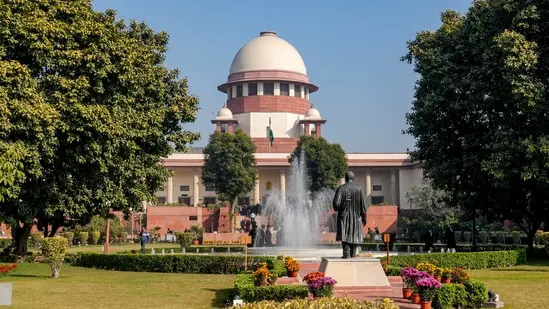
The Supreme Court has ordered the demolition of all unauthorised structures, including illegal additions in economically weaker section (EWS) houses and encroachments in setback areas, across Meerut and its outskirts, ruling that illegal constructions cannot be legitimised by the passage of time or official inaction, while also declaring that courts, as guardians of rights, cannot hesitate to tell people things they do not want to hear.
“No man is above the law, and no man is below it; nor do we ask any man’s permission when we ask him to obey it. Obedience to the law is demanded as a right; not asked as a favor. We are guardians of rights, and we have to tell people things they often do not like to hear,” a bench of justices JB Pardiwala and KV Viswanathan noted in its July 14 order, released later.
The court’s sweeping directions came while monitoring compliance in a contempt case arising out of rampant illegal constructions in Meerut, where residential properties had been converted into schools, hospitals, maternity clinics, diagnostic centres and banks in blatant violation of planning laws.
After examining a fresh compliance report filed by the Uttar Pradesh Awas Evam Vikas Parishad, the bench noted that all 44 identified illegal commercial properties had already been sealed pursuant to its earlier orders. It now directed that wherever these structures were commercial in nature, they “shall be demolished at the earliest.”
In cases where residential houses had been partly converted for commercial purposes through unauthorised additions, the court directed authorities to identify the offending portions, issue 15-day demolition notices to owners and, upon failure to comply, demolish the structures themselves and recover the demolition costs as arrears of land revenue.
The bench also issued one of its strongest directions on setback violations, rejecting every plea for regularisation. “We direct that all setback areas of each and every property shall be demolished,” it ordered.
SC rejects plea to regularise illegal structures
The Parishad had urged the court to permit compounding of unauthorised additional floors constructed in EWS houses, relying on provisions of the Uttar Pradesh Housing and Development Board Regulations, 1982. The bench, however, held that Regulation 16 itself prohibited compounding of constructions inconsistent with the master plan. “There is no question of compounding…We make it abundantly clear,” said the court.
‘Passage of time can’t cure illegality’: SC
Rejecting the argument that old illegal constructions deserved leniency, the bench said administrative delay could never become a source of legality.
“Mere passage of time or laxity on the part of the authorities in taking timely action will not cure the illegality by itself. Passage of time can never be a ground to compound the illegality or unauthorised construction. What is illegal or what is unauthorised would always remain so,” said the bench, adding that the very idea of compounding such violations “is strongly deprecated.”
The court also widened the scope of the exercise beyond the 44 identified properties. It directed the chairman of the Uttar Pradesh Awas Evam Vikas Parishad to undertake a fresh survey across Meerut to identify residential premises being illegally used for commercial activities and to specifically inquire into unauthorised constructions in the town’s outskirts, particularly Uldepur. The bench said that the exercise was necessary to ensure there was no selective enforcement.
“There should not be any discrimination insofar as the action which has been taken to demolish all illegal buildings,” said the court while directing teams to conduct extensive inspections and submit a fresh report.
Bench links illegal buildings to recent fire tragedies
Recalling its earlier observation that the litigation was “an eye-opener” not merely for Uttar Pradesh but for the entire country, the court linked rampant illegal construction to recent fire tragedies claiming innocent lives.
“Over a period of last three months, there have been some heart-wrenching casualties wherein innocent children…got charred to death because of fire,” it said, directing authorities to ensure such incidents never recur.
“We once again impress upon the state and all its authorities that if action is not taken today, it will be too late in the day thereafter to proceed in accordance with law. Do not give an impression to the people at large that they will be saved or their illegal constructions will be compounded on mere asking… Right action at the right time must be taken, and that is the only way that the state will be able to maintain the Rule of Law,” the bench added.
The latest order follows the court’s April directions, when it had described the situation in Meerut as “shocking and highly disturbing” after discovering that schools, hospitals and other commercial establishments were operating from illegal residential buildings without sanctioned plans or adequate safety measures. At that stage, the bench had ordered the immediate sealing of all 44 identified properties, granted authorities two months to demolish all illegal setback constructions after issuing notices, and remarked that the litigation should serve as “an eye-opener” for governments across the country.
According to the compliance report placed before the court, all 44 properties have since been sealed, students from unauthorised schools shifted to recognised institutions, and patients admitted in illegal hospitals relocated elsewhere. The matter will next be heard on September 21, when the court expects a fresh report on illegal constructions across Meerut and its surrounding areas.