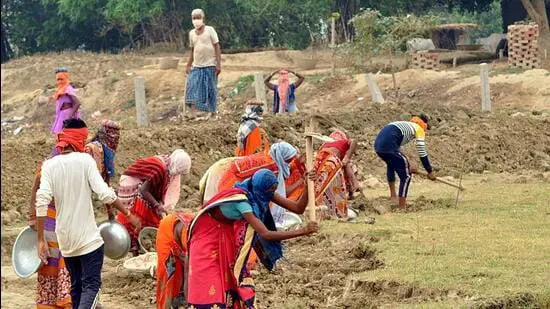
Artificial intelligence (AI) will be woven into the new rural employment law to plan village works, audit implementation and detect fraud, according to internal documents seen by HT and officials aware of the matter who stressed that all administrative decisions will continue to rest with human authorities.
The new technology is part of the government’s revamped Viksit Bharat-Guarantee for Rozgar and Ajeevika Mission (Gramin), or VB-G RAM G. The underlying law came into force and on July 1, replacing the Mahatma Gandhi National Rural Employment Guarantee Scheme (MGNREGS), increasing the number of guaranteed workdays but also introducing changes to how the programme is funded and operational nuances.
While debate around the legislation has focused on its replacement of the existing scheme and mandatory face authentication, internal documents reviewed by HT show the law envisages a much wider digital architecture, with AI operating at three stages: planning, audits and fraud-risk mitigation.
For instance, on audits, engineers will digitally map worksites before construction, during the work and after completion, with AI comparing the images to flag if a project’s location shifts or a different asset is built from the one approved. Similarly, for planning, the technology will read satellite imagery, watershed maps and groundwater data to suggest where a check dam should go – and flag if a similar structure already exists nearby under another scheme.
AI will function as a decision-support tool, identifying potential irregularities and analysing trends, rather than replacing officials or automatically approving or rejecting projects, a senior government official HT spoke to said, requesting anonymity.
According to the official, the technology ecosystem, including the AI-enabled functionalities, is being developed by the ministry of rural development in collaboration with technical agencies, including the National Informatics Centre (NIC) and the National Remote Sensing Centre (NRSC), and “other technical and implementation partners, as required” – hinting at potential third party contractors.
One of its biggest uses will be in planning village infrastructure through a Viksit Gram Panchayat Plan – a long-term development blueprint identifying all infrastructure and public assets required for a village’s development, instead of simply drawing up an annual list of works. The plan will continue to be prepared and approved by the Gram Sabha, but unlike the earlier “shelf of works”, it will be based on scientific planning and convergence with other government schemes, according to an internal ministry document.
It will, for instance, identify all the infrastructure a village requires – from roads and water conservation structures to Anganwadis, and community halls. While works that fall under the rural employment programme will be funded through it, projects requiring support from other departments will be linked to schemes run by ministries such as health, agriculture or animal husbandry, the official explained.
According to the document, AI and GIS-based planning tools will be tapped into. The planning system will draw on multiple datasets, including rainfall patterns, previous rural employment works and assets created under other government schemes.
Fraud detection and audits
The worksite mapping that underpins fraud detection will be carried out by engineers at three stages – before construction starts, while work is under way, and after completion. According to the ministry document, the system can compare records and flag discrepancies.
The technology will also support audits by analysing complaints and social audit findings to identify recurring patterns. For instance, if a particular district repeatedly reports delayed wage payments, attendance-related issues or poor-quality works, the system will flag these trends for officials to investigate and take corrective action, the official explained.
The wider digital system
Workers’ attendance will be registered through face authentication instead of paper registers. “The worksite supervisor… would just need to hover the camera of their phone in front of the worker’s face. The app will capture the image and match it with the photograph already downloaded in the electronic muster roll. Once the face matches, the attendance will be recorded,” a senior rural development ministry official explained to HT, describing how the system works.
Addressing concerns over technology failures, the official said the system includes an exception-handling mechanism for cases where face authentication fails because of poor connectivity, device malfunction or other technical issues. In such cases, supervisors can seek an exemption through the application itself, and workers will not be denied employment if their attendance cannot be recorded through face authentication.
Attendance and daily work records will be maintained through electronic muster rolls – digital records that capture workers’ attendance, work allocation and wages – while engineers will record measurements of completed works in electronic measurement books instead of paper files, the official said. The same digital system will be used to geo-tag completed assets so their location can be verified, monitor implementation through real-time management information system (MIS) dashboards, and allow workers to file and track complaints through an online grievance redressal system.
Digital rights experts, however, have raised concerns about the expanding use of AI in the programme. Apar Gupta, a digital rights and constitutional lawyer, said the use of AI across planning, attendance, audits and grievance redress “cannot be treated as a routine administrative upgrade” because earlier digitisation of MGNREGA had already created barriers for workers accessing their legal entitlements.
Gupta pointed to a 2026 study by Realising Rights, which analysed more than 30 million wage transactions and found that Aadhaar-based payments neither improved payment timeliness nor reduced rejection rates. He added that research on the National Mobile Monitoring System (NMMS) attendance application had documented workers losing wages because of poor connectivity, lack of smartphones and incorrect digital records.The research was conducted by LibTech India, a consortium of researchers and activists who frequently analyse rural employment data.
“Under VB-G RAM G, these harms will deepen as algorithmic determination will influence who receives work, which projects are approved or whether a complaint is considered genuine,” Gupta said.
The senior rural development ministry official, however, rejected the suggestion that AI would make administrative decisions. The official told HT that AI would only assist officials by identifying patterns, suggesting locations for assets and flagging potential irregularities, while decisions on employment, project approvals, wage payments and grievance redressal would continue to be taken by gram sabha or officials as the case may be as per the provisions of the Act.
Rohit Kansal, secretary, ministry of rural development, said the technology-enabled governance framework has been designed to “strengthen transparency, accountability and efficient service delivery while ensuring that there are adequate exception-handling mechanisms and that no genuine worker is denied attendance or employment due to poor network connectivity, technical glitches or device-related issues.”