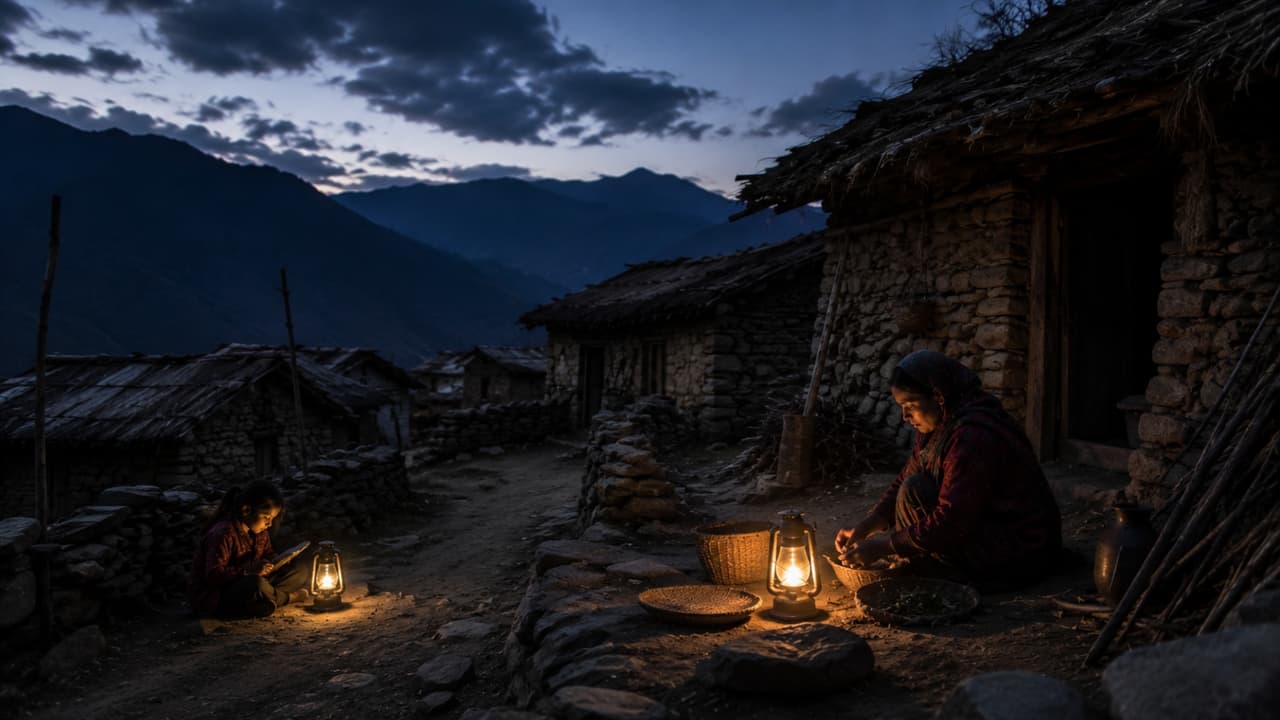
Villages Without Electricity: Are there villages in the world where electricity is not available even today? Know the story of 7 remote settlements, where the day starts with sun and ends in darkness.
Villages Where Electricity Has Not Reached: The world is becoming increasingly digital. This is the era of Artificial Intelligence, 5G and Smart Cities, but even today there are many villages in the world where electricity is not available or is available in very limited form. In these villages, people start their day according to sunlight and most of the work stops as soon as it gets dark. Let us know about 7 such villages of the world, where even today electricity system has not become a part of people’s lives.
1. Fuerte Bullones (Chile) – Village at the end of the world
Fuerte Bullones is an extremely remote area located in the Patagonia region of southern Chile. The national electricity grid has not reached here. Some homes have solar panels or small generators, but do not have access to regular electricity.
How do people live?
- Cook food with wood.
- Collect rain water.
- Use lantern or solar light at night.
2. Oymyakon (Russia)
Oymyakon in Siberia is counted among the coldest inhabited areas in the world. The temperature here drops below -50°C. Due to extreme cold and remote location, electricity supply does not reach many outlying settlements.
People’s life-
- Heat is provided by wood and coal.
- Diesel generators are run when needed.
- Life has completely adapted to the weather.
Read this also- Why is air not visible? Does air have any color?
3. Koro (Papua New Guinea)
Many mountainous villages in Papua New Guinea are still not connected to the national electricity network. Koro is one such village.
How is life here?
- Farming and fishing are the main occupations.
- Kerosene oil lamps are lit at night.
- One has to travel many kilometers to charge the mobile.
4. Dharnai (Bihar, India) – Where there was never electricity
Dharnai village in Gaya district of Bihar remained deprived of electricity for years. Later, solar microgrid was started here, but this village remained an example of life without government electricity for a long time.
What is learned?
- Dharnai showed that solar energy can become a better option for remote areas.
Read this also- How does Cyber Fraud happen? Just one mistake and your bank account is empty!
5. Higher settlements around Namche (Nepal)
Many villages in the Himalayan heights are still not connected to the national electricity grid. Some places have small hydro projects or solar systems, but many settlements still rely on limited electricity.
How is life here?
- Farming and tourism are the main sources of income.
- Night life is very quiet due to limited electricity.
- Candles or solar lamps are still used in many homes.
6. Tribal villages of the Amazon rainforest (Brazil)
Many tribal villages located in the Amazon forests of Brazil are far from the national electricity network.
How do people live?
- The river is their main route.
- Hunting, fishing and farming are the basis of life.
- Modern facilities are extremely limited.
- Many communities in these villages deliberately want to maintain their traditional lifestyle.
7. Remote settlements around Kibber (Himachal Pradesh, India)
Some small high altitude villages and seasonal settlements in Spiti Valley remained without regular electricity for long periods. Today, solar and micro-hydro systems have been installed in many places, but due to harsh weather, availability of electricity still remains a challenge.
Life here-
- In winter the roads remain closed with snow for several months.
- People use wood and yak dung for fuel.
- Due to limited electricity, energy is used very wisely.
Has electricity reached the entire world?
No. According to the United Nations and the International Energy Agency (IEA), millions of people in the world still do not have access to electricity. The most affected areas are Sub-Saharan Africa, South Asia and remote mountain and rainforest areas. Electricity has definitely reached many countries, but its supply is not regular.
Content Source – Various reports from International Energy Agency (IEA), United Nations Sustainable Development Goal 7 (Affordable and Clean Energy), World Bank, International Renewable Energy Agency (IRENA), Our World in Data, Reuters and BBC.