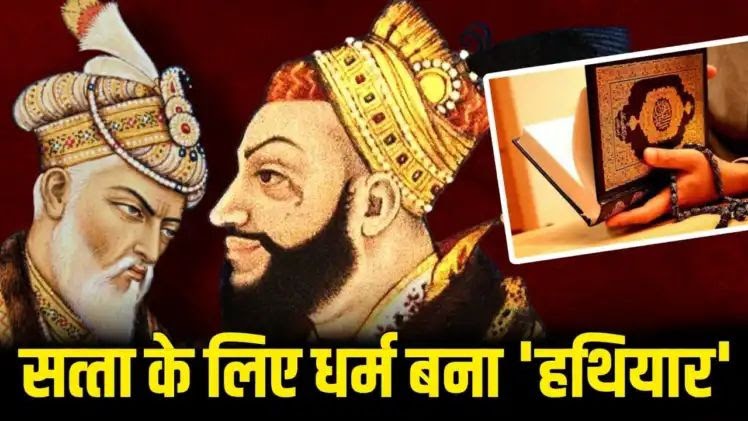
Using religion for profit is not a new thing. It was used extensively during the Mughal period. When Babar and Humayun sought help from the Emperor of Iran, he put a condition before both of them to accept Shia faith.
Both of them accepted it. But as soon as the work was done, it was thrown away like clothes. According to Shah Jahan’s daughter Jahanara, in the fight for the throne, Aurangzeb used religion as a weapon against Dara and brutally killed him by calling him an infidel. Jahanara refuted the claim that Dara was anti-Islam. Read the story of Dara from the pages of history.
Shahjahan never hid the fact that after him the heir of the Mughal Sultanate of India would be his elder son Dara Shikoh. In order to avoid any conflict between his sons on this issue, while he always kept Dara with him in the court, he tried to keep Aurangzeb, Shuja and Murad away from Agra by giving them responsibilities of other provinces. However, nothing Shahjahan thought was possible in the future. Dara continued to rule the court as long as he remained strong. But every news of Darius’s increasing power increased the resentment towards him among the other three brothers. During Shah Jahan’s illness in 1657, Dara sat near his bed day and night and continued serving him.
He continued to look after the administration in his father’s name but did not make any attempt to attain kingship during his tenure. Shahjahan was cured this time. But in the beginning, when he had given up hope of living, he called the courtiers and expressed his wish in favor of Dara.

Mughal emperor Shahjahan. Photo: Wikimedia commons
Closeness to father weakened Darius.
Father’s love for Darius further proved to be his weakness. Due to always being kept in the court, he could not acquire the skills of strategy of wars and facing the ground challenges of governance. According to the famous historian Yadunath Sarkar, his father’s excessive love caused great harm to Dara. He wrote, “Apart from the third siege of Kandahar, Dara was never sent to handle the provinces or conduct war.
As a result, he could not have any experience in war or directly handling the state. He remained ignorant of the criteria of difficulty and danger. There was no direct contact with the army either. Gradually he became incapable of winning the war of succession. The courage and strategic skill required to win the battle for the throne could not be compensated by Dara’s bookish knowledge and decency.

Dara Shikoh. Photo: Wikimedia commons
Jahanara was dear to both the brothers
These weaknesses of Dara proved to be heavy for him. He was defeated in the battles of Dharamat, Samugarh and Dorai against Aurangzeb. His next time was spent running in an attempt to escape. On August 30, 1658, Dara was brutally cut into pieces. The fight may have been for the throne, but Aurangzeb publicized Dara’s murder as being anti-Islamic. But his sister Jahanara says this is wrong.
Shahjahan’s eldest child Jahanara was coincidentally the favorite of two brothers, Dara and Aurangzeb, who were each other’s mortal enemies. Despite being aware of Jahanara’s inclination towards Dara, Aurangzeb did not cause any harm to Jahanara even after ascending the throne. He even allowed Jahanara to stay with his father Shahjahan to take care of him while he was imprisoned in the Agra Fort. After the death of Shahjahan, Jahanara was reunited and given the title of Mallika-e-Jahan.

Jahanara Begum.
One brother is expert in books, the other in ground situations.
Jahanara has penned down all the incidents related to the Mughal Sultanate of that period. He has also written in detail on the bloody war between brothers for their father’s succession. In Heramb Chaturvedi’s book “Jahanara – A Dream, a Reality”, he wrote, quoting Jahanara, “Indeed, among our four brothers, both of them, Dara and Aurangzeb, were different from their peers and were far above their shoulders. Dara was at the top in the world of thoughts and books, while Aurangzeb was in implementing his ideas.
Apart from Islam and Sufism, Dara had also read Vedas, Puranas and Bible, while Aurangzeb had mastered Islamic law. Aurangzeb was also inclined towards religious mysticism. He also had knowledge of religion but believed in keeping it limited to bookish knowledge.

Mughal emperor Aurangzeb. Photo: Wikimedia commons
Dara had objection to fanaticism, not Islam.
The difference in thinking between Dara and Aurangzeb on religious questions was not on the issue of following Islam but on its fanaticism. Jahanara wrote, “Dara accepted religious information as a reality of life, while Aurangzeb accepted even books. If both of them could have coordinated like Akbar, then perhaps there would have been no scope for conflict on this issue, because both Dara and Aurangzeb were believers of Islam. While Dara was in favor of protecting it from the fanaticism of the Ulama, Aurangzeb wanted to keep the Ulama in political hands. Dara wanted to make Islam unequivocal and flexible in its mysticism, whereas Aurangzeb was against any compromise in Islam.
One has knowledge, the other has power.
According to Jahanara, Dara had confidence in his knowledge while Aurangzeb had confidence in his strength. Dara was engrossed in mental and spiritual matters and Aurangzeb in typical physical and worldly desires. Jahanara wrote, “Aurangzeb strongly disliked Dara and his ideas. In his letters, he warned that Bhaijaan should read Jiyu’s (Dara’s) stories but should not believe in them at all. Bhaijaan is a blasphemer and will make everyone go to hell with him. Dara only wanted to be a good person and see others also becoming good people. On the other hand, Aurangzeb was not ready to listen to anyone except himself.
Historian Yadunath Sarkar also does not consider Dara as anti-Islam. In his book ‘Aurangzeb’, he wrote, “He made Akbar his ideal. He believed in pan-theistic philosophy. He studied Talmud, Bible, Sufi, Hindu Vedanta etc. He had the intention of coordination between Hindus and Muslims. But he was not anti-Islam. He compiled the lives and teachings of Muslim saints. He was a disciple of Muslim saint Mian Mir. There was no disregard for Islamic beliefs in his writings. He only Expressed respect and faith in the principles of Sufis.
One has his father’s hand on his head, the other has faith in his sword.
Both Dara and Aurangzeb had the desire to capture Takht-e-Taus. While Dara’s father Shah Jahan was at the helm, Aurangzeb had gathered the capital of courage, patience and war skills in difficult battles. Jahanara wrote, “Both had ideas and dreams, which needed to outwit each other in political moves to have the power to implement them. In this, Aurangzeb had gone far ahead.”
Aurangzeb had always faced difficulties. Therefore he was accustomed to every environment. Whereas Dara spent time only in the court and in favorable circumstances. Darius was defeated in the fighting and taken prisoner. ” Aurangzeb also eliminated the other brothers Shuja and Murad who were claimants to the throne. But he took the cover of religion for the murder of Dara. During the next fifty years on the throne, Aurangzeb used brother Dara’s blood, bones and marrow as the foundation of the religious fanaticism that he maintained as an essential part of his rule.
Jahanara wrote, “Aurangzeb declared Dara an infidel and paraded him through the streets of Delhi and then brutally killed him. No enemy should have suffered such a painful death as the one he gave to Dara.”