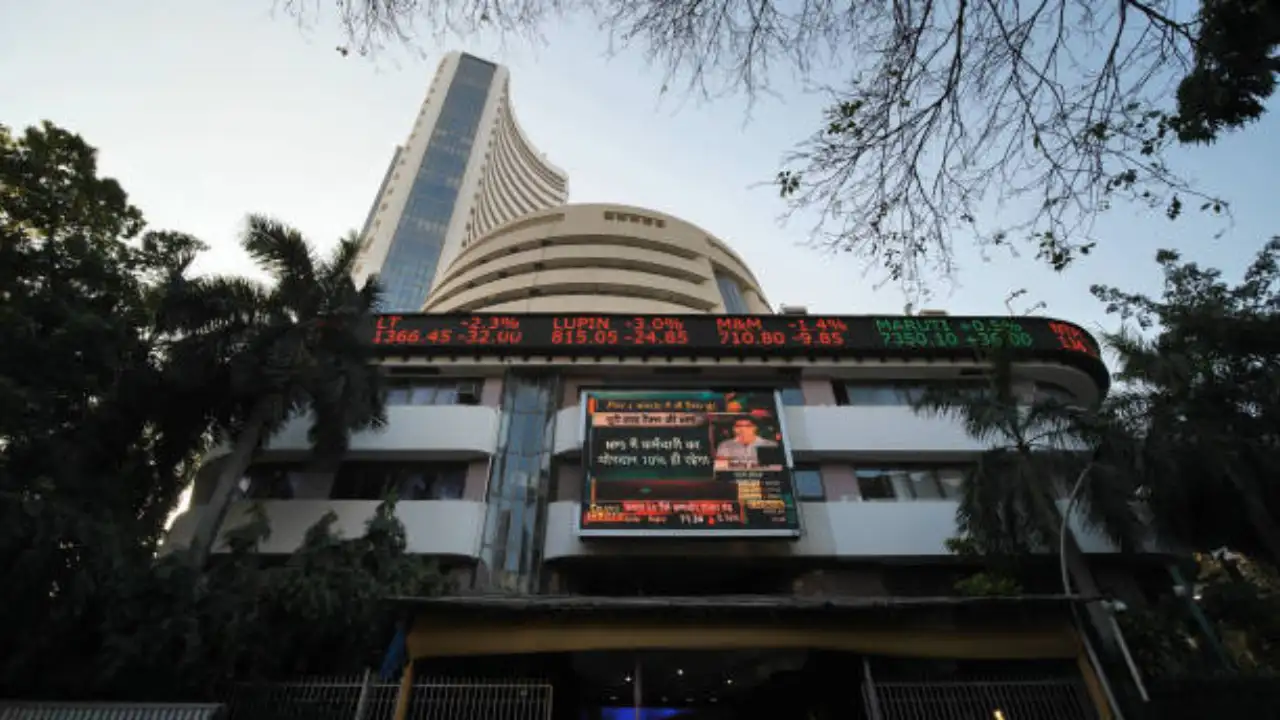
The Indian Stock Markets on Monday regained the losses as the Sensex gained 1200 points from day’s low and Nifty ended above 23,650 at close. Market begin the week in morning on a negative note. During the intraday trade, Sensex crashed more than 1,000 points, or over 1%, to 74,180, while the Nifty 50 tanked over 1% to the day’s low of 23,317.
At the time of closing, Sensex gained 77.05 points or 0.1% at 75,315.04, while the Nifty ended 6.45 points or 0.03% higher at 23,649.95.
During the intraday trade, the overall market capitalisation of the BSE-listed firms fell below Rs 453 lakh crore from nearly Rs 461 lakh crore in the previous session. Investors lose nearly Rs 8 lakh crore in a single session.
Among the sectors, Information Technology, , Healthcare, and Telecommunication were in the gaining momentum while Auto, Capital Goods, Metal, Oil & Gas, Consumer Durables, Power, Commodities, and Realty remained under pressure.
What led to market rebound?
The Indian stock market regained from the early losses with Sensex gaining over 1000 points. Value buying was seen in some of the sectors with Nifty IT index continuing to be the highest gainer, up around 2%. Among the IT stocks,
Coforge was the top performer, up around 4%.
Market volatility also eased as India VIX, the volatility index eased from 20.05 to 19.63.
The geopolitical updates also triggered the markets rebound after US President Donald Trump comments.
Experts commentary:
Vinod Nair, Head of Research, Geojit Investments Limited said, “The prolonged stalemate between the US and Iran continues to cast a shadow over near-term sentiment, yet the equity market managed to recover intraday losses and closed on a flat note, supported by value buying in IT and banking stocks. The ongoing earnings season has provided a constructive narrative, though caution persists as higher bond yields, elevated crude oil prices, and a weakening rupee reinforce inflationary concerns. Investors appear to be adopting a staggered allocation strategy rather than waiting for complete clarity, particularly in export-oriented sectors. A meaningful breakthrough in diplomatic negotiations with Iran—especially regarding uranium stockpiles and sanctions—remains critical for reducing volatility and enabling a decisive upward move in the market.”
Siddhartha Khemka – Head of Research, Wealth Management, Motilal Oswal Financial Services Ltd, “Markets are likely to remain event-driven in the near term, with volatility expected to persist amid elevated crude oil prices near USD 106 per barrel, continued weakening rupee (touched new low of 96.2 against the US dollar), rising bond yields and mounting inflationary concerns are collectively creating a challenging backdrop for domestic equities.”