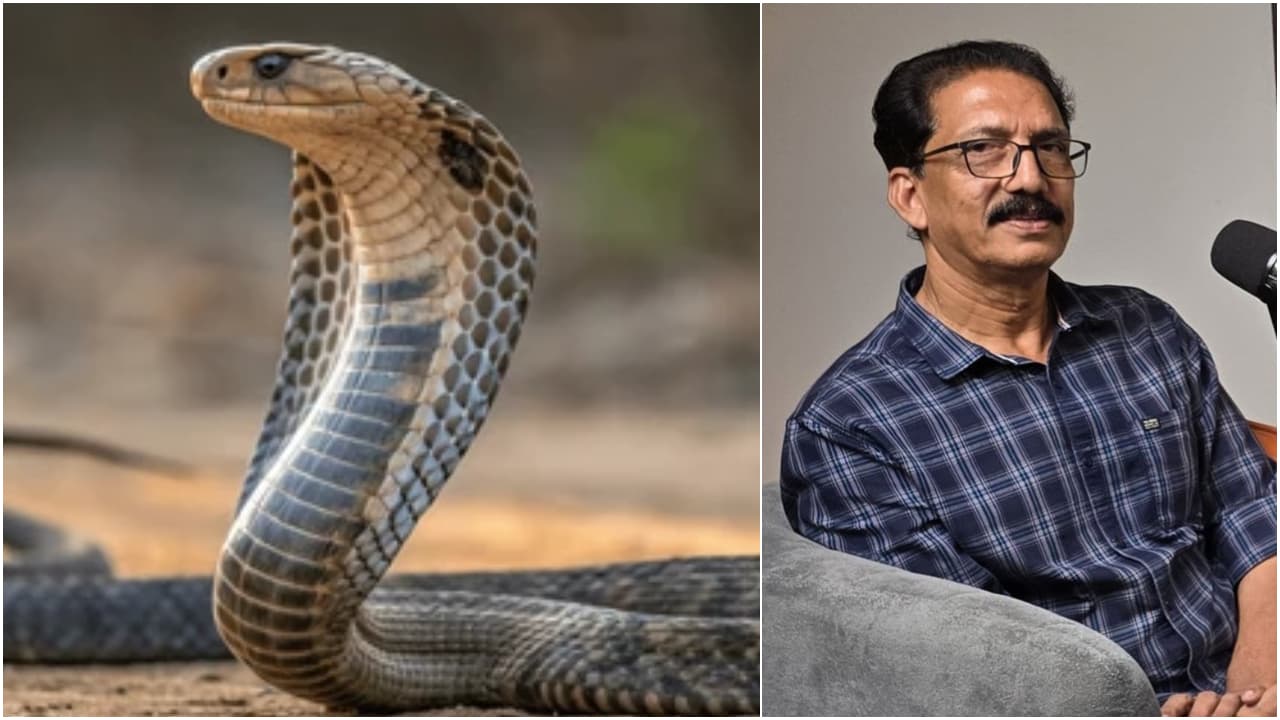
Entomologist Vijayakumar Blathur breaks down the connection between snakes and the rising heat. He says snakes, being cold-blooded, aren’t coming out at night just because it’s hot. They’re actually looking for cool spots and food.
With snakebite incidents on the rise in Kerala, entomologist and vlogger Vijayakumar Blathur has explained the link between snakes and the current high temperatures. In a Facebook post, he clarified that snakes aren’t just appearing because of the heat. They are also searching for cooler places and food. He pointed out that when the surroundings are dry, snakes will naturally move towards areas with water and shade. But he made it clear that they don’t come out of their holes at night just to ‘get some fresh air’ because it’s stuffy inside. “If heat were the only reason, wouldn’t they be out during the day?” he asked.
Blathur explained that snakes are cold-blooded, which means they can’t control their own body temperature. Their body heat simply changes with the environment. However, he added that if they get too much sun, they will definitely crawl towards a cooler spot
Here’s What His Facebook Post Said
There’s a small problem here! A lot of discussion is happening around the idea that snakes are coming out of their holes because of the heat. But it’s a bit wrong to think that snakes feel the heat just like we do. When it gets hot, we feel restless, switch on the fan or AC, or step outside if the room is stuffy. High humidity makes it even worse for us, which is why 38 degrees can feel like 40. We are warm-blooded animals. We have to keep our body temperature within a very specific range, otherwise our internal organs will be in trouble. When it’s cold, our metabolism speeds up to keep us warm. When it’s hot, we sweat to cool our bodies down. That’s why we need more food in winter (for this burning process) and more water in summer (for sweating).
But cold-blooded animals can’t regulate their own body temperature. They don’t sweat, and they don’t shiver. We mammals and birds use energy from our food to control our body temperature. But these animals can’t do that. Instead, their body’s temperature just changes according to the temperature of their surroundings.
It’s not just snakes. Lizards, chameleons, crocodiles, frogs, fish, turtles, and even insects are all cold-blooded. The scientific term for them is ‘Ectothermic’. So, unlike us, they don’t come out at night to catch a breeze just because it’s hot. If that was the case, we’d see them out more during the day, right? In the mornings, they actually come out to soak up the sun to warm their bodies. This is what makes their muscles active. You might have seen a chameleon on a fence with its mouth open, sunbathing. This is called ‘basking’. Crocodiles also lie on rocks to bask in the sun. If it gets too hot, they will hide in places that are not in direct sunlight. They’ll move to places with water, moisture, or coolness. They rest in holes, cracks, or under leaves where the sun doesn’t hit directly. Even butterflies spread their wings in the morning sun to absorb heat and get active. If there’s no sun, they can barely fly! That said, it’s true that too much heat can cause them stress.
When the outside temperature drops, their bodies also cool down. When it gets hotter, their bodies heat up. Since they don’t spend energy to heat themselves, they need much less food compared to a warm-blooded animal of the same size. This is why a snake can survive by eating just once a week or even once a month.
So, the snakes we are seeing now are not out just because of the heat. They are moving around looking for cooler places and for food, which could be rats, lizards, or even other snakes. When everything around is dry, they will come looking for water and shade. In the winter, they might even come looking for our body heat and try to get into our blankets. It’s also their breeding season right now. The baby snakes that hatch will move far apart to avoid competing for food. And remember, even the young ones of venomous snakes have enough venom to kill a person.