reserve Bank of India
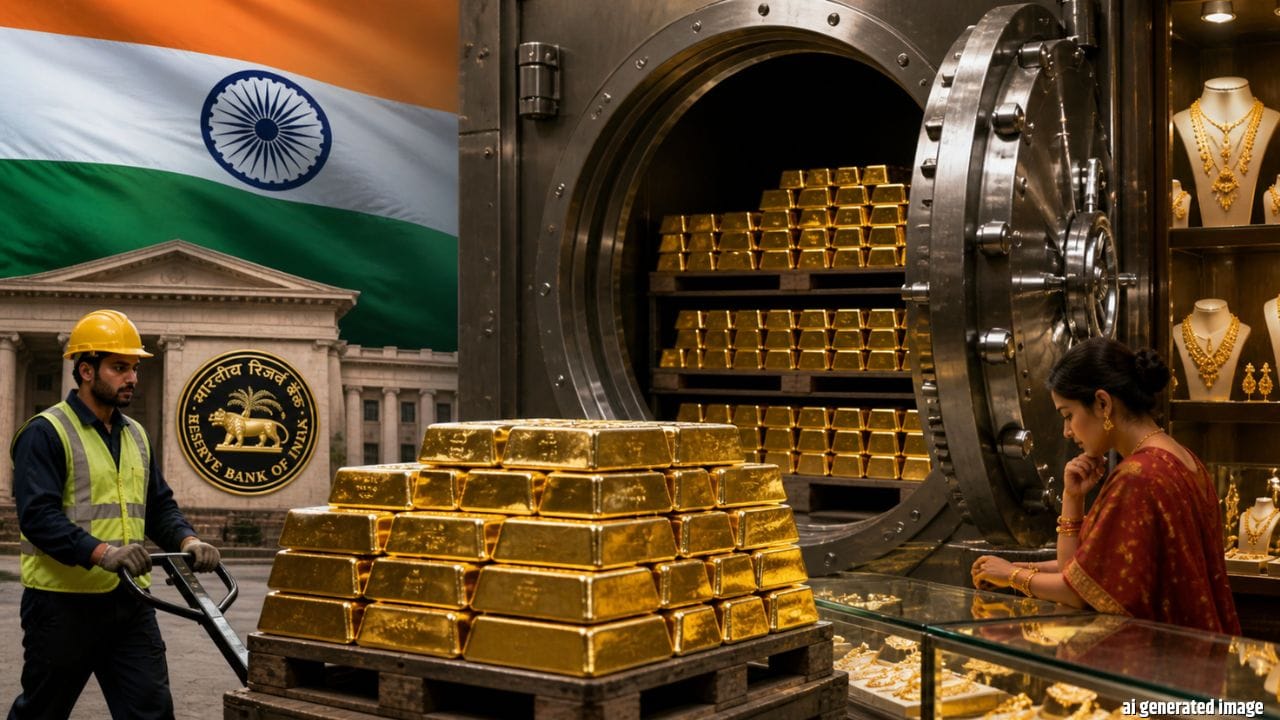
Recently, the Reserve Bank of India (RBI) has taken a big step and brought back its 104.23 metric tonnes of gold kept abroad to India. This huge consignment has been safely delivered to the coffers of the country during the six months ending March 2026. This question is bound to arise in the mind of the common man that when so much gold has come into the country, will the price of gold go down in the bullion market? Will it now become cheaper to buy jewelery for investment or marriage?
How did the mathematics of storage change in the safe?
According to the Central Bank report, India’s total gold reserves have registered a slight increase during this period. In September 2025, this figure was 880.18 metric tons, which increased to 880.52 metric tons by March 2026. The real change is not in the total quantity of gold, but in its addresses. The figure of gold kept safe within the country till March 2026 was recorded at 290.37 metric tonnes. Earlier, it was 575.82 MT in September 2025 and 511.99 MT in March 2025.
Why is the reserve kept outside?
It is interesting that RBI does not keep all its gold within the country. According to the data of March 2026, 197.67 metric tons of gold was present in the safe custody of the Bank of England and the Bank for International Settlements (BIS). Apart from this, 2.80 metric tonnes of gold was kept in foreign safes as ‘gold deposit’. A big and strong economic strategy works behind this. Keeping gold internationally ensures liquidity i.e. cash flow. Trading of gold remains active in the world market, hence in times of crisis, it becomes easy to raise dollars immediately by mortgaging this gold on foreign soil. At the same time, bringing a large part back to our country strengthens strategic control and increases trust in the system.
Changing trend of dollar and investment
The prices of precious metals are continuously at high levels in the global market. The direct impact of this increase has also been seen on India’s foreign exchange reserves. In the last six months, the share of gold in India’s total forex reserves has jumped from 13.92 percent to 16.7 percent. According to the report, out of India’s total foreign currency assets of $552.28 billion, a major part, i.e. $465.61 billion, is invested in foreign securities. Apart from this, 46.83 billion dollars are deposited in other central banks and BIS, while 39.84 billion dollars are registered in the accounts of foreign commercial banks. This time a slight change has been seen in the investment pattern, where deposits in securities and foreign banks have decreased slightly and deposits in other central banks have increased. With this, the net forward assets (payable) of RBI have reached $ 103.06 billion by March 2026, which reflects strong foreign exchange management.
Will gold prices become cheaper?
Will this big step reduce gold prices? The direct answer to this is- no. This step is completely a strategic and logistics decision of RBI. Gold prices in the market are mainly determined by international conditions, movement of the US dollar, interest rates, inflation and geopolitical tensions as well as global demand-supply. The Reserve Bank has neither sold nor bought any new gold in the market during this entire process. This is just a physical transfer from one place to another. Therefore, it will not have any impact on bullion market prices for the common man.
Also read- GST 2.0: Public happy, traders worried. Traders’ money is getting stuck due to the new rule.