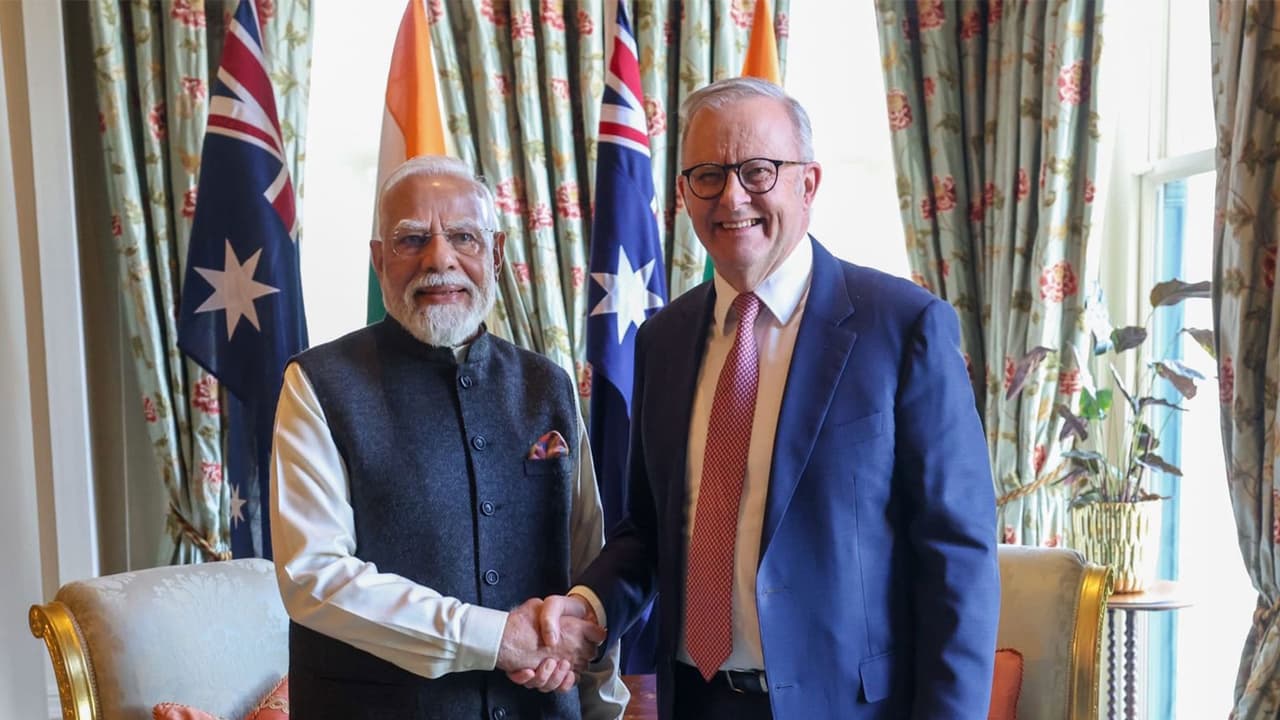
PM Modi’s Australia visit led to 18 major agreements, boosting the India-Australia Strategic Partnership. Pacts cover defence, maritime security, energy, critical tech, education, mining, research, and cultural cooperation.
Prime Minister Narendra Modi’s visit to Australia from July 8-10 culminated in 18 major outcomes spanning defence, maritime security, energy, critical technologies, education, mining, research and cultural cooperation, significantly expanding the India-Australia Comprehensive Strategic Partnership.
According to the Ministry of External Affairs (MEA), the outcomes include the adoption of a Joint Declaration on Defence and Security Cooperation, a Maritime Security Collaboration Roadmap, an India-Australia Joint Statement on Energy Security, and an administrative arrangement under the India-Australia Civil Nuclear Agreement, alongside a series of agreements in education, skills development, research, innovation and heritage conservation.
Strengthening Defence and Security Ties
The Joint Declaration on Defence and Security Cooperation aims to advance defence industrial collaboration and joint innovation ecosystems, promote information sharing, and deepen cooperation in humanitarian assistance and disaster relief (HADR).
The Maritime Security Collaboration Roadmap seeks to enhance information sharing, capability development and operational coordination while strengthening cooperation in HADR, pollution response and search and rescue operations.
An MoU was also signed between the Indian Coast Guard and Australia’s Maritime Border Command to enhance coordinated coastal surveillance, maritime domain awareness and maritime law enforcement.
Australia further invited an Indian military instructor to join the Australian Defence College for 2028-29, aimed at strengthening professional military engagement and knowledge exchange.
Bolstering Energy and Nuclear Security
The two countries also issued a Joint Statement on Energy Security, reaffirming their commitment to strengthening energy security, recognising India’s role as an important supplier of liquid fuels and downstream energy products to Australia, and supporting the continued flow of energy products between the two countries.
An administrative arrangement under the India-Australia Civil Nuclear Agreement will enable the supply of Australian uranium to India, diversify India’s energy sources and strengthen its energy security.
Partnership in Technology and Supply Chains
Among the strategic initiatives, India and Australia launched the Australia-India Partnership for Cyber, Critical Technologies and Supply Chains to strengthen cooperation in cybersecurity, resilient supply chains and emerging technologies.
Expanding Economic and Education Collaboration
The economic and education outcomes included an MoU to establish a Centre of Excellence in Mining and Mining Equipment, Technology and Services at the National Skill Training Institute (NSTI), Bhubaneswar, a Letter of Intent for Flinders University to establish a campus in Bengaluru, and a Letter of Approval permitting Victoria University to establish its campus in Gurugram.
India’s National Council for Vocational Education and Training (NCVET) and the Australian Skills Quality Authority (ASQA) also signed a Letter of Intent to strengthen quality assurance in vocational education, align occupational standards and promote capacity building.
Cultural Cooperation and Repatriation
The visit also saw the repatriation of three Indian antiquities from Australia: the sacred bull Nandi, an 11th-12th century granite sculpture; a bronze Trident with Bhadrakali; and a 12th-century basalt sculpture of the six-headed Skanda (Karttikeya).
Broadening Research and Innovation
Both sides operationalised the Rooftop Solar Training Academy at Pandit Deendayal Energy University, Gandhinagar, to train 2,000 women and youth as solar technicians under India’s clean energy programme.
Other agreements included an MoU under the Australia-Canada-India Technology and Innovation (ACITI) Partnership; cooperation between Geoscience Australia and Geological Survey of India on advanced mineral exploration; a Traditional Knowledge Digital Library access agreement between Council of Scientific and Industrial Research and IP Australia; an MoU between CSIR and University of Melbourne on collaborative research; and an agreement between Satyajit Ray Film and Television Institute and Griffith Film School to promote collaboration in film education and academic exchanges. (ANI)
(Except for the headline, this story has not been edited by Asianet Newsable English staff and is published from a syndicated feed.)