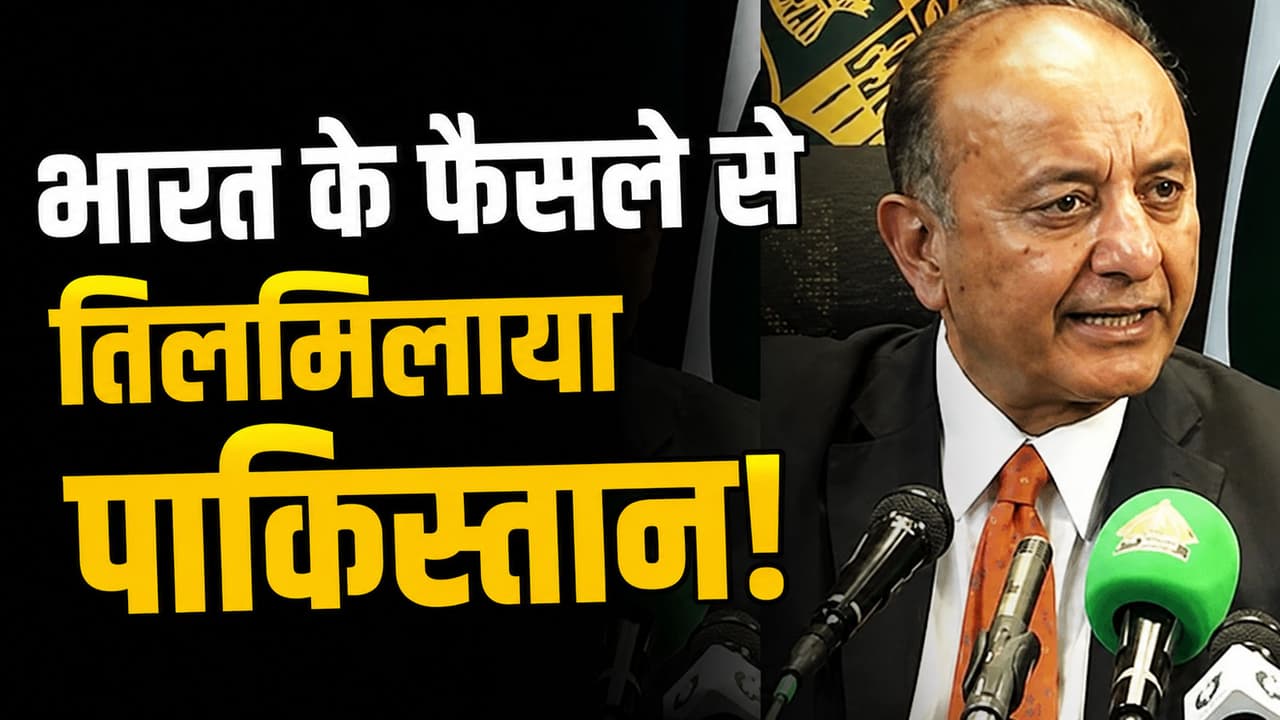
Pakistan has once again raised an alarm over the Indus Water Agreement. This time Pakistani minister Musadiq Malik has threatened to cut off his hand. Know the whole matter and VIDEO of the minister’s statement…
Indus Waters Treatment Row: The tension between India and Pakistan regarding the Indus Waters Treaty is once again in the news. Now Pakistan’s Climate Change Minister Musadiq Malik, who is struggling with the deteriorating economy, has given a new threat to India. In a press conference held in Islamabad, Pakistan’s Climate Change Minister Musadiq Malik and Information Minister Ataullah Tarar spewed venom against India. He said that if anyone tried to claim Pakistan’s share of water, ‘we will cut off those hands.’ This statement of the minister has come at a time when there is already tension between the two countries regarding the Indus Water Treaty.
What threat did the Pakistani minister give?
In a joint press conference with Information Minister Ataullah Tarar, Climate Change Minister Musadiq Malik directly targeted India. He said that India is trying to stop Pakistan’s water, and for this he used very aggressive language. Malik said, ‘There is a tap which is being controlled by the Prime Minister of the neighboring country. He says that he will not allow even a single drop of water to enter Pakistan. He did not stop here, but gave a jackal bark and said, ‘Whoever will claim a share of our water, we will cut off his hands.’ This statement was reported by Pakistani news channel 24NewsHD and many other media outlets and its video clips also went viral on social media.
Scroll to load tweet…
Pakistani Information Minister claims – Treaty is still in force
In the same press conference, Information Minister Ataullah Tarar made a different claim. He said that the Indus Water Agreement is still legally binding, and no country can single-handedly cancel or amend it. Tarar said that India’s stand has not received support in any forum of the world, hence the treaty should still be considered in full force. He also reiterated the old statement of Prime Minister Shehbaz Sharif and Army Chief Field Marshal Asim Munir, which said that ‘Water is our lifeline and also our red line.’
Preparation to convene an international seminar
During this press conference, Pakistani ministers made another big announcement. He says that the first international seminar on Indus Water Treaty is being organized in Islamabad on Tuesday, in which legal experts, water specialists and foreign delegates will participate. In this seminar, the legal and technical aspects of the treaty are said to be discussed in detail.
How did the Indus Water Treaty dispute start?
Actually, the Indus Water Agreement was signed in the year 1960 with the mediation of the World Bank, under which the water of the Indus River System is divided between India and Pakistan. According to this agreement, India got the rights to the eastern rivers like Ravi, Beas and Sutlej, while Pakistan got most of the water of the western rivers like Indus, Jhelum and Chenab. This treaty remained in place despite decades of war and tension, but the situation changed completely after the terrorist attack in Pahalgam in April 2025. 26 people lost their lives in this attack and India blamed Pakistan-backed terrorists behind it. India then announced that the treaty would remain in abeyance until Pakistan ends cross-border terrorism ‘credibly and permanently’. Pakistan vehemently denied these allegations.
First army, then threat from Pak minister
This is not the first time that such a threat has come from Pakistan. Earlier, Pakistan’s Defense Minister Khawaja Asif had also said that if water security is felt to be threatened, then Pakistan can also adopt the path of war against India. Speaking to ARY News, Asif had said, ‘The moment we feel that our national security is in danger and water is a part of it, we will go to war against India. Will definitely do.
India’s befitting reply, the treaty is now obsolete
India has given a blunt reply on its stand. In the 62nd session of the United Nations Human Rights Council, India’s First Secretary Anupama Singh said that it is wrong to expect from a country which has made terrorism a part of its policy, that India will continue cooperation with it on the basis of trust and friendship. Singh further said that a treaty signed in 1960 cannot be treated as a permanent right, especially when the situation has changed so much in the last six decades. He also advised Pakistan to focus on its domestic issues, instead of raising baseless issues on international forums. India has always maintained that ‘Jammu and Kashmir was, is and will always be an integral part of India’, and Pakistan keeps raising such issues only to divert the world’s attention from its terrorism-related failures and domestic crises.