One of the dirty little secrets in Hollywood is that not all perfect films are created equal.
The truth is, it takes a lot of work to bring out the best version of a movie. Sometimes those stories become part of a film’s mythology. Sometimes they stay hidden behind the scenes. Either way, filmmaking is rarely the work of a single person. It takes an entire village to create the finished product that audiences eventually see in theaters.
That’s especially true when a movie feels effortless.
Sometimes you’re watching a film and wondering how something so obvious, so clean, and so entertaining could possibly have taken years to make. But that’s exactly what separates masterpieces from merely good movies. The very best films hide all the work. They make the impossible look easy.
For me, Back to the Future and E.T. the Extra-Terrestrial are two of the gold standards. They’re movies that feel nearly flawless from beginning to end. When it comes to horror, that list is much smaller. Even some of my all-time favorites, films like Aliens, The Shining, In the Mouth of Madness, and The Evil Dead, have little things you can pick apart if you’re approaching them from a critical perspective.
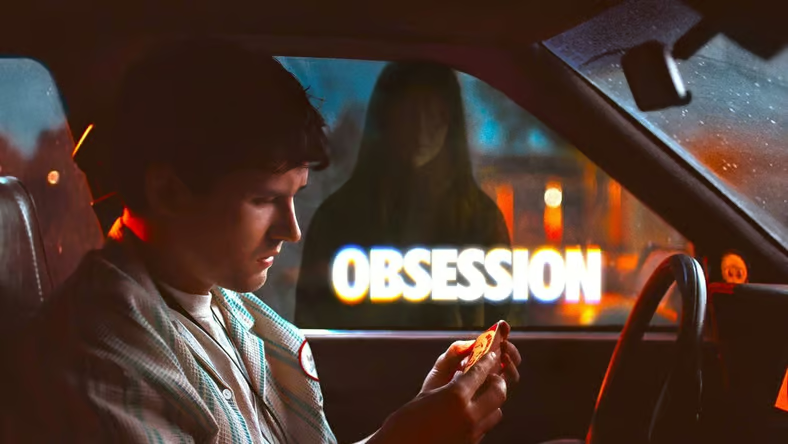
Right now, though, Obsession sits in a very different category for me.
I have a hard time debating people on this one because I’m pretty firm in my stance that what ultimately ended up on screen is about as close to perfect as horror gets. It’s funny, terrifying, emotionally devastating, and somehow manages to stick the landing with one final button that feels like a chef’s kiss.
The funny thing is, it wasn’t always that movie.
And that’s okay.
As I said, sometimes greatness comes from the work done after the first cut.
A great example is Paranormal Activity. Before it became the film that launched a franchise and helped turn Jason Blum into one of the most influential producers in horror, it was a tiny, homemade production. With the support of Steven Schneider and others, the film was reworked, enhanced with professional sound design, re-edited, supplemented with new material, and ultimately transformed into the phenomenon audiences know today.
Somebody helped push it across the finish line.
The same thing appears to have happened with Obsession.
In fact, Curry Barker has openly discussed how one of the film’s most important creative decisions came after production had already wrapped. Speaking with , Barker revealed that he originally shot what he described as a “Romeo and Juliet” ending in which Nikki also takes her own life (co-star Michael Johnston as well). The director explained that multiple versions of the finale were filmed, including the ending audiences ultimately saw in theaters. But after watching Inde Navarrette’s performance in a version where Nikki survives, Barker began hearing the same feedback from several people around him, including his father. As Barker recalled to EW, people kept telling him that it was “way more disturbing if she just survives this thing,” advice he ultimately agreed with.
And they’re right.
It’s hard to imagine Obsession ending any other way now. Nikki surviving transforms her from another casualty into perhaps the film’s greatest victim. The ending lingers because she’s left holding the pieces after everyone else is gone.
But that wasn’t the only ending in play.
“There was once an earlier version of Obsession where, like many A24 movies that Barker grew up watching, the writer-director kept us guessing whether everything was in Bear’s head or not — that’s what the director sets up with the pills early on,” revealed TheInsneider.
What makes all of this fascinating is that the alternate ending wasn’t the only thing that changed.
From what I’ve heard, there were several significantly different versions of Obsession throughout post-production. There was additional photography. There were conversations about character clarity, particularly regarding Cooper Tomlinson‘s role and how audiences would perceive him. There were editorial adjustments designed to sharpen the tone and better balance the film’s horror and comedy. At one point, an uncredited editor reportedly took a pass at reshaping the movie.

In other words, many people rolled up their sleeves and did the hard work required to transform a promising horror movie into something exceptional.
Not every filmmaker has that luxury.
Sometimes there simply isn’t enough money.
Sometimes there isn’t enough time.
Even in the case of Obsession, which was still made on a relatively modest budget, resources reportedly had to be allocated after principal photography to strengthen the final product. Thankfully, there were people behind the scenes who recognized opportunities to improve the movie and had the support to pursue them.
And thank God they did.
Because the version of Obsession currently destroying audiences in theaters feels remarkably polished for a filmmaker’s debut feature.
Looking back now, it’s difficult to separate where the original vision ends and where the collaborative process begins. But maybe that’s the point. The best version of a movie isn’t always the first version. Sometimes it’s the version that survives the fight.
It’s easy to watch a finished movie and assume greatness simply appeared out of the ether. In reality, greatness is often the result of dozens of difficult decisions, painful cuts, reshoots, rewrites, alternate edits, and people willing to challenge the material until it becomes the strongest possible version of itself.
That’s not a flaw in the process.
That’s the process.
Now that audiences know there were alternate endings, different editorial approaches, and material left on the cutting room floor, it’s hard not to be curious about what else exists in the vault. Maybe one day we’ll get to see some of those deleted scenes, abandoned storylines, and alternate takes. Maybe Barker will finally release the director’s cut he’s teased, complete with the infamous festival version featuring the extended ,
Whether that happens or not, Obsession stands as proof that perfect movies aren’t born.
They’re built.
