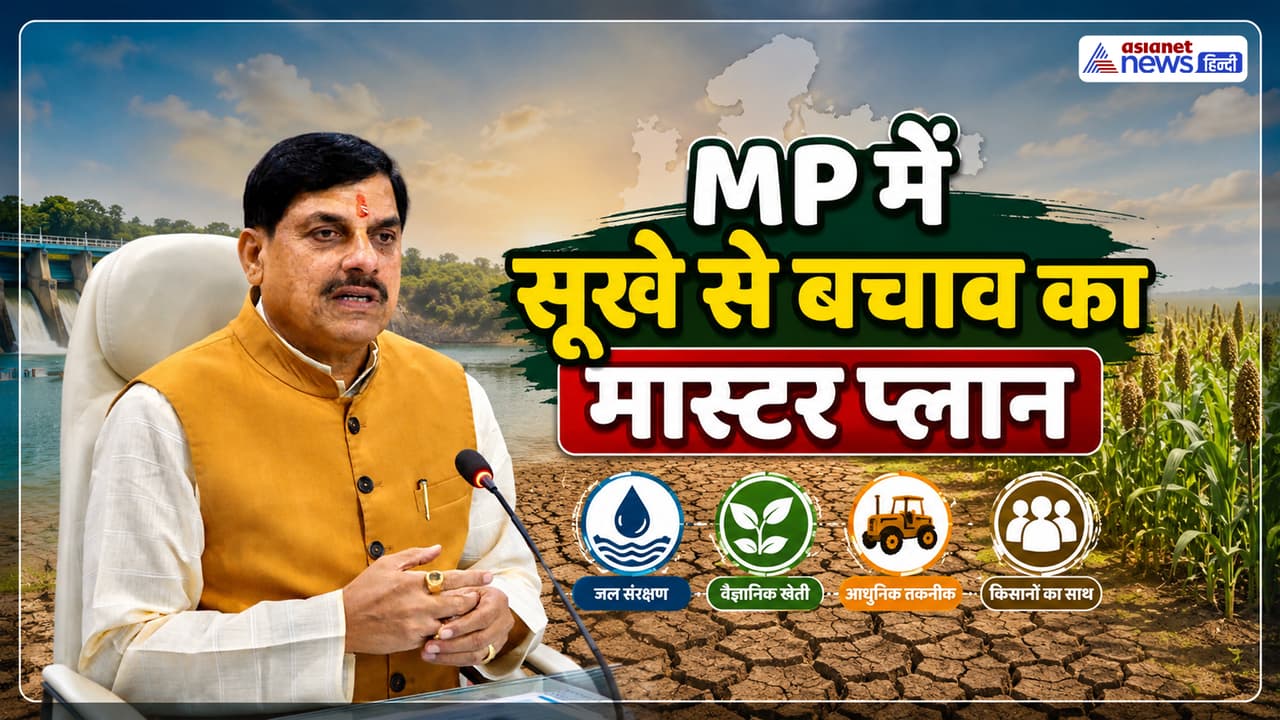
In view of the possible short rainfall, Chief Minister Dr. Mohan Yadav reviewed the agriculture, water and irrigation departments and gave instructions to implement scientific farming, water conservation and emergency action plan for the farmers.
Bhopal. In view of the possibility of possible short rainfall, Madhya Pradesh Chief Minister Dr. Mohan Yadav on July 2 reviewed the preparations of various departments including farmer welfare and agricultural development, water resources, horticulture, animal husbandry, fisheries, cooperation, public health engineering in the ministry. In the meeting, he said that the possibility of less rainfall should be considered as an opportunity for better planning, scientific farming and timely preparation rather than a crisis. He directed all the departments to work with mutual coordination and provide necessary information and guidance to the farmers on time, so that there is no negative impact on agricultural production and farmers’ income.
Farmers will be motivated for scientific farming and less water-intensive crops.
Chief Minister Dr. Mohan Yadav said that the priority of the government is that every farmer of the state can face the challenges of weather scientifically and with proper preparation. He asked the officials to make farmers aware about such crops which require less water and which are ready in less time. He laid special emphasis on adopting coarse cereal and pulse crops like jowar, bajra, urad, moong, tur, kodo and kutki. He said that these crops give good yields even with less water and can prove to be economically beneficial for the farmers.
Do not hurry in sowing, do farming only after sufficient moisture.
The Chief Minister directed to advise the farmers not to sow before sufficient moisture is created. Along with adopting moisture conservation measures in the fields, maximum use of improved varieties and modern agricultural techniques which give higher production in a shorter period should be made.
He said that the advice of agricultural scientists and experts should be effectively conveyed to the farmers, so that the right crop can be selected according to the local conditions. For this, emphasis was also laid on making the agricultural extension system more active. The Chief Minister clarified that the state government is constantly monitoring the weather conditions and all possible technical and administrative assistance will be provided to the farmers.
Preparation to strengthen water conservation and water supply in two years
It was told in the meeting that after identifying alternative water sources in all the urban bodies of the state, a contingency plan for tanker supply will be prepared. Instructions have been given to complete water supply schemes on time under AMRUT 2.0. Under Jal Jeevan Mission in rural areas, every village will be reviewed and a 90-day special campaign will be run to repair closed or incomplete tap water schemes.
Under the ‘Jalabhishek 2.0’ campaign, old ponds, wells, stepwells and other water structures will be surveyed and renovated. With the help of MNREGA, a target has been set to revive at least 100 water structures in each development block in the next two years.
Special focus will be on groundwater conservation and irrigation system
The government will carry forward the construction of recharge shafts, check dams, stop dams and farm-ponds in all development blocks in mission mode. Special work will be done on the concept of “farm water in the field and village water in the village”. Along with this, instructions have been given to complete the cleaning and repair of canals before the Rabi season and to fix the responsibility of delivering irrigation water to the last mile.
Low water farming and contingency crop plan ready at district level
It was informed in the meeting that low water crops like pulses, oilseeds and grains will be promoted. The system of procurement at their support price will also be strengthened. Separate contingency crop plans are being prepared for each district along with promotion of Direct Seeded Rice (DSR) and alternative wet-dry irrigation method in paddy growing areas.
Clear protocol will be decided for operation of reservoirs
The government will ensure that rules and regulations are followed in the operation of all major reservoirs including Indira Sagar, Omkareshwar, Bansagar and Gandhisagar. The priority for water use will be drinking water, followed by irrigation and finally power generation. Apart from this, real-time water dashboards will be prepared at the state level, so that reservoirs and water resources can be continuously monitored. Public participation programs will also be conducted on the lines of “Jal Ganga Augmentation” campaign. In each district, a separate contingency plan will be prepared under the chairmanship of the Collector to deal with the water crisis.
Information will reach farmers through crop insurance, digital survey and social media.
It was told in the meeting that under RBC 6(4), joint training of officials of Revenue, Agriculture and Panchayat Department for crop damage survey will be completed in advance. A target has been set to complete the survey within 15 days by assessing the damage through digital crop survey and satellite imagery.
Action is also being taken to expand the scope of crop insurance and ensure speedy settlement of claims. State level emergency action plan has been uploaded on the departmental portal. Targets of improved seed distribution, crop demonstration and rain water conservation under Balram Talab Yojana have been given to the districts.
The government will continuously provide weather forecast, farming advice and necessary information to farmers through social media and other means. Instructions have also been issued to collectors of all districts to regularly review the situation of irrigation, waterlogging, availability of electricity for life-saving irrigation and drought. Contingency action plans were also discussed in detail in the gram sabhas held between June 26 and 30.