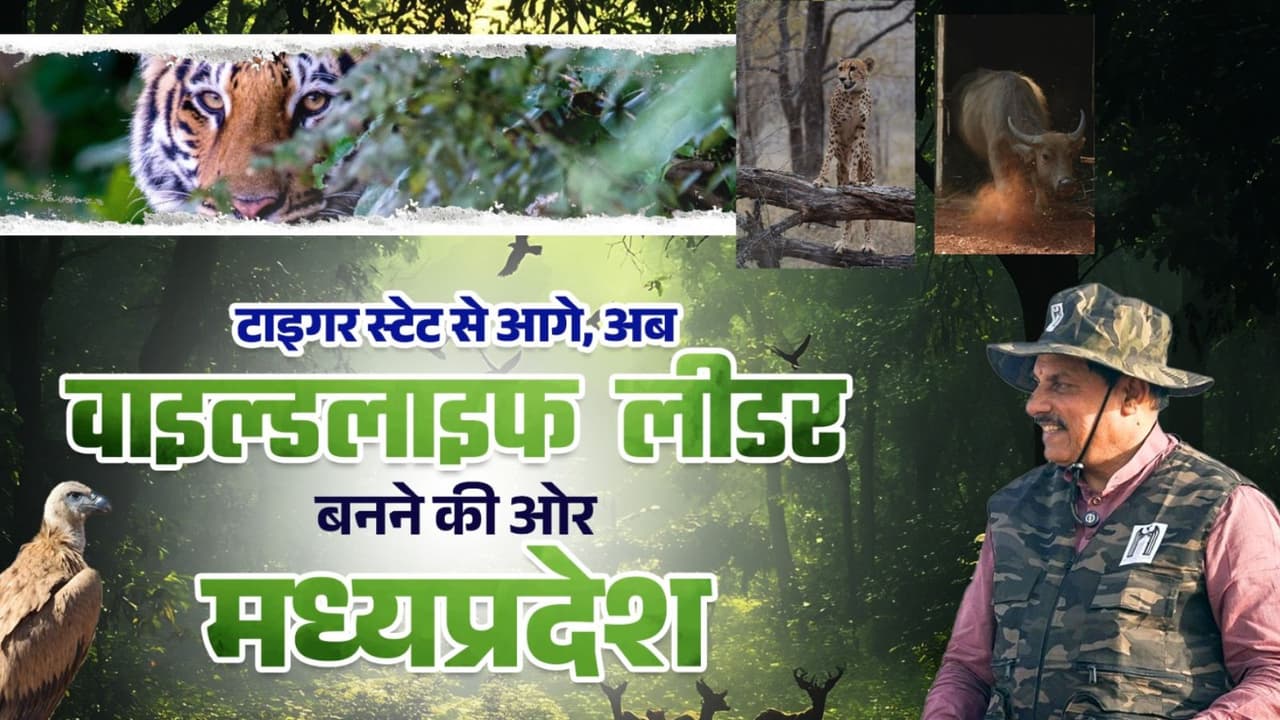
Chief Minister Dr. Mohan Yadav will be on a visit to Kuno National Park on May 10-11, where he will release two female leopards brought from Botswana into the wild. Since becoming the Chief Minister, Dr. Yadav has given a new direction to wildlife conservation.
Bhopal. Madhya Pradesh Chief Minister Dr. Mohan Yadav, who is committed to environmental protection, will visit Kuno National Park located in Sheopur district on 10-11 May. During this time, they will release two female leopards brought from Botswana from their enclosure in the forest area. In this way, Madhya Pradesh has once again proved that if political will, scientific approach and conservation-sensitive leadership come together, then wildlife conservation can become not just a government scheme but a people’s movement. Under the leadership of Chief Minister Dr. Yadav, the state is progressing rapidly in the field of wildlife conservation. In this area, the state seems to be becoming a model for the entire country.
It is noteworthy that, after taking oath as the Chief Minister in December 2023, Dr. Mohan Yadav did not consider wildlife conservation only as an environmental issue, but linked it to cultural heritage, biodiversity, tourism and rural economy. This is the reason why unprecedented decisions were taken in Madhya Pradesh in the last one and a half years. The biggest decision was to declare Ratapani Tiger Reserve as the 8th tiger reserve of the country and the new tiger reserve of the state. Despite getting permission from the National Tiger Conservation Authority in the year 2008, this proposal remained pending for about 17 years, but it was approved during the tenure of Chief Minister Dr. Yadav. Not only this, conservation was also linked to cultural pride by naming it after archaeologist Vishnu Shridhar Wakankar, who discovered the World Heritage Site Bhima Baithaka. The biggest feature of Ratapani is that it is the first tiger reserve in the country, which is located closest to the capital of a state. This is likely to give a new direction to both conservation and eco-tourism.
Madhav Tiger Reserve: Initiative to reduce human-wildlife conflict
In March-2025, Madhav Tiger Reserve was declared the 9th tiger reserve of the state. The construction of a 13 km long security wall here is being seen not just as an infrastructure project but as a practical strategy to reduce human-wildlife conflict. Wildlife experts believe that the biggest challenge to conservation in India is no longer hunting, but increasing conflict between humans and wildlife. In such a situation, this initiative is being considered as a step taken keeping in mind the future needs.
Leading the country in vulture conservation, Madhya Pradesh has emerged as the biggest center in the country for the return of vultures which were once on the verge of extinction. Today, more than 14 thousand vultures are present in the state, which is the highest in the country. In collaboration with Bombay Natural History Society and Van Vihar National Park, a rescue center for injured vultures is being run in the Kerava area of Bhopal. Recently, a vulture freed by the Chief Minister has completed a long flight to Uzbekistan, which is considered a symbol of the success of this conservation campaign.
Global Conservation Laboratory Work being done in Kuno National Park
Today it is in the eye of conservation scientists all over the world. After the success of ‘Project Cheetah’, the number of cheetahs here has reached 57. The return of cheetahs to India after decades has given the message that rehabilitation of extinct species is possible if there is proper scientific management and political commitment. Now work is going on to develop Kuno as a global breeding centre. Along with this, Gandhi Sagar Wildlife Sanctuary is being developed as the second habitat of cheetahs and Nauradehi Wildlife Sanctuary is being developed as the third big cheetah landscape. The bhoomi pujan of soft release Boma construction in Nauradehi is being considered as the beginning of the next phase of this project.
New Sanctuaries: The Expanded Geography of Conservation
The government of Chief Minister Dr. Mohan Yadav also took swift decisions towards expanding forest areas and giving legal protection to sensitive biodiversity areas. In April 2025, 258.64 square kilometer area in Sagar district was declared Baba Saheb Dr. Bhimrao Ambedkar Wildlife Sanctuary. Apart from this, two new wildlife sanctuaries were approved in Omkareshwar and Jahangarh. These decisions are not limited to just adding new protected areas, but are also being considered as the foundation of future wildlife corridors and biodiversity protection networks.
Tapti becomes the first conservation reserve of the state
Declaring Tapti area as the first conservation reserve of Madhya Pradesh in August 2025 is also an important achievement. The presence of rare species like tiger, leopard, bison and wild dogs in this area of Betul district makes it extremely vulnerable. According to experts, the Conservation Reserve Model is considered a modern way of establishing a balance between the local community and conservation.
Focus on conservation of alligators, crocodiles and turtles
National Chambal Sanctuary is considered to be the largest refuge of crocodiles in the world. Recently, crocodiles and turtles were released in the Kuno river by Chief Minister Dr. Yadav, while a special initiative has also been started to increase the number of crocodiles in the Narmada river. The release of crocodiles in Omkareshwar area is being considered an important step towards re-balancing the eco-system of Narmada.
Return of extinct wild buffaloes: Settlement of wild buffaloes brought from Kaziranga National Park in Kanha Tiger Reserve is being considered as a historic chapter in the conservation history of Madhya Pradesh. This is not just species rehabilitation, but an effort to bring back lost biodiversity.
Elephant conservation: from conflict to coexistence
The state government has approved a comprehensive scheme worth over Rs 47 crore to conserve elephants and reduce human-elephant conflict. Steps like the ‘Hathi Mitra’ scheme, radio tagging, solar fencing and the state-level elephant task force indicate that Madhya Pradesh is now moving towards a scientific and long-term management model rather than merely reacting post-crisis. Especially increasing the compensation amount from Rs 8 lakh to Rs 25 lakh is being considered an important decision towards increasing social acceptance towards wildlife conservation.
Tiger Corridor: Future Conservation Model In wildlife conservation, merely creating reserves is no longer considered sufficient, but ensuring safe movement between them is the biggest challenge. Under this thinking, work is going on on the Mega Tiger Corridor project worth more than Rs 5500 crore connecting Kanha, Bandhavgarh, Panna and Pench in Madhya Pradesh. The underpass and overpass being built in the Itarsi-Betul section on NH-46 are being considered an example of future ‘wildlife friendly infrastructure’.
Special route for wildlife conservation
To prevent the death of wildlife due to road accidents, various experiments are being done in the Tiger Reserve, such as ‘Red Blocks’ have been made by NHAI on the two kilometer road on the National Highway passing through Veerangana Durgavati Tiger Reserve to prevent accidents involving vehicles of wildlife. These are called ‘table top marking’. While passing through it, light shocks are felt due to which the speed of vehicles remains controlled. Soundproof Corridor – The 12 kilometer stretch of the highway passing through the forests of Ratapani Tiger Reserve has been designed as a completely soundproof corridor. 7 underpasses have been built for wildlife during the 12 km stretch. There is lush green forest all around and 3-3 meter high boundary walls have been built on both sides of the road, which are completely sound proof. Such innovations serve to balance wildlife conservation with modern development.
From conservation to employment, the most positive aspect of wildlife conservation was that it also benefited the local economy. Project Cheetah, Tiger Reserve expansion and eco-tourism activities have given new impetus to employment and tourism in rural areas. Today Madhya Pradesh is creating its new identity not just as a “Tiger State” but as a holistic wildlife conservation model. And at the center of this change is the thinking of linking conservation with development, culture and local participation, which has given the state a new identity at the national level.