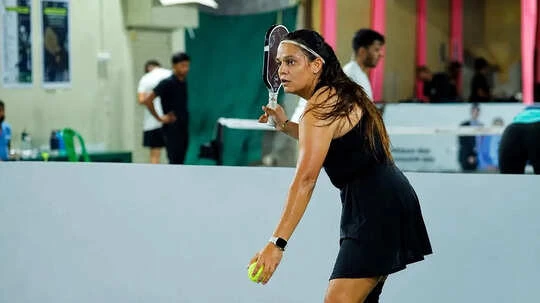
The scale of pickleball’s rise in Kolkata is becoming harder to ignore, and for players on the circuit, the shift is visible from one tournament to the next.
At the ongoing Kolkata Open, larger draws, tighter matches and a noticeable increase in women’s participation have pointed to a sport that is moving beyond early adoption and into a more competitive phase. The change is not just in numbers but in quality, with new players entering regularly and pushing standards across categories. For Shreya Chakraborty, who has been part of this growing circuit over the past several months, the transformation reflects a broader trend in Indian pickleball, where structured tournaments, clearer pathways and exposure to higher levels are beginning to shape player development.
“I think every day coming out here, it’s a change. It’s growing and it’s great to see how many people have turned up for this tournament and to see so many women come out. That’s something we’ve always spoken about, especially for Kolkata, and we’re seeing more women come out and that’s great to see,” she said.
Chakraborty, who has been active on the circuit for the past few months, said the pace of change has been consistent across events.
“I have played for the last maybe eight to nine months and since I’ve come, every tournament I go, there’s a change. It’s always growing. There are a lot of positive vibes, a lot of competition, new players coming in and the competition is rising. It’s great to be a part of that,” she said.
The increasing depth in the field has also made even mid-tier tournaments competitive. “It’s competitive. The mixed doubles out here is pretty tough. The groups are tough and qualifying itself is very difficult. It’s obviously not the same as PWR 700 or 1000 because of the number of entries, but the level of play is the same, if not more,” she said.
Chakraborty credited the emergence of younger players for raising standards. “Younger players like Aditya and Arjun are doing great. They are examples and there’s a lot to learn from them. At such a young age, they are doing wonders for the country,” she said.
She also pointed to improved structure in Indian pickleball, with more tournaments and clearer progression pathways. “I think IPA, with Surya B Sir, Aditya Khanna and the team, are doing a fabulous job. With so many events happening, we now have a better pathway. And with pickleball being added to the Olympics, it’s definitely something to look forward to. Indian players are working towards that goal,” she said.
While participation and competition have improved, Chakraborty said infrastructure in Kolkata is still developing. “I think this is a good infrastructure for a PWR 400, but obviously it can be bigger. We’ve seen bigger setups in Hyderabad and Bombay. For Calcutta, I think we are going in the right direction. Maybe it will take a few more months to get to that level,” she said.
She added that the city has the potential to host larger events if investment follows. “I’m sure there are venues. It’s just about the right people coming forward and building them. I’m sure the West Bengal Pickleball Association is working towards it. Hopefully, we’ll have a big facility here as well,” she said.
Chakraborty also backed the idea of Kolkata having representation in the Indian Pickleball League. “Definitely. It’s always great to play in such a big league and have a team representing your city. Hopefully we do have a team this year,” she said.
Drawing from her experience in the league, she said exposure to international players has helped shape her approach. “It was a pleasure to share a court and train with Megan Fudge. One of the biggest things I learned from her is the amount of time she puts on court. Regardless of whether she has a match or is jet-lagged, the effort she puts in on the court and in the gym is very important if you want to take your game to the next level. Just drilling, drilling,” she said.
Preparation, she added, remains key in managing long tournament days. “Before a tournament, I like to be on court for a couple of hours and spend at least an hour to an hour and a half in the gym. We have long days that start early and go on till late, so recovery is also very important. Right before tournaments, it’s important to drill a lot, get with your partner, play some games and go from there,” she said.
For Kolkata, the direction is clear. The numbers are rising, the competition is tightening and the foundations, while still evolving, are beginning to take shape.