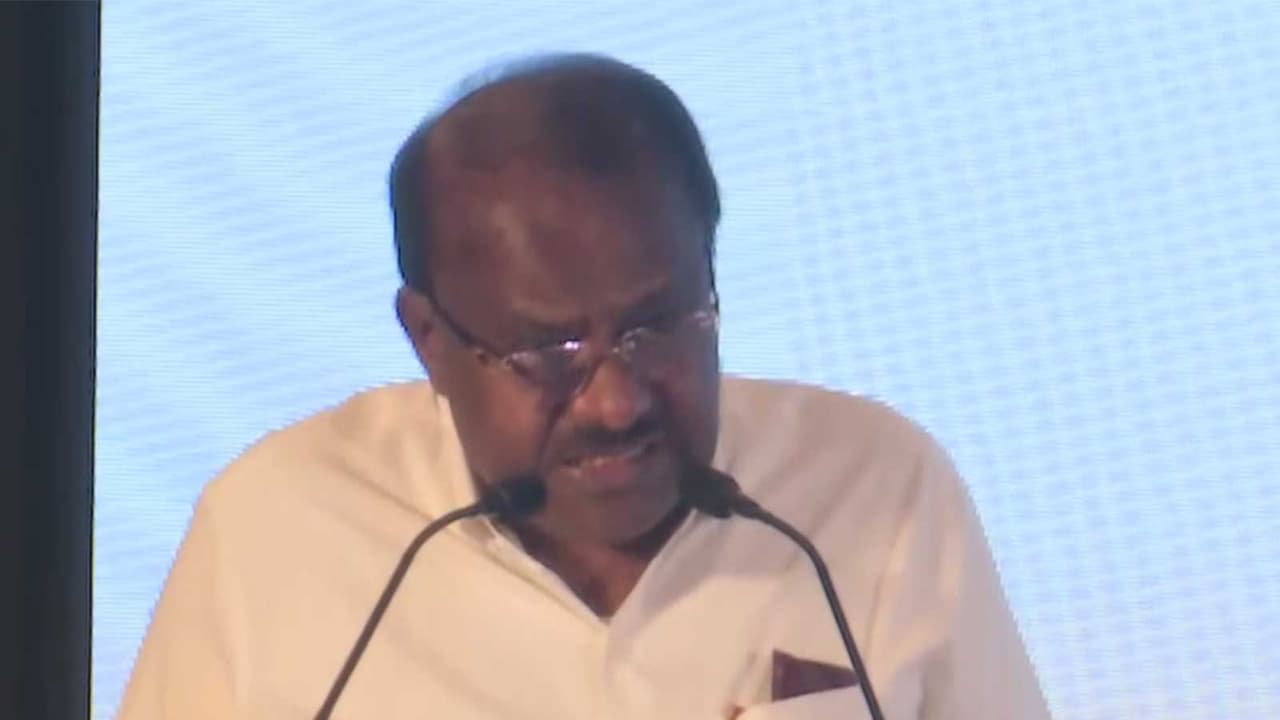
Union Minister HD Kumaraswamy urged the auto industry to adopt a broad-based, human-centric approach. He highlighted record sales, the success of government schemes like PM E-DRIVE and PLI, and the sector’s role in creating livelihoods.
Union Minister for Heavy Industries and Steel H D Kumaraswamy on Tuesday urged the automobile industry to keep its growth broad-based, ensure a human-centric transition and place the Indian customer at the centre of decision-making.
“Let us keep the growth broad-based, keep the transition human and keep the Indian customer at the center of every decision we take,” Kumaraswamy said while addressing the 8th Auto Retail Conclave organised by the Federation of Automobile Dealers Associations (FADA).
Kumaraswamy said India’s mobility story was no longer confined to a few cities or segments and was expanding across vehicle categories, powertrains, regions and income groups. “India’s mobility story is no longer the story of a few cities or a few segments. It runs across two wheelers and tractors, across petrol, diesel, CNG, and electric, across metropolitan India, and district India, and across every income group,” he said.
He said such broad-based mobility growth reflected the policy direction of the government under Prime Minister Narendra Modi, guided by the principle of “Sabka Saath, Sabka Vikas, Sabka Vishwas, Sabka Prayas”.
Record-Breaking Retail Sales
According to FADA data, India’s automobile retail sales reached a record 2.97 crore vehicles in FY2025-26, registering 13.30 per cent growth over the previous financial year. Five of the six vehicle categories recorded fresh annual records.
Kumaraswamy said tractor retail sales crossed 10 lakh units for the first time, while commercial vehicle retail sales crossed the 10-lakh mark, returning above that level for the first time since FY2018-19.
Government Initiatives Bolstering Growth
Push for Electric Mobility
The minister also highlighted the government’s push for electric mobility through the PM E-DRIVE scheme, which has an outlay of Rs 10,900 crore. He said the scheme had supported the sale of more than 26.5 lakh electric vehicles.
Boosting Domestic Manufacturing
On domestic manufacturing, Kumaraswamy said the Production Linked Incentive (PLI) Scheme for Automobile and Auto Components, with an outlay of Rs 25,938 crore, has 82 approved applicants and attracted cumulative investment of more than Rs 44,326 crore, generating close to 68,000 jobs.
He said incentives had been extended to more than 30.6 lakh vehicles, with benefits available only to products achieving a minimum of 50 per cent domestic value addition. “This is not import substitution on paper. It is value being created in India,” Kumaraswamy said.
Manufacturing’s Role in Viksit Bharat
The minister said manufacturing would have to remain at the core of India’s economic strength as the country moves towards Viksit Bharat 2047, but added that manufacturing alone could not build prosperity. “It must reach the household,” he said.
Automobile Retail: A Livelihood Engine
Kumaraswamy also highlighted the role of India’s automobile retail network in creating livelihoods across the country. He said the sector has around 15,000 dealerships and more than 30,000 outlets, supporting approximately 50 lakh livelihoods and providing employment opportunities close to people’s districts and families.
“That is inclusive development in its truest form,” he said.
The Road Ahead: ‘Bharat is in the Driver’s Seat’
The minister congratulated FADA on the release of the FADA Digest 2026 and said studies of this kind strengthen the entire automobile value chain.
“Bharat is indeed in the driver’s seat,” Kumaraswamy said, adding that the sector should ensure that its growth remains broad-based, its transition remains human and the Indian customer remains at the centre of decisions. (ANI)
(Except for the headline, this story has not been edited by Asianetnews Editorial staff and is published from a syndicated feed.)