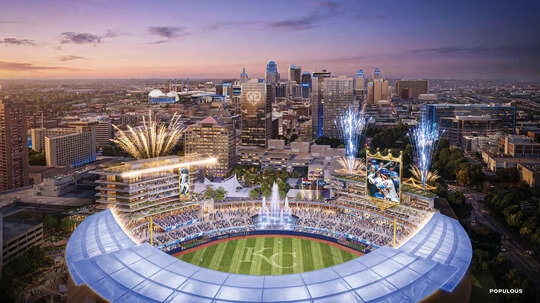
KANSAS CITY, Mo. (AP) – The Kansas City Royals will relocate from Kauffman Stadium to the Crown Center area, partnering with Hallmark Cards on a $3 billion redevelopment initiative featuring a new ballpark at its core.
Royals owner John Sherman announced the project Wednesday, joined by Hallmark chairman Don Hall Jr., Missouri Governor Mike Kehoe, and Kansas City Mayor Quinton Lucas, among other local and state officials.
Details of the New Stadium
Although the final master plan is still in progress, Sherman indicated that the $1.9 billion stadium is set to break ground next year as part of the initial phase of an 85-acre project. Approximately two-thirds of the funding will be sourced from private investments, with the remaining one-third derived from public partners, including state funds allocated for stadium developments.
Community and Economic Impact
During the announcement, Sherman emphasized the collaboration between the two institutions, stating, “We are committed to creating a vision which honors our history, the rich past of both organizations, while reinvigorating and reimagining what our future can be together.”
The announcement follows a recent ordinance passed by Kansas City officials, allowing City Manager Mario Vasquez to negotiate a $600 million deal to facilitate the Royals’ downtown move. Although there were initial expectations for the stadium to be situated on Washington Square Park, it will instead be located just south of the park, which will be incorporated into the overall development.
Infrastructure and Transportation
Hallmark plans to establish a new headquarters in the area, which is conveniently connected by a streetcar to the Power & Light District, where the T-Mobile Center is located. This segment of downtown Kansas City will serve as a picturesque backdrop beyond the stadium’s outfield fence.
Officials highlighted the availability of public parking and efficient traffic flow from nearby highways as advantageous factors for the new stadium’s location.
Funding and Financial Considerations
Missouri’s financial contribution stems from legislation enacted last year, which allows for bonds to cover up to 50% of the costs associated with new or renovated stadiums in the state. This includes up to $50 million in tax credits for each stadium, along with unspecified support from local governments.
Governor Kehoe remarked, “We think it’s a great investment for our Missouri taxpayers, because this does not affect existing programs. The ripple effect from this facility will truly be far-reaching into rural Missouri and other parts of the state.”
Future Plans and Challenges
The Royals have maintained that they will vacate Kauffman Stadium once their lease expires at the Truman Sports Complex in 2031. Since acquiring the team in 2019, Sherman has expressed a commitment to establishing a new downtown ballpark as a replacement.
However, the path to this announcement faced significant hurdles. Notably, a joint renovation proposal for Arrowhead Stadium and Kauffman Stadium faltered when Jackson County voters rejected a sales tax extension that would have funded the project.
In addition, the Chiefs pursued a $2.4 billion bond plan for a new domed stadium in Kansas City, Kansas, ultimately deciding to relocate across the state line, which included plans for a new training facility in Olathe, Kansas.
While there was some interest in the Royals from Kansas officials, their engagement with the MLB team remained lukewarm. The Royals evaluated various options before ultimately rejecting a proposal in Overland Park, Kansas, and allowing a deadline to pass for a site in Clay County, Missouri.
Economic Perspectives
Experts have long debated the economic viability of subsidizing stadiums, often arguing that such investments do not yield a net benefit for local communities, as they tend to redirect economic activity rather than expand it. Despite this, public funding for stadium renovations and constructions remains prevalent, with a majority of MLB and NFL stadiums being publicly owned or located on public land.
As an illustrative example, Sherman cited Truist Park in Atlanta, which was developed through a public-private partnership that included significant contributions from various stakeholders, culminating in a total cost exceeding $1.1 billion.
“There are many great ballpark neighborhoods in Major League Baseball,” Sherman noted, “but this is a bigger project with more land in downtown and in the heart of the city. We are bringing a modern, state-of-the-art ballpark experience to our fans, closer to our public transportation and where more people work and live.”