Iran has suffered a loss of more than Rs 4 thousand crores every day due to the American blockade.
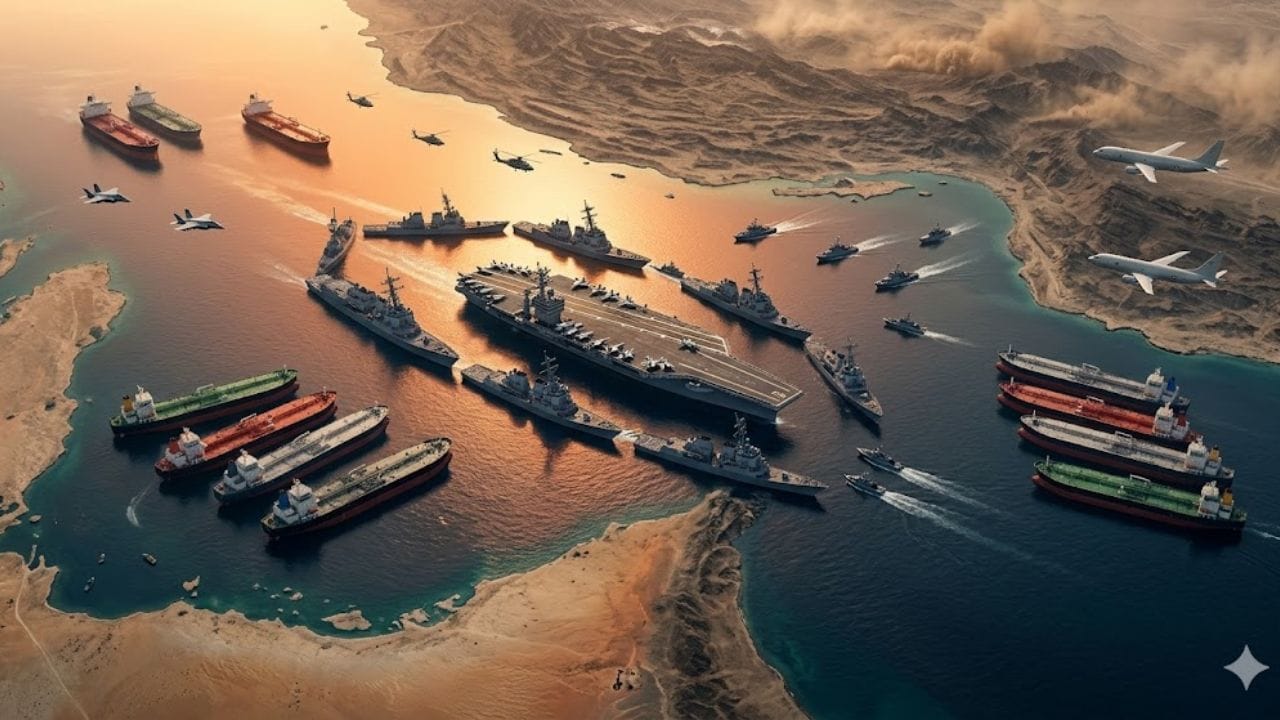
US President Donald Trump is now planning to completely break Iran economically. According to a report in the Wall Street Journal, the US blockade targeting Iranian ports located along the Strait of Hormuz could cause economic losses to Iran of up to $435 million, or approximately Rs 4,081 crore, every day. This situation has arisen when tension between Tehran and Washington is increasing under the leadership of US President Donald Trump. The blockade, which Trump said began on Monday, is expected to disrupt the flow of crude oil, fertilizer, food and other essential goods, potentially adding to inflationary pressures.
How much Iranian oil is in the sea?
Wall Street Journal analysts said the actual scale of the damage would depend on a number of factors, including how effectively the US enforces the blockade and whether Iran can reroute its exports through the Jask terminal outside the Strait of Hormuz. In the near future, this impact may be mitigated to some extent by Iranian oil already in transit. Kpler data shows that as of the end of March, Iran had about 154 million barrels of crude oil held outside the Gulf region affected by the blockade.
Estimate of daily loss of Rs 4000 crore
Miyan Maleki, a former official at the US Treasury Department’s Office of Foreign Assets Control, told the Wall Street Journal that the US blockade of Iran’s ports would cost Iran about $435 million in economic losses every day. He estimated that about $276 million of this would be lost due to reduced exports, mainly crude oil and petrochemicals. Maleki’s calculations are based on the assumption that Iran exports 1.5 million barrels of oil per day, which has a wartime price of about $87 per barrel. Also, more than 90 percent of the consignments are usually sent via Kharg Island located in the Persian Gulf.
This threat of blockade came after ceasefire talks failed over the weekend. Iran had previously restricted the movement of tankers through the Strait of Hormuz, allowing only select ships considered ‘friendly’, and also imposing heavy transit fees. The US strategy aims to exert maximum economic pressure on Iran by blocking the flow of energy revenues, without resorting to direct military action.
The challenge before the US is no less
Implementing this blockade remains a difficult challenge. According to a report by the Associated Press, while on the one hand about 16 US warships are deployed in the Middle East, on the other hand no ship is currently deployed inside the Persian Gulf, which is a large part of Iran’s maritime border. A notice issued to seafarers said access to Iranian ports was being restricted, but operational details of how these measures would be implemented were still “in preparation”.
The sheer scale of maritime traffic makes the task of enforcing this blockade even more complex. In peacetime, approximately 20 percent of the world’s oil trade passes through the Strait of Hormuz, making it one of the world’s busiest shipping routes. Siddharth Kaushal said that a lot will depend on the initial days of this blockade—such as how many ships the Americans are able to seize and how effectively they are able to stop others. “There is every possibility that it will prove difficult for America to implement it.”
Iran has suffered a loss of 270 billion dollars
Additionally, according to Iranian state television Al-Alam Arabic, Iran’s total war-related losses have been estimated at approximately $270 billion. An Iranian official said that one of the issues on which our negotiating team is working, and which were also discussed in the Islamabad talks, is war reparations. Damage usually has to be investigated at several levels. The loss caused to Iran due to the attacks by America and Israel has currently been estimated at about 270 billion dollars.
Iran has also intensified its diplomatic efforts for compensation. According to state news agency IRNA, Iran’s Ambassador to the United Nations, Amir Saeed Iravani, has appealed to Bahrain, Saudi Arabia, Qatar, UAE and Jordan to pay compensation to Tehran. He has alleged that during the conflict, these countries had allowed America and Israel to use their territories.