Solar Defence’s indigenous counter-drone system ‘Bhargavastra’ will complete trials in 2-3 months, says Chairman Satyanarayan Nuwal. He is confident it will lead to the development of the ‘Sudarshan Chakra’ air defence system by 2030.
Chairman of Solar Defence and Aerospace Ltd (SDAL), Satyanarayan Nuwal, said on Friday, that indigenous counter-drone system ‘Bhargavastra’ will complete its internal trials within the next two to three months, expressing confidence that the technology would pave the way for the development of the ambitious “Sudarshan Chakra” air defence system by 2030.
Successful Trials and Demonstration
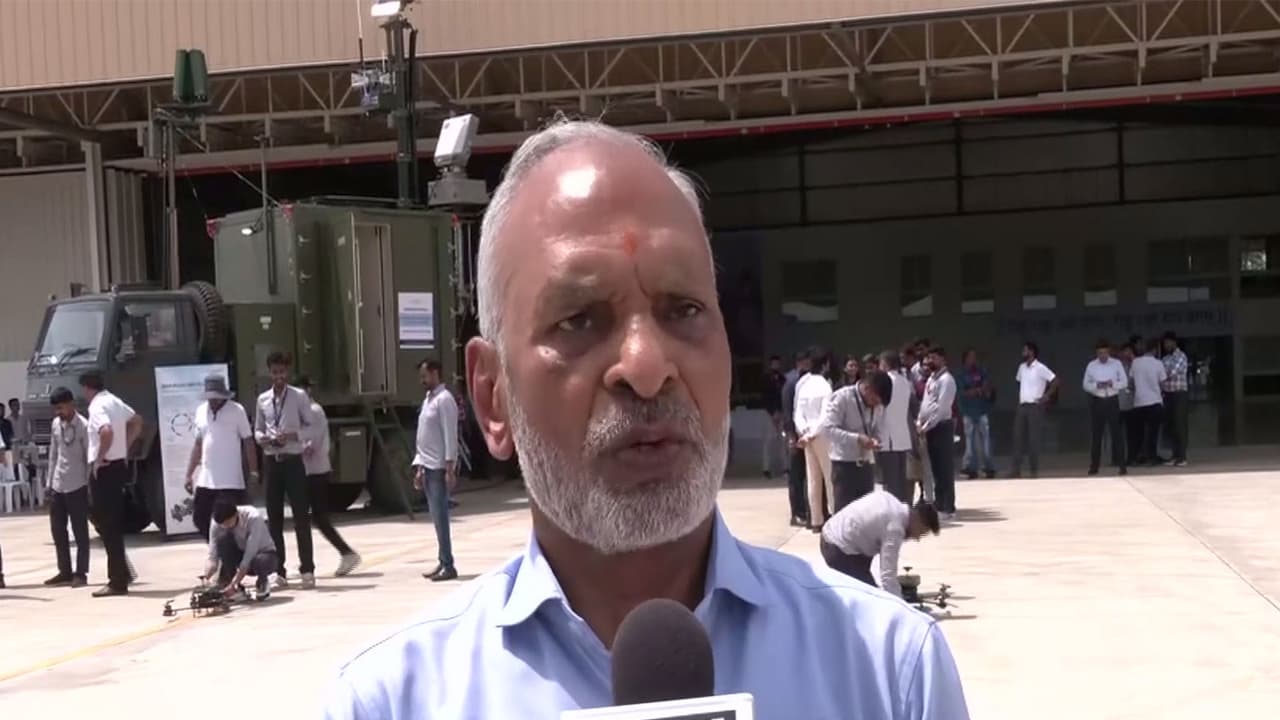
Speaking after the demonstration of the indigenous, vehicle-mounted, multi-layered Counter-Swarm Drone System in Nagpur, Nuwal said the integrated system had already undergone several successful component trials and was progressing towards the next stage of evaluation.
“This entire system is complete in itself. We will complete its internal trials in 2-3 months. Officers from the Navy had come yesterday, and now Army officers have seen this. We had already tested the micro-missile in Balasore and Pokhran. Today, we also tested the radar, electro-optics control system and missile. We have the complete system, and trials have also been done,” Nuwal told ANI.
Advanced Technical Capabilities
He said the system’s radar can detect aerial threats up to 10 kilometres, while the Electro-Optical Tracking System (EOTS) has a range of six kilometres, exceeding the Army’s current operational requirement of 2.5 kilometres.
“Radar has a range of up to 10 km and the EOTS is six kilometres. As per the Army’s requirement, its range is up to two and a half kilometres, but we have already started making this six-kilometre missile,” he said.
Foundation for ‘Sudarshan Chakra’
Expressing confidence in India’s indigenous defence capabilities, Nuwal said Bhargavastra would serve as the foundation for a larger multi-range air defence programme.
“Whatever the Prime Minister had envisioned and dreamed about Sudarshan Chakra, I believe that, whether it is DRDO or any other agency working on it, on the basis of this Bhargavastra, I can say with confidence that by 2030 we will be completely successful in making Sudarshan Chakra with ranges of 2.5 kilometres, 6 kilometres and 25 kilometres,” he said.
System Architecture and Integration
Developed entirely in India, Bhargavastra is designed to counter weaponised drones, loitering munitions and autonomous drone swarms through a layered engagement architecture using indigenously developed unguided rockets and precision micro-missiles.
The system is integrated with an advanced Command, Control, Communication and Intelligence (C4I) architecture featuring radar, Electro-Optical/Infrared (EO/IR) sensors and passive RF detectors, enabling detection, tracking and engagement of multiple drone threats. An Indian Army team visited SDAL’s Nagpur facility on Thursday as part of a status review under the Make-II programme. During the demonstration, SDAL flew a swarm of drones that were successfully detected by the radar, EO/IR and RF sensors, while the C4I system generated a real-time air situation picture and assigned targets to the launcher. Actual rocket firing was not carried out at the facility due to safety considerations. (ANI)
(Except for the headline, this story has not been edited by Asianetnews Editorial staff and is published from a syndicated feed.)