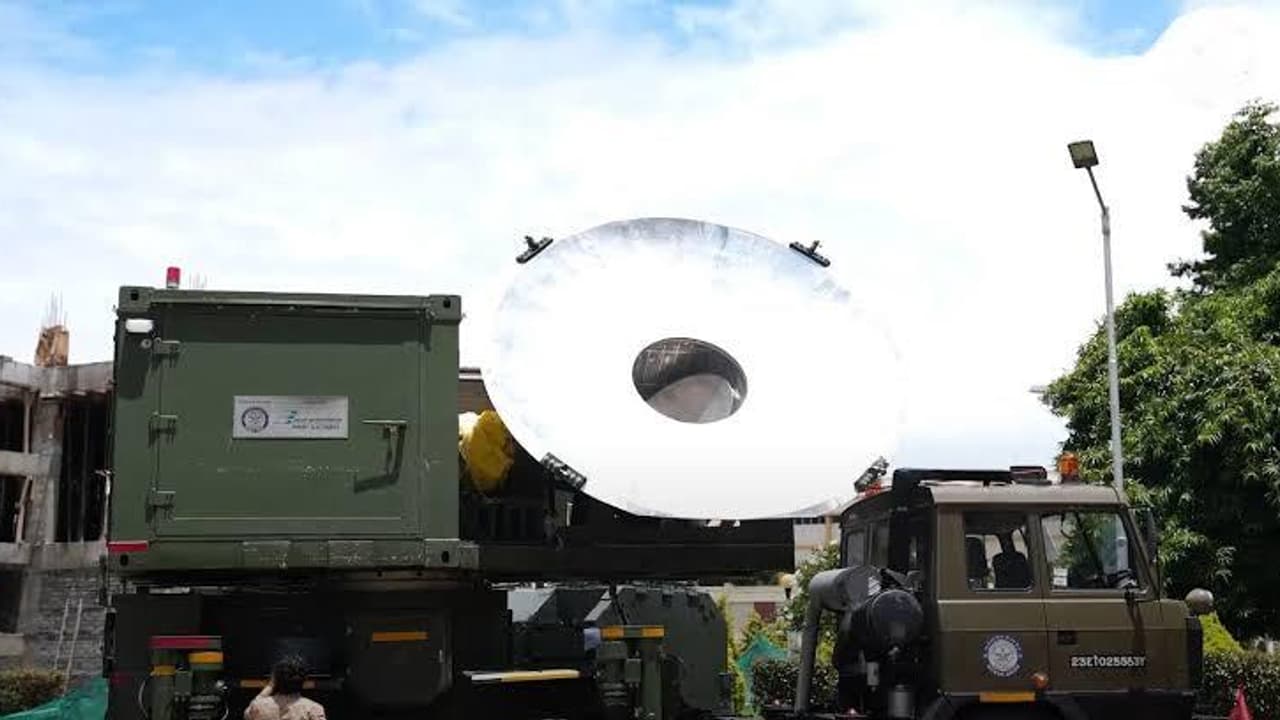
DRDO has launched the SHIELD initiative under the Technology Development Fund to build an indigenous S-band High-Power Microwave evaluation system. Utilizing Gallium Nitride amplifiers, SHIELD tests electronic vulnerabilities against microwave attacks, enabling India to harden radars, aircraft, and drone defenses against directed-energy threats.
In an Indian laboratory, a powerful microwave lamp will be switched on. Small electronic brains placed in front of it will freeze, restart, or die. That is the whole point. Before India can protect its radars, command posts and aircraft from a microwave attack, it must first create that attack on purpose, measure it honestly, and learn from it.
That idea is called SHIELD — the S-band High-Power Microwave Integrated Evaluation System for Lethality and Damage. DRDO has asked Indian companies to build it under the Technology Development Fund: here is the problem, invent the machine in India. The Fund is meant for Indian firms, especially small companies and startups, so this hardware is made here rather than bought abroad.
What is a high-power microwave?
A kitchen oven uses a few hundred watts of the same waves that carry Wi-Fi and radar to heat food. An HPM system takes that idea and makes it fierce, throwing much stronger pulses through open air. When the field over a target becomes large enough, a chip gets confused, a computer restarts, or the electronics are ruined. Soldiers call this a soft kill. The drone may look unhurt, but its radio, camera and flight computer have stopped thinking. Against a swarm this matters: a laser must stare at one drone until it burns, while one microwave pulse washes over several at once.
Why S-band?
That is the slice of radio from about 2 to 4 gigahertz. It is a crowded neighbourhood: home Wi-Fi, some satellite phones, airport radars, and the remote-control links of cheap drones. If energy arrives at a frequency a device already uses, it slips more easily into antennas and cables. So this test machine asks a blunt question: if a real attack came in this band, which box would stumble, which recover, and which never wake again?
The key number is a peak electric field of at least 3 kilovolts per metre, measured at a distance where the beam has settled, not right at the antenna. Imagine 3,000 volts stretched across a one-metre stick. That is huge next to the faint field around a phone. It is still a laboratory strength, used to study weakness, not the fiercer field of a finished weapon beside its target.
The machine will fire in short bursts. Engineers call the on-and-off pattern the duty cycle — the fraction of time the transmitter is actually shouting. Keep that fraction low and the heat stays under control, while each burst hits like a hammer. Without cooling plates and heat sinks, the chips inside would overheat and fail.
The heart of SHIELD is a Gallium Nitride solid-state amplifier. Older high-power machines used vacuum tubes such as magnetrons and klystrons, which still produce enormous bursts. DRDO’s own S-band prototype in Bengaluru is publicly described as peaking around 450 megawatts and knocking down small quadcopters at about one kilometre. Solid-state GaN is a different road: no long warm-up, instant start, blocks stacked like Lego, and if one chip fails the rest keep working. A huge tube weapon usually needs a truck. A GaN unit can be built small enough to hang under a drone, which is why the tender mentions drone mounting.
The most important line: SHIELD is not a battlefield gun. It is a measuring instrument. Scientists will use it to see how badly a microwave field breaks radios, sensors, computers and flight controllers. India is already working on HPM weapons separately, including tests against swarms. What was missing is a repeatable bench — a standard lamp — against which shielding, cable layout, filters and spare computers are judged before they fly into a real fight.
A student with a physics book hears several chapters at once: how field strength falls with distance, why an antenna’s focus matters, why a chip dies when a sudden voltage punches through the thin layers inside that act like switches, and why cooling is half the job in high-power electronics.
For everyone else the meaning is simpler. Today’s wars are full of cheap flying computers. Shooting a missile at every small drone is a bill no country can keep paying. Directed energy offers a magazine made mostly of electricity. But no country can field such systems, or harden its own radars, unless it can first switch the threat on in a lab.
If SHIELD works, India will not only own a test machine. It will own people who can design these transmitters, handle violent bursts of power, keep dense electronics cool, and turn field readings into protection rules. The drone-mountable line points to the next chapter: lift this lamp off the workbench into the sky, where movement and the routes the energy uses to sneak into wires and antennas no longer look like a textbook — they look like war.
(Girish Linganna is an award-winning science communicator and a Defence, Aerospace & Geopolitical Analyst. He is the Managing Director of ADD Engineering Components India Pvt. Ltd., a subsidiary of ADD Engineering GmbH, Germany.)
Disclaimer: The opinions expressed are solely those of the author and do not reflect the views or stance of the organization. The organization assumes no responsibility for the content shared.