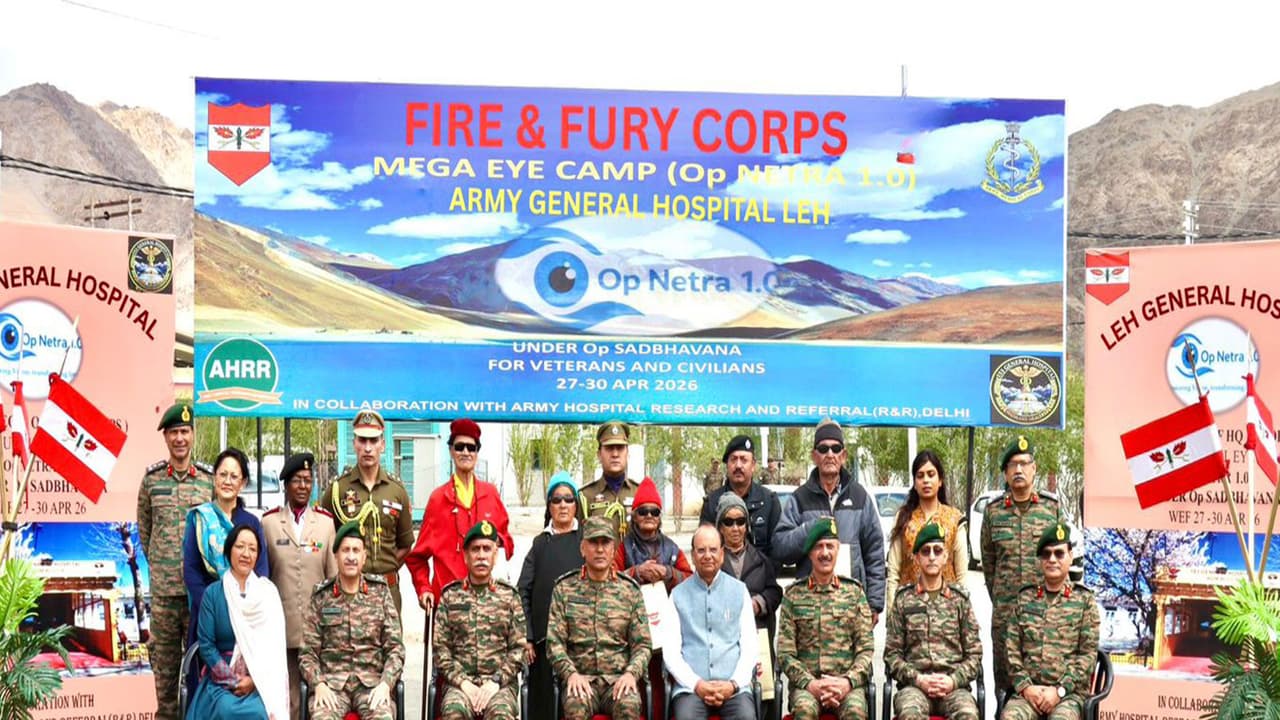
The Indian Army completed a four-day surgical eye camp in Leh, Ladakh, screening 950 patients and performing 214 specialized procedures. This civil-military mission restored sight for hundreds, including 15 who were completely blind.
A Landmark Civil-Military Mission
In a landmark triumph of medical logistics and humanitarian grit, the Indian Army successfully concluded a four-day Advanced Surgical Eye Camp at 153 General Hospital in Leh, Ladakh. This mission stands as a premier example of civil-military liaison, showcasing a seamless collaboration between top-tier government leadership and the armed forces to deliver essential services to the nation’s most remote and underprivileged borders.
The genesis of this impactful medical mission lies in a shared vision of service, which is applauded by the Defence Minister Rajnath Singh. The critical responsibility for executing and overseeing the mission’s completion was entrusted to Lieutenant General Pratik Sharma, the Northern Command Army Commander, highlighting the Indian Army’s commitment to delivering vital healthcare after the successful conduct of Operation Drishti in November 2025 at Command Hospital Udhampur, according to a release.
This landmark mission was spearheaded by DGAFMS Surg Vice Adm Arti Sarin, whose vision has been the driving force behind these mega surgical eye camps. Operating at the very edge of the habitable world, an elite surgical vanguard led by Brigadier Sanjay Kumar Mishra, Head of Ophthalmology at Army Hospital (R&R), has brought a new dawn of vision to the people of Ladakh. The operation was officially inaugurated and supervised by Lt Gen Hitesh Bhalla, GOCin-C 14 Corps at 153 GH, Leh.
Technological Innovation: The Op Netra App
A primary technical milestone of the mission, titled OP NETRA 1.0, was the debut of the Op Netra App, an innovative digital solution developed in-house by 153 General Hospital to revolutionise camp workflow. The application digitised patient records from the point of entry, enhanced the speed and accuracy of clinical assessments, and automated surgical scheduling through QR code generation to ensure 100% accuracy in patient identification and safety. This indigenous development represents a significant stride toward technological self-reliance, leveraging home-grown technology to solve complex problems in one of the most challenging environments on Earth.
A Nationwide Humanitarian Journey
This Leh mission marks the latest chapter in a staggering humanitarian journey that has spanned the nation, from the desert frontiers of Bhuj to the tropical reaches of Lakshadweep. With the conclusion of the Leh camp, this elite team has now performed more than 2500 life-changing surgeries till date, building on the massive volume of successes that began in Udhampur in November 2025 and continued from Dehradun, Jaipur, Bagdogra, and recently in Gorakhpur, the release said.
Unprecedented Scale and Surgical Precision
The scale of this mission was unprecedented for the region. Over the course of the camp from April 27 to 30, a staggering 950 patients were screened across seven districts of Leh and Ladakh. In a breathtaking display of surgical precision, the surgical team from Army Hospital (Research & Referral) performed a total of 214 specialised procedures with high precision. These interventions included 197 complicated cataract surgeries, 10 vitreo-retinal procedures, and advanced technical procedures such as Glued Intraocular Lens (IOL) implantation, Minimally Invasive Glaucoma Surgery (MIGS), Vitrectomy, Pterygium Excision, and IOL Repositioning. Among those treated, 15 patients who were totally blind had their vision restored.
Serving the Highest Inhabited Frontiers
This “Flying Hospital” overcame extreme atmospheric challenges to serve patients descending from some of the highest inhabited points on Earth. The dedication of the medical team was matched only by the resilience of the patients who traveled from: Chushul: 4,330 meters (14,200 ft): a high-altitude region near the LAC, Hanle: 4,500 meters (14,760 ft): a vital sector on the southern shore of Pangong Tso near the China border and Durbuk: 3,800 meters (12,470 ft): a strategic gateway leading toward the LAC sectors like Galwan and Pangong.
Patients also arrived from the rugged terrains of Demchok (a disputed sector on the LAC), Fukche, and Drass (famed for its proximity to the LoC with Pakistan), as well as Zanskar, Batalik, Chumathang, and Turtuk, representing the diverse and often neglected rural heartlands of the Himalayas.
Stories of Renewed Hope and Vision
Behind the clinical statistics of the operating theatre list lie stories of profound human impact, where the loss of sight had previously meant the loss of independence in an unforgiving landscape, the release noted.
For 15 years, Rigzin Wangyal lived in a world of limited shadow, having been a one-eyed patient for over a decade. The simple joy of depth and clarity had been stolen by a dense cataract in his remaining left eye. Following his successful surgery at the camp, his world has been fundamentally transformed, granting him a “new lease of light” he thought was lost forever.
The 88-year-old Skanzang Phumchok from Spangmik arrived at the camp battling both cataracts and the persistent strain of hypertension. Despite the complexity of his case, the surgical team restored his vision, a poignant reminder of why this elite team travels to the most remote frontiers.
Ghulam Haider, a 67-year-old from the distant village of Bogdang, suffered from the dual complications of Diabetes and Hypertension. For a man living in such a secluded frontier, world-class intervention was once a distant dream. Today, he stands among the hundreds whose lives have been rewritten.
Logistical Prowess and a Commitment to Care
Under the sacred banner of Nation First, this monumental mission was made possible through the airlift of sophisticated medical equipment by the Indian Air Force, ensuring that the calibre of care provided in Leh matched that of the nation’s highest leaders, according to a release.
The camp reached its emotional conclusion today, with the closing ceremony attended by the Honourable Lieutenant Governor of Union Territory of Ladakh VK Saxena, and the Northern Command Army Commander, Lieutenant General Prateek Sharma, serving as a reminder that no citizen shall be left to languish in the shadows of medical neglect. (ANI)
(Except for the headline, this story has not been edited by Asianet Newsable English staff and is published from a syndicated feed.)