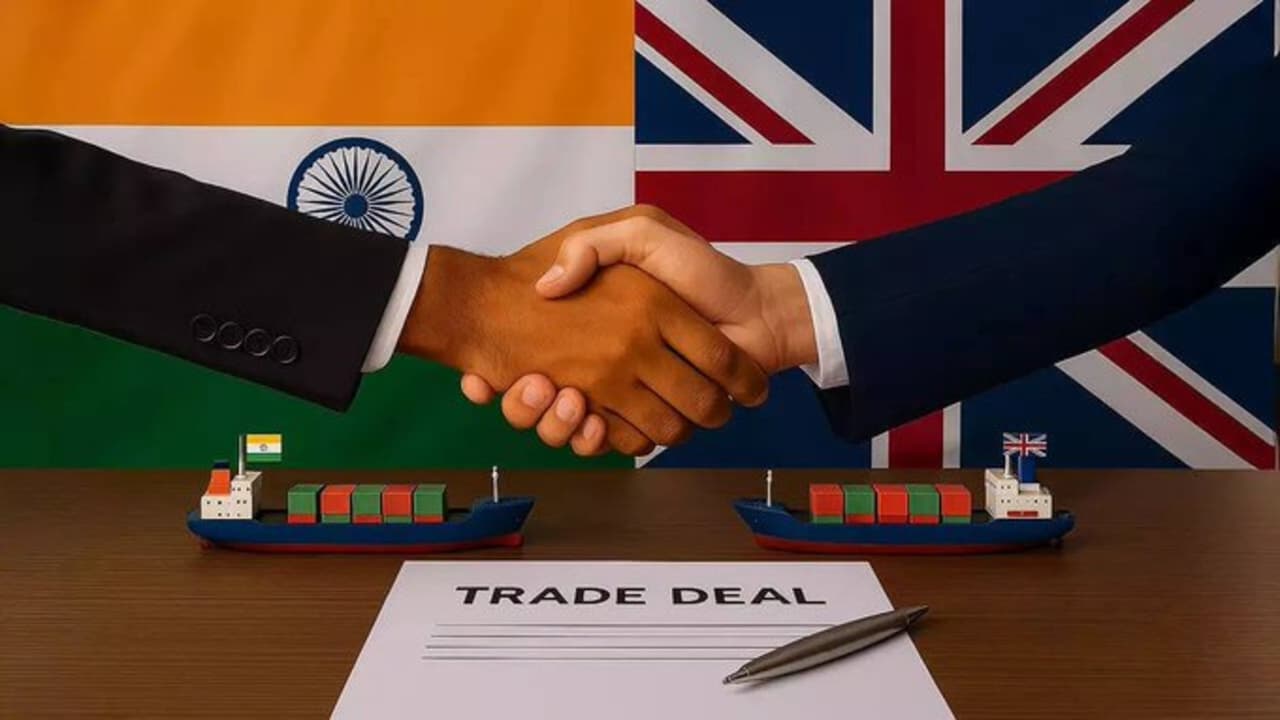
India-UK FTA comes into effect from today. Now whiskey, luxury cars and many foreign goods can become cheaper, while 99% of Indian products will go to the UK tax-free. After all, who will benefit the most?
India UK Free Trade Agreement: After a long wait, the Free Trade Agreement (FTA) between India and the United Kingdom (UK) has officially come into effect from today i.e. 15 July 2026. This deal, implemented after negotiations lasting about three and a half years, is being considered as a new chapter in the economic relations between the two countries. With this agreement, 99% of India’s products will now be able to reach Britain at almost zero duty, while the average tariff in India on most of the UK products will be significantly reduced. This is the reason why the market, industry and investors all have their eyes fixed on the impact of this agreement. Let us know what effect this agreement will have on your pocket and what major changes are going to come in the trade relations between the two countries.
A historic agreement: 14 rounds of talks and a new dawn
This deal did not happen overnight. After 14 rounds of long and intensive talks that lasted for about 3 years, it was signed on 24 July 2025 by Indian Commerce Minister Piyush Goyal and British Trade Minister Jonathan Reynolds in the presence of Prime Minister Narendra Modi and British PM Keir Starmer. Britain’s High Commissioner to India Lindy Cameron expressed happiness on social media, calling it a ‘historic moment’. With the implementation of this agreement, 99% of India’s products will be able to enter the UK market without any customs duty (zero tariff). At the same time, 99% of UK goods can be imported into India at a very nominal (average 3%) tariff. It is estimated that with this, the mutual trade between the two countries will double to 120 billion dollars by the year 2030.
Scotch, cars and clothes: what’s going to be cheaper?
The most exciting news for Indian consumers is that many premium items coming from Britain will now be available at much cheaper prices.
- Scotch and Gin: Till now, there was a huge tariff of 150% on Scotch whiskey and gin coming from UK, which will now directly reduce to 75%. By the 10th year of the agreement, it will be gradually reduced to just 40%. That is, the bottle of Scotch which was earlier available for ₹ 5,000, will now be available for around ₹ 3,500.
- Luxury Cars: British luxury cars like Jaguar Land Rover and Rolls Royce will get major duty concessions under the quota system, which could reduce their prices by 20 to 30%.
- Everyday Brands and Food: Along with chocolates, biscuits, salmon fish, mutton and soft drinks imported from Britain, fashion clothes, shoes and home decor items will also be available in Indian markets at much lower prices.
The fortunes of Indian industry will shine.
This deal will not only make imports cheaper, but will also open up the huge UK market for Indian exporters. India’s textile, leather, engineering, pharmaceuticals and agriculture sectors will directly benefit. The UK tax of 8-12% on Indian bedsheets, curtains and fabrics will now be completely abolished, making Indian fabrics more affordable and popular compared to competing countries like Bangladesh and Vietnam. Apart from this, auto parts manufacturing hubs like Pune and Chennai are also going to benefit greatly from UK’s zero tariff.
Special questions and answers: Understand the whole deal in simple language
Here are the 7 most important questions related to this agreement and their answers, which will clear all your doubts:
Question 1: Which UK goods are going to become cheaper in India? Are?
Answer: The average tariff on goods coming to India from the UK will reduce from 15% to 3%, while 85% of goods will become completely tariff-free in 10 years. Mainly the following things will be cheaper:
- Scotch and Gin: The tariff has been reduced from 150% to 75% immediately (which will be reduced to 40% going forward).
- British cars: Due to reduced duty under the quota system, cars can become cheaper by 20% to 30%.
- Food and Beverages: Salmon, lamb (mutton), chocolate, biscuits and soft drinks.
- Other accessories: British fashion wear, branded shoes, medical equipment, aerospace parts, luxury furniture and electronics.
Question 2: Which main sectors of India will benefit from this agreement?
Answer: Several key sectors of India are expected to benefit heavily:
- Textile Sector: With the abolition of 8-12% tax on bedsheets and curtains, exports from hubs like Surat, Tiruppur and Ludhiana could increase by 40%.
- Leather and Footwear: There will be zero tax on leather shoes and bags, which will give a big boost to the MSME sector.
- Engineering and Auto Parts: Manufacturing hubs of Chennai and Pune will benefit from the abolition of UK duty on auto parts.
- Pharmaceuticals: Indian generic medicines will get faster and easier approval in the UK Health System (NHS).
- Agricultural and Marine Products: The income of Indian farmers and exporters will increase with the abolition of duty on Basmati rice, spices, tea and lobster.
Question 3: What will be the overall benefit to India’s economy from this deal?
Answer: This deal will prove to be a game-changer for the Indian economy:
- Huge jump in exports: With 99% of goods going zero duty, India’s exports to UK can reach $29 billion by 2030.
- New employment opportunities: Jobs in labor-intensive industries like textiles and leather are projected to double.
- New strength to MSMEs: India’s 6 crore small industries will get new foreign markets and better profit margins.
- Foreign Investment (FDI): UK companies will increase investment in India’s IT, finance and green technology sectors.
Question 4: When did the talks regarding this historic agreement start between India and UK?
Answer: Official talks regarding this deal between the two countries started on January 13, 2022. It could be finalized after about three and a half years of complex negotiations and 14 rounds of meetings. India has also signed such agreements with Mauritius, UAE, Australia and EFTA countries in the last few years.
Question 5: How many types of trade agreements are there?
Answer: Trade agreements between countries are divided into different categories depending on their scope and terms:
- PTA (Preferential Trade Agreement): In this, duty is reduced on some selected products.
- FTA (Free Trade Agreement): An agreement made to facilitate trade between two or more countries.
- BTA (Bilateral Trade Agreement): Bilateral agreement between two countries.
- RTA (Regional Trade Agreement): An agreement between several countries in the same region.
The World Trade Organization (WTO) broadly classifies these as Regional Trade Agreements (RTA).
Question 6: What exactly is a ‘Free Trade Agreement’ (FTA)?
Answer: Free Trade Agreement is an agreement made to facilitate trade between two or more countries. Under this, countries either completely eliminate or drastically reduce trade barriers among themselves such as custom duty (tax), quota system and other restrictions, so that import and export of goods between the two countries can happen easily.
Question 7: With which countries or groups has India made such agreements so far?
Answer: India has so far signed trade agreements with Sri Lanka, Bhutan, Thailand, Singapore, Malaysia, South Korea, Japan, Australia, UAE, Mauritius as well as ASEAN and EFTA blocs. According to the Global Trade Research Initiative (GTRI), after building strong relations with Asian countries (East), India is now focused on making big trade agreements with western partners like the European Union (EU) and America (US).
Question 8: What benefits do countries get from these agreements?
Answer: Zero duty entry into the markets of partner countries helps in diversification and expansion of export markets. Equal opportunities are given to our competitors and trade partners.