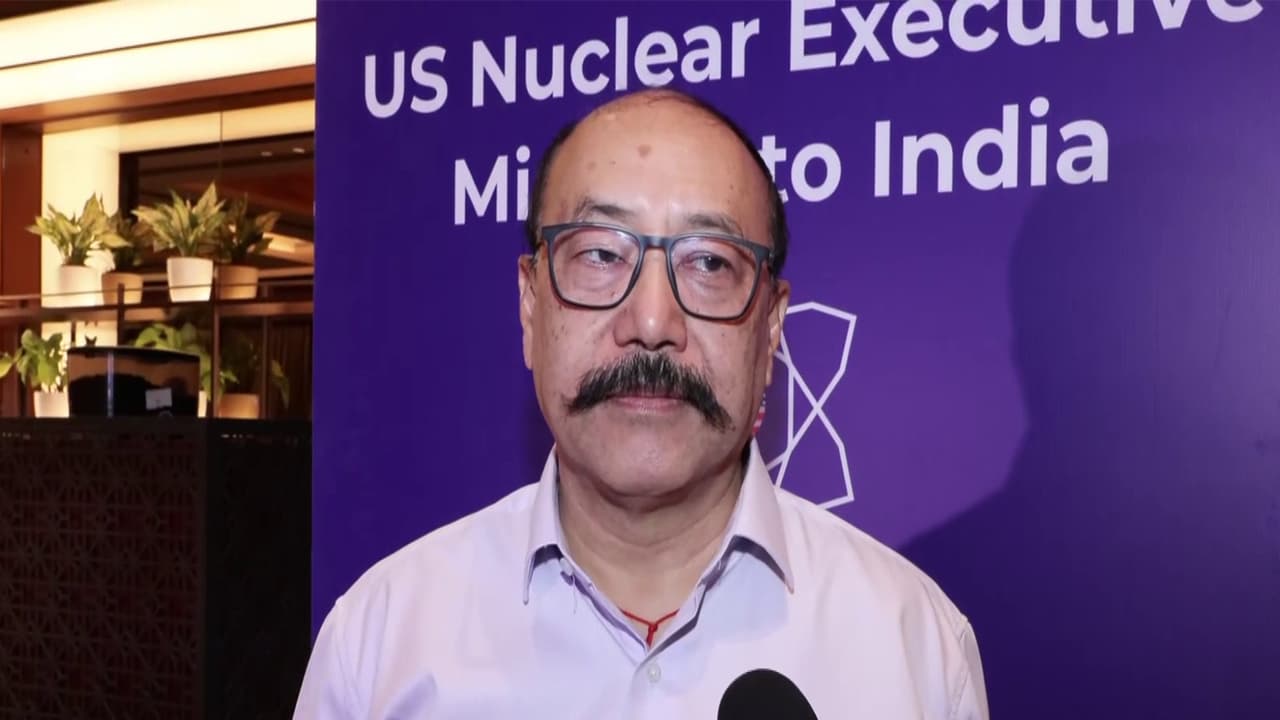
BJP MP Harsh Vardhan Shringla says India aims for 100 GW nuclear capacity by 2047, thanks to the new SHANTI Act. The law enables private/foreign investment, reviving the stalled India-US civil nuclear partnership.
BJP Rajya Sabha MP Harsh Vardhan Shringla emphasised on the importance of scaling up the country’s nuclear capacity, as the US Executive Nuclear Mission came to India, highlighting that the target is to scale up the capacity to 100 gigawatts by 2047.
Speaking to ANI on Monday, Shringla pointed to the passage of the recent landmark Sustainable Harnessing and Advancement of Nuclear Energy for Transforming India (SHANTI) Act, 2025, as the foundation for this rapid expansion. “In December, Parliament gave its approval for the ‘SHANTI Bill,’ which subsequently became the ‘SHANTI Act.’ This Act established a framework under which both domestic and foreign investment can be deployed within the nuclear energy sector. In other words, our goal is to scale up our nuclear energy capacity from the current 8.8 gigawatts to 100 gigawatts by 2047,” he said.
Shringla tied this massive push towards nuclear energy to the momentum of India’s development. “Our economy is growing at a very rapid pace; therefore, we require not only renewable energy sources but also a reliable ‘baseload’ capacity–something which, I believe, nuclear energy is uniquely positioned to provide,” he said.
US Welcomes Landmark SHANTI Act
Meanwhile, Maria Korsnick, President and CEO of the Nuclear Energy Institute (NEI), also stated that the recent passage of the landmark SHANTI Act in India has “opened the door now for a new day”, fundamentally reshaping the horizon for the US and Indian civil nuclear industries. Enacted as a sweeping legislative reform, the Sustainable Harnessing and Advancement of Nuclear Energy for Transforming India (SHANTI) Act, 2025, has fundamentally restructured the nation’s civil nuclear architecture. By replacing the decades-old Atomic Energy Act of 1962 and the Civil Liability for Nuclear Damage Act of 2010, the landmark law legally opens the doors for private industry participation in nuclear energy operations for the first time since independence.
Speaking to ANI, Korsnick outlined the primary objectives of a visiting executive trade mission, which is being jointly hosted by NEI and the US-India Strategic Partnership Forum (USISPF). She emphasised that this high-level delegation offers an ideal platform for the American commercial sector to understand the Indian government’s clean energy roadmaps, as well as private-sector integration under this new legislative landscape.
Resolving a 20-Year Bottleneck
This legislative breakthrough addresses a long-standing bottleneck in bilateral relations. Reflecting on the legacy of nuclear diplomacy, Korsnick observed that while the landmark 2005 India-US civil nuclear agreement was a monumental step forward, commercial progress remained stalled for nearly two decades due to unresolved liability issues. “Back in 2005, it was a step forward, but that nuclear liability was not resolved and so for 20 years, we really haven’t made significant steps forward,” she stated. “The SHANTI Act has opened the door now for a new day. “
Evolved Technology and Versatile Options
Beyond resolving these historical liability concerns, Korsnick noted that the technology itself has significantly evolved during this period, offering more versatile options for industrial deployment.”It wasn’t just the large reactors, which we had in 2005. Yes, it’ll still be large reactors, but large, medium, small, light water, advanced reactors, all different shapes and sizes,” she said. (ANI)
(Except for the headline, this story has not been edited by Asianet Newsable English staff and is published from a syndicated feed.)