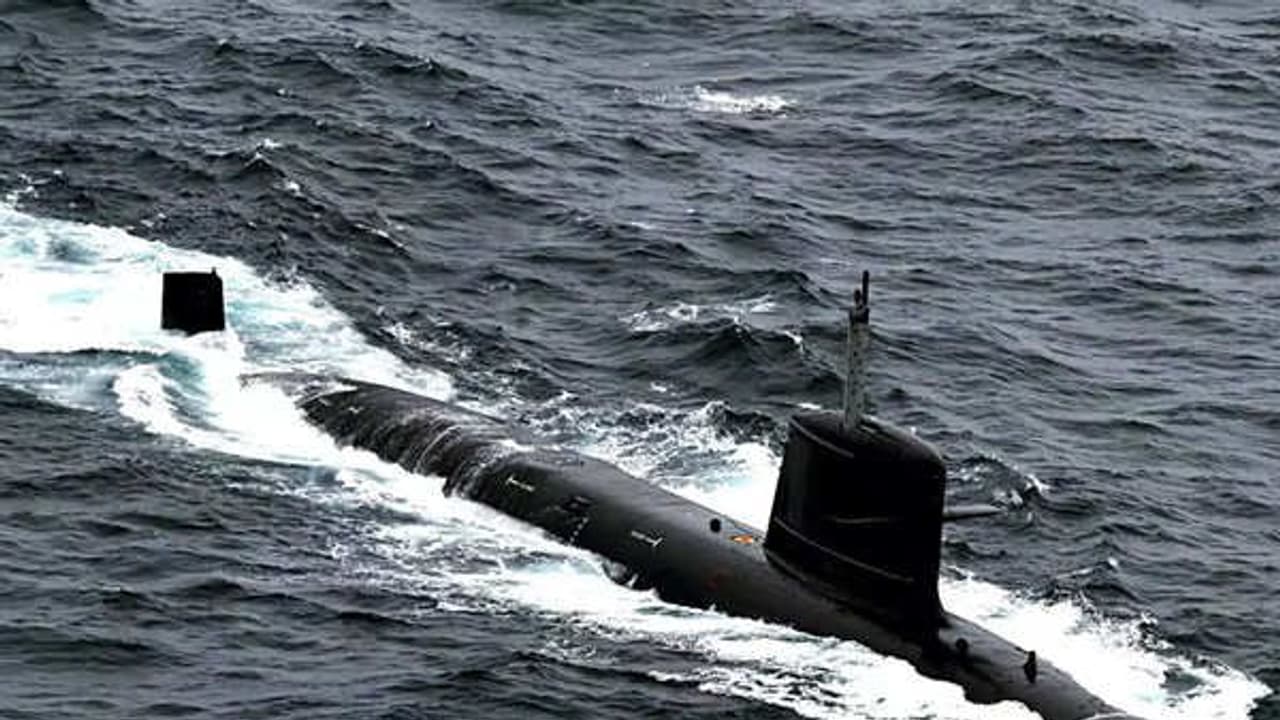
India is finalizing a Rs 70,000-crore deal for six AIP-equipped submarines even as it operates no such vessels today, while Pakistan rapidly expands its own underwater fleet with Chinese assistance.
New Delhi: India is set to conclude negotiations for one of its most significant naval acquisitions in decades, with a contract for six advanced conventional submarines under Project 75 India (P-75I) expected to be finalized by September. Valued at approximately Rs 70,000 crore (roughly $8.4 billion), the programme has moved closer to fruition after an inter-ministerial group is scheduled to clear the process by the end of this month.
Mumbai-based Mazagon Dock Shipbuilders Limited (MDL) will serve as the Indian strategic partner for the project, working in collaboration with Germany’s ThyssenKrupp Marine Systems (TKMS). Under the arrangement – structured within the defence ministry’s Strategic Partnership model, which requires an Indian firm to co-produce with a foreign original equipment manufacturer – TKMS will transfer submarine design and technology to India, with production facilities to be established domestically.
A defining feature of the programme is the mandatory inclusion of air-independent propulsion (AIP) technology in all six submarines. AIP allows a conventional submarine to remain submerged far longer than conventional diesel-electric boats, which must periodically surface or raise a snorkel to recharge batteries – a vulnerability that AIP largely eliminates.
The first submarine is to be delivered seven years after signing, with one additional boat to follow each year thereafter.
The programme carries firm indigenous content requirements: the first vessel must incorporate a minimum of 45% locally sourced components, rising to 60% by the sixth. This escalating threshold reflects New Delhi’s broader push to build a self-sustaining defence manufacturing base under its ‘Atmanirbhar Bharat’ framework.
AIP gap
The strategic urgency behind P-75I is sharpened by a stark capability deficit. India currently does not operate a single submarine equipped with AIP technology. Its existing fleet of 16 conventional submarines includes 10 ageing boats approaching the end of their service lives – a situation that defence planners regard with growing unease.
Pakistan, by contrast, is moving rapidly. On April 30, 2025, it commissioned its fourth AIP-capable submarine at a ceremony held in China. The vessel is the first of eight Hangor-class boats being built with Chinese assistance.
Pakistan is expected to field up to 11 AIP-equipped submarines within the next few years, giving it a qualitative edge in underwater endurance over the Indian Navy in the near term.
The Defence Research and Development Organisation (DRDO) has been developing an indigenous AIP capsule to address this gap. The system is expected to be ready by June 2026 and is planned for integration with INS Khanderi, the second of the Navy’s six Kalvari-class diesel-electric submarines, which is scheduled to dock for maintenance by the end of 2026.
The programme has, however, run behind schedule. The AIP module was originally intended for INS Kalvari, the lead boat of the class, built at MDL with technical assistance from France’s Naval Group. Since the system was not ready in time, Kalvari proceeded with its refit without AIP.
The Kalvari class – known internationally as the Scorpene class – currently forms the backbone of India’s conventional submarine capability and represents the country’s most significant step toward domestic submarine construction in recent decades.
Effect in IOR strategy
The pressure on India’s submarine programme is not limited to Pakistan. China’s People’s Liberation Army Navy (PLA Navy), now the world’s largest by hull count with approximately 355 warships and submarines, has substantially increased its presence in the Indian Ocean region in recent years.
The PLA Navy is projected to operate 65 submarines in 2025, with plans to grow that number to around 80 by 2035. Beijing’s expanding underwater reach into what New Delhi considers its strategic neighbourhood has added urgency to India’s own force-building timeline.
India’s total naval fleet currently numbers over 130 vessels. The Navy has set a target of expanding this to between 170 and 175 ships and submarines within five years – an ambitious goal that places P-75I at the heart of long-term maritime planning.
AIP technology is now standard in most modern conventional submarine fleets. A small group of nations – among them Germany, France, Sweden, Japan, South Korea, and China – possess mature, operationally proven AIP systems. India’s reliance on a foreign partner for this technology in the near term, while its indigenous programme matures, underscores both the complexity of the task and the scale of the catch-up required.
If the September timeline holds, the P-75I contract will mark a turning point for the Indian Navy – one that has been in the making for well over a decade.