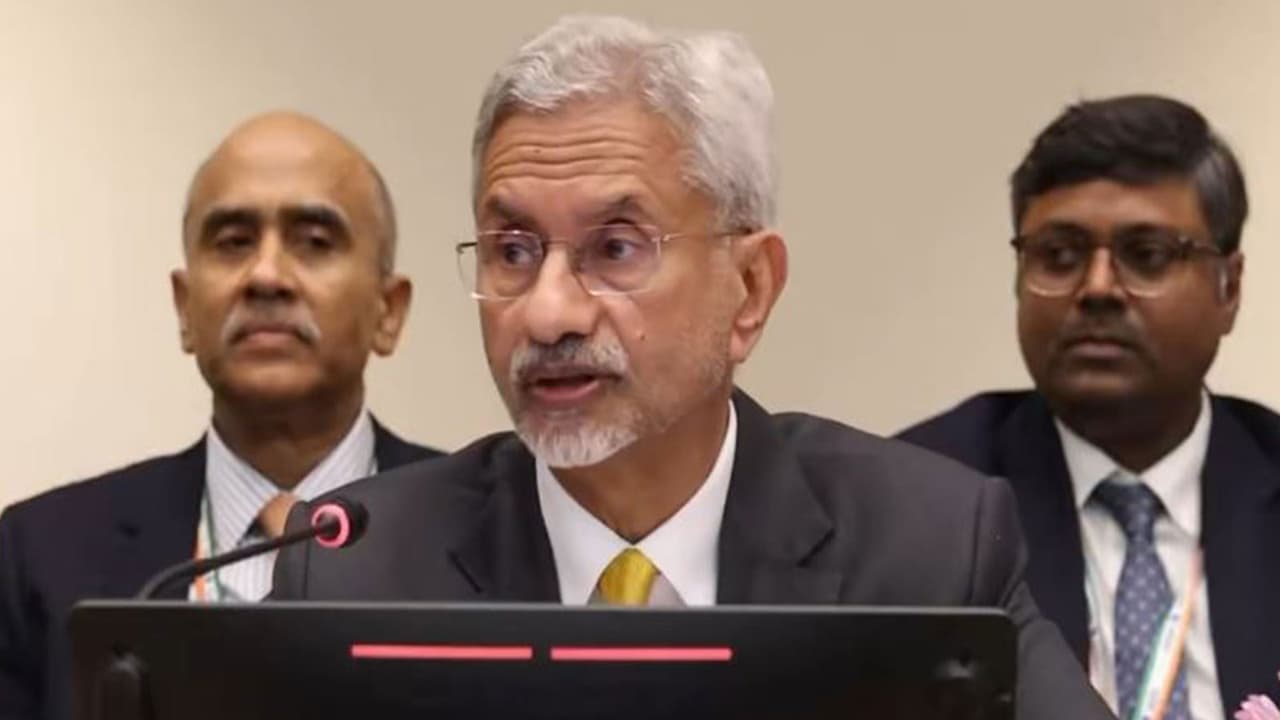
Addressing the India-CELAC Foreign Ministers’ Meeting, EAM S Jaishankar noted that trade has crossed USD 50 billion annually. He called for stronger economic partnerships, highlighting India’s robust growth and its commitment to the Global South.
External Affairs Minister S Jaishankar on Tuesday (local time) called for stronger economic and development partnerships between India and the Community of Latin American and Caribbean States (CELAC), saying India-CELAC trade has crossed USD 50 billion annually. “We are glad to note that India–CELAC trade has now crossed over USD 50 billion annually, yet there is much more room to grow,” he said.
Addressing the India-CELAC Foreign Ministers’ Meeting, Jaishankar said India had emerged as one of the world’s major economies over the past decade, with its GDP more than doubling and growth remaining robust. Co-chaired the India-CELAC Foreign Ministers’ Meeting today along with FM Mario Lubetkin @MinLubetkinUy of Uruguay. #UNGA81. Thank the CELAC trio FM Alva Baptiste of Saint Lucia and FM @omarbula of Columbia for joining. Attended by 30 CELAC members, the largest ever, CELAC… pic.twitter.com/z5BYdgbeO2 — Dr. S. Jaishankar (@DrSJaishankar) September 22, 2026
India’s Economic Rise
“Our GDP has more than doubled, growth has remained robust, and India today combines a large and increasingly skilled human resource base with increasing capabilities, growing market, strong digital infrastructure and expanding technology capacities,” Jaishankar said.
Commitment to the Global South
He said India’s engagement with the Global South went beyond its national interest and reflected its commitment to shared prosperity. “India’s engagement with the Global South goes beyond its national interest and reflects our solidarity and commitment to shared prosperity,” he said.
Development Cooperation in the Region
Highlighting India’s development cooperation with the region, Jaishankar said, “Whether through projects supporting livelihoods in Caribbean, responding to the devastation caused by Hurricane Melissa, the military hospitals that we sent to Venezuela after the earthquake, or the medicines that were shipped to various Latin American countries, India has sought to place its capabilities at the service of those in need.”
Exploring Complementary Strengths
Jaishankar said India and CELAC had complementary strengths, with India bringing technology, pharmaceuticals, skilled resources and digital capabilities, while the region offered opportunities in critical minerals, sustainable energy, agriculture and food resources. “Our own growing middle class makes us a natural partner for each other,” he said. “We need to work towards diversified trade, investment and business partnership with stronger business-to-business linkages, improved connectivity and more predictable market access,” he added.
Strengthening Economic Frameworks
He also said India and CELAC should consider upgrading the Annual Business Summit from next year. “India is trying to forge robust and balanced economic partnerships with the region through the proposed CEPA with Chile, an FTA with Peru, and the expansion of the PTA with MERCOSUR,” Jaishankar said. “Our objective is to create frameworks that are mutually beneficial. We seek swift progress, while remaining mindful of each other’s sensitivities and priorities,” he added.
Future Avenues for Cooperation
Calling India’s development record an important strength in its international partnerships, Jaishankar said there was a need to explore new areas of cooperation. “Let us look at human resources as a bridge for development and partnership. Let us explore opportunities in digital space, in AI, and in innovation generally together,” he said.
A Shared Vision for a New Global Order
He added, “India sees CELAC not just as a regional grouping, but as a very important partner in shaping a more representative, balanced and inclusive global order. We have much to learn from each other. We have much to offer each other. And, above all, we have a shared interest in ensuring that the Global South has a stronger voice in determining the future of the international system.” (ANI)
(Except for the headline, this story has not been edited by Asianet Newsable English staff and is published from a syndicated feed.)