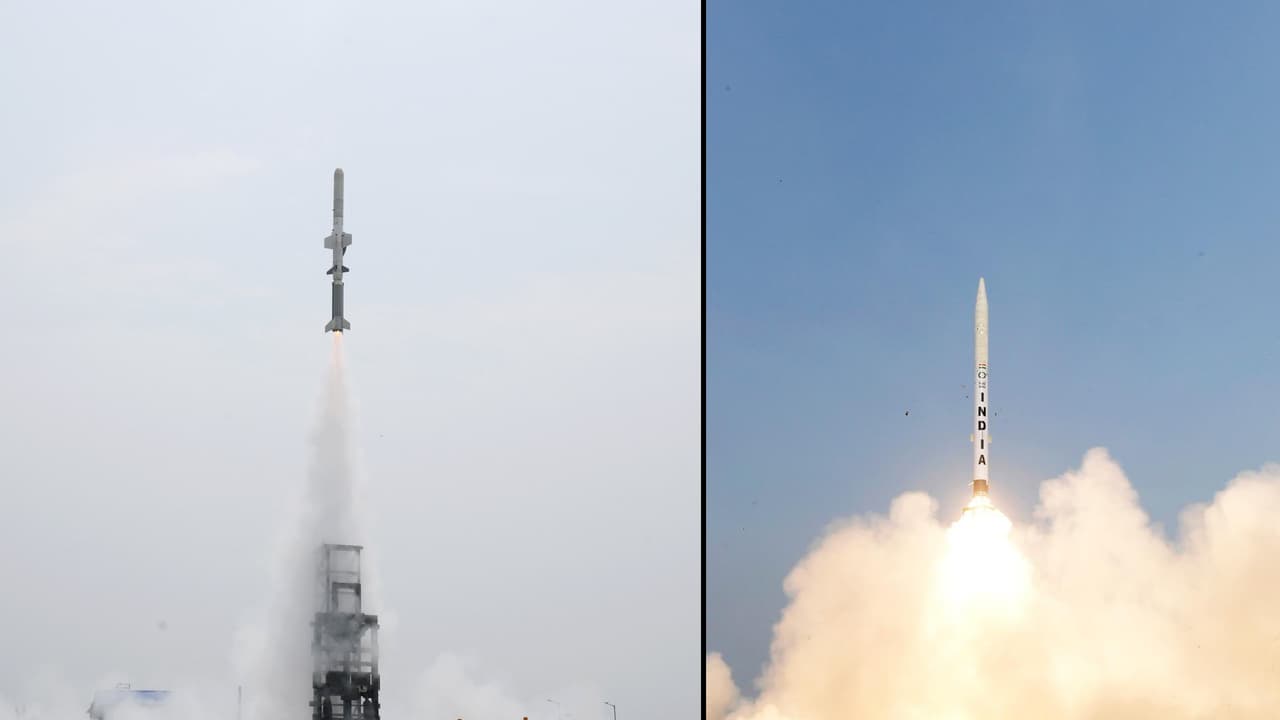
DRDO successfully test fired Ballistic Missile Defense (BMD) System. India can now intercept ICBMs with a range of more than 5,500 km. Also, the first successful test of Naval Anti-Ship Missile (NASM-MR) was also conducted.
New Delhi: India has achieved a huge success in the defense sector. Now India has also joined the club of those few countries like America, Russia and Israel, which can stop intercontinental range ballistic missiles i.e. from one continent to another. This success comes after three consecutive successful tests conducted by the Defense Research and Development Organization (DRDO) on June 10 and 11. These tests tested the multi-layered Ballistic Missile Defense (BMD) system and also saw the first successful launch of the Naval Anti-Ship Missile-Medium Range (NASM-MR).
BMD tests proved the ability of the defense system to hit targets at every layer. Every interceptor successfully hit the target assigned to it. According to the Defense Ministry, during the test, a target missile resembling an enemy ballistic missile was launched. After this, the radars of our weapon systems deployed on land and sea detected this threat and tracked it. Then a signal was given to the air defense interceptor system, which successfully hit the target. All the objectives of these tests were met.
India’s BMD program has been running for more than two decades. Its Phase-I system, which became operational in around 2020, was designed to intercept missiles with a range of up to 2,000 kilometers. It has two layers – Prithvi Air Defense (PAD) which engages targets above 50 kilometres, and Advanced Air Defense (AAD) which intercepts low altitude threats.
Now the Phase-II system has been tested, the results of which were announced on June 13, 2026. The system is designed to intercept Intercontinental Ballistic Missile (ICBM) class missiles, which have a range of more than 5,500 kilometers. This is a huge qualitative leap in India’s defense capability.
These tests have taken place at a time when the regional security environment is changing rapidly. According to reports, Pakistan is developing Multiple Independently Targetable Re-Entry Vehicle (MIRV) technology for its ballistic missiles. With this technology, a single missile can drop multiple warheads simultaneously on many different targets.
Along with the BMD trials, the first successful trial of NASM-MR is an equally important achievement. This medium-range anti-ship missile will increase the strength of the Indian Navy, allowing it to target enemy ships in the sea from a distance. This missile will bridge the gap between existing short-range systems and long-range hypersonic variants under development. DRDO has tested several sea-based weapons in recent years. This shows that efforts have intensified to give the Indian Navy an edge in disputed maritime areas, especially in the Indian Ocean region.
Defense Minister Rajnath Singh congratulated DRDO for these successful demonstrations. Rajesh Kumar Singh, Secretary, Department of Defense Research and Development and Chairman, DRDO, directly monitored these trials and appreciated the combined efforts of the organization’s scientists and industry partners. Senior officers of the three armies also witnessed these tests.
These tests are part of the surge in India’s indigenous defense production. The government has set increasingly high targets for domestic purchases in recent years. From the Tejas fighter aircraft to the Pinaka rocket artillery system and submarine-launched ballistic missiles, DRDO has played a central role in many programs that are now in advanced testing or induction into the Army.