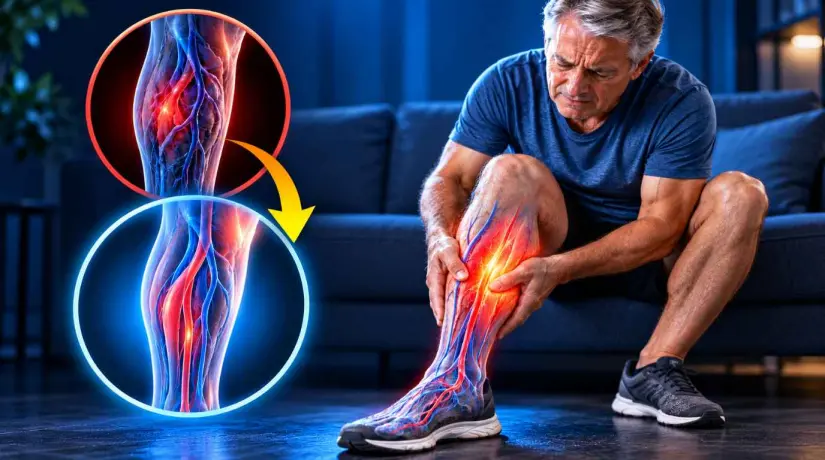
Sore, heavy or crampy legs are often blamed on “poor circulation,” but that phrase covers two very different problems. Dr. Brad Weening and Dr. Paul Zalzal of Talking With Docs count down seven ways to help the blood flow in your lower legs, and one of them is the single strongest finding in the field: structured walking can improve walking ability more than medication, and in some respects as much as stenting. Their version simplifies some of the numbers and overstates a few claims, so this guide keeps what the evidence supports and corrects the rest.
Two Systems, Two Different Problems
Your arteries carry blood down from your heart to your legs, and your veins carry it back up. When arteries narrow, as in peripheral artery disease (PAD), the muscles can’t get enough oxygen during effort. The classic result is claudication, leg pain that appears when you walk and typically eases within a few minutes of rest. When veins struggle, the problem is return flow: the veins rely on one-way valves and on the calf muscles squeezing them, so weak calves or damaged valves let blood pool, leaving the legs heavy, aching or swollen, often worse by the end of the day.
This is a rule of thumb, not a diagnosis. The Society for Vascular Surgery lists walking pain that eases with rest among venous symptoms too, and Cleveland Clinic notes that many people have both conditions. The seven strategies below mostly help the vein side, except the first, which helps both. They also assume you have already dealt with the basics that matter most for the arteries: quitting smoking and controlling cholesterol, blood pressure and diabetes.
 Discover the four overlooked factors your prescriptions were never designed to address—and why they may still affect how you feel.
1. Walk: The Best-Supported Option
Walking works on both systems. In the veins, each step squeezes the calf muscles and pushes blood upward. In the arteries, walking is one of the few things shown to increase how far you can go before claudication stops you.
Their key evidence is the CLEVER trial, which randomized 111 people with claudication from aortoiliac disease (blockage in the large arteries of the pelvis) to optimal medical care, stenting, or supervised exercise. They get the idea right but some details wrong:
- Timing: the main results were measured at 6 months, not 12 weeks.
- Baseline: peak walking time was about 5 minutes (5.3 minutes in one report).
- Gains: medical care added 1.2 minutes, stenting 3.7 minutes and supervised exercise 5.8 minutes. On a 5.3-minute starting point, that works out to roughly 23%, 70% and 109%. Their quoted 25%, 70% and 125% round the first up and overstate the last.
- Exercise versus stenting: exercise beat stenting by 2.1 minutes at 6 months (P = 0.04). At 18 months the gap was no longer significant (+5.0 versus +3.2 minutes, P = 0.16).
- Quality of life: stenting scored better on several scales, and more stented patients were claudication-free at 6 months (42.5% versus 21%).
It also helps to know what “exercise” meant in the trial: up to 78 supervised one-hour sessions, three times a week. That is a structured program. The 2024 ACC/AHA peripheral artery disease guideline gives supervised exercise therapy, or a structured community-based program, its strongest recommendation (Class 1), and rates unstructured exercise lower (Class 2b). In supervised programs, people typically walk 30 to 60 minutes, three times a week for 12 weeks, walking until moderate-to-severe discomfort, resting, and repeating. The American Heart Association says home programs can start at about 10 minutes and add about 5 minutes a week up to 45 to 50 minutes.
If walking hurts at first, do what the doctors suggest: walk a little, rest, walk again, or split it into several shorter walks through the day.
2. Don’t Sit for Too Long
Prolonged sitting lets blood pool in the legs and may impair how well your arteries dilate. In a small study of 12 healthy young men, flow-mediated dilation of the leg artery dropped from 4.72% to 0.52% after one hour of sitting and was still reduced after three hours. When the men took 5-minute walks at 30, 90 and 150 minutes, it stayed at 5.04% or higher. That study measured artery function, not swelling, and used treadmill walks, but it supports the idea behind the “exercise snacks” idea. A practical habit is to stand up and move every hour, and on long flights to walk the aisle when it is safe to do so.
3. Do Seated Ankle Pumps
If standing exercises are too hard, sit with your feet flat and rise up onto your toes, then lower. This engages both main calf muscles, the gastrocnemius and the soleus, and helps push blood back toward the heart. In a small study of 20 healthy seated volunteers, active ankle exercise increased blood flow velocity in the thigh vein. We found no trial of ankle pumps for leg swelling or circulation problems in patients, so treat them as a safe, sensible habit and not a proven treatment.
4. Strengthen Your Calves
The calf works as a pump, so a stronger one should pump better. Calf raises are the simplest version: rise onto your toes and lower, holding a handrail if your balance is unsteady. Progress to one leg when it gets easy. No weights are needed. The best evidence comes from chronic venous insufficiency: in a randomized trial of 31 patients, six months of structured exercise improved calf pump function (ejection fraction +3.48 versus −1.4 in the control group), but symptoms and quality-of-life scores didn’t change. The doctors say you can see “relatively quick improvement.” The trial shows improvement over months, not days.
5. Keep Your Ankles Moving
Stiff ankles from arthritis or an old injury limit how well the calf muscles can work. Maintaining or improving ankle range of motion, by drawing the alphabet with your foot, pointing and flexing your toes, or gentle stretching, helps your calves keep pumping. This is mainly an indirect benefit and we found no trial of it on its own.
6. Consider an Under-Desk Foot Device
Small devices that sit and make you point and flex your foot are designed to work the calf pump while you work. We found no clinical trial of these devices, so the benefit is inferred from the ankle-movement evidence above. A simple footrest-free alternative is to do ankle pumps and heel raises at your desk.
7. Electrical Stimulation Devices: Weak Evidence
The doctors say devices that stimulate the muscles to contract may help “a little bit,” while TENS machines and vibration plates have no evidence. The research is more mixed than that:
- Electrical muscle stimulation: a 2020 systematic review found five studies, two randomized, with walking distance gains of about 40 meters (roughly 34%), but called the evidence too weak to recommend. A 2023 trial of a foot-plate stimulator in 200 people with claudication found no significant improvement in walking distance (P = 0.28), while supervised exercise clearly beat medical therapy alone.
- TENS: a small trial of 40 patients with claudication found increased treadmill walking distance, though pain didn’t improve.
- Vibration: a meta-analysis of 10 studies in healthy adults found a single session raised peripheral blood flow.
So “no evidence” is too strong, and “proven” is too strong. Devices are a low-priority extra, not a replacement for walking. Avoid them if you have a deep vein thrombosis, a pacemaker or are pregnant, and ask your doctor first.
When to See a Doctor
Leg problems with a wound that isn’t healing are a separate issue that needs medical attention. See a doctor promptly for pain at rest, an ulcer or sore on the foot or leg that won’t heal, cold, numb or discolored toes, or one foot or lower leg noticeably cooler than the other. Sudden worsening needs urgent treatment. A swollen, painful, throbbing calf on one side can be a deep vein thrombosis: seek urgent care, and call emergency services if you also have chest pain or breathlessness. Smoking, diabetes, high blood pressure and high cholesterol are the main risk factors for PAD, so these are worth addressing with your doctor. factors for PAD, so these are worth addressing with your doctor.
Frequently Asked Questions
How can I tell if my leg problem is arterial or venous?
Pain that comes on with walking and eases within minutes of rest points to an arterial problem, while heaviness, aching and swelling that build through the day point to a venous one. It is a rule of thumb with overlap, so a doctor should confirm the cause.
Is walking really better than a stent?
For walking time, supervised exercise was better at 6 months in the CLEVER trial, but the gap was no longer significant at 18 months, and stenting scored better on quality-of-life measures. The trial covered one type of blockage in the pelvic arteries, so it doesn’t apply to every case.
How should I start walking if it hurts?
Walk until you feel moderate discomfort, rest until it eases, and repeat. Home programs can start at about 10 minutes and add roughly 5 minutes a week up to 45 to 50 minutes. Several shorter walks across the day also count.
Are leg circulation gadgets worth buying?
The evidence is weak or mixed. A 200-person trial of a foot-plate stimulator found no significant walking improvement, and reviews call the evidence for electrical stimulation too weak to recommend. If you try one, avoid it with a deep vein thrombosis, pacemaker or pregnancy, and check with your doctor first.
Leg Circulation Checklist
- ☐ Walk most days, resting when pain builds and repeating, and build up gradually
- ☐ Stand up and move for a minute or two every hour
- ☐ Do seated ankle pumps when you can’t stand
- ☐ Do calf raises (holding a rail if needed) a few times a week
- ☐ Keep ankles mobile with gentle range-of-motion movements
- ☐ Stop smoking and keep cholesterol, blood pressure and blood sugar in check
- ☐ See a doctor for non-healing wounds, rest pain, a cold foot, or a swollen painful calf