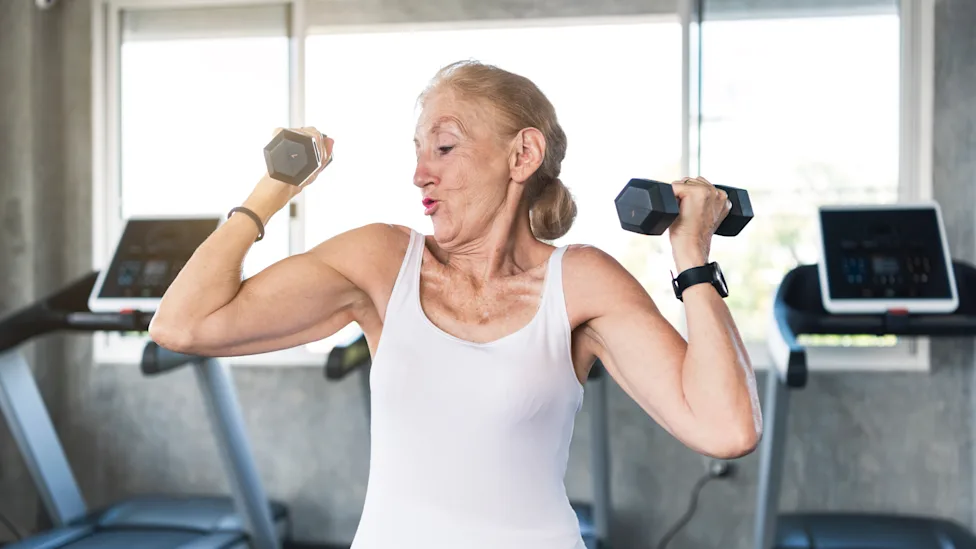
In longevity medicine, the gap between what most people believe about aging and what the science actually supports can be significant. Living longer and healthier isn’t just about taking the right supplements or seeing the right doctor. It comes down to a handful of daily habits that most people are either underestimating or doing wrong. DO, FAAMM, AOBOS, ABAARM, a double board-certified orthopedic surgeon. has seen this firsthand with his patients. Here, he shares insights on osteoporosis, the habits he’d keep for life, and the one thing he tells patients that stops them in their tracks.
Osteoporosis is more than a calcium deficiency

A doctor reviews bone health spine model with a patient — osteoporosis is often more treatable than people assume.
(alvarog1970 / Shutterstock)
There’s a lot of misinformation out there about bone health. “Osteoporosis is not simply a calcium deficiency,” Dr. Lucas told me. “It is often reversible, or at least improvable, with the right combination of resistance training, hormone optimization, and nutrition.”
He said most patients walk in expecting a medication-first model and walk out with a very different picture of what’s possible. For the millions of people managing low bone density, that reframe matters enormously. Also, Dr. Lucas observed that what’s happening in your bones reflects what’s happening everywhere else in your body.
The 5 daily habits that support a longer, healthier life

A protein-forward, whole-food plate — one of the five daily habits Dr. Lucas says matter most for long-term bone and overall health.
(Romix Image / Shutterstock)
Strip away the supplements and the technology, and the habits that most reliably support longevity come down to five fundamentals. Dr. Doug Lucas said these are the ones he would hold onto no matter what.
-
Consistent resistance training or at least mechanical loading of the bones.
-
Prioritizing protein at every meal.
-
Daily movement beyond formal exercise.
-
Sleep discipline that’s built around a consistent schedule.
-
Intentionally healthy food choices centered on whole foods and adequate calories.
Why older adults with low bone density should be lifting heavy, not avoiding it

High-intensity resistance training — even for people with low bone density — is what Dr. Lucas says actually strengthens bone, not weakens it.
(PeopleImages / Stutterstock)
Of those five habits, resistance training is the one that surprises people most. Conventional thinking for older adults with low bone density tends toward caution and avoidance. Lucas said that instinct is exactly backward. “High-intensity resistance and impact training for older adults, especially those with low bone density,” he said, is the habit that looks counterintuitive from the outside but delivers results. Loading the skeleton is what signals it to stay strong. Protecting it from load is what accelerates its decline.
The blood tests and bone markers most doctors rarely order but should

Bone turnover markers like CTX and P1NP, measured through routine bloodwork, can reveal what’s happening inside your bones in real time.
(CrizzyStudio / Shutterstock)
Standard lab panels miss a lot. Lucas pointed to three markers worth knowing about: FSH (follicle-stimulating hormone), CTX, and P1NP. FSH, he shared, helps optimize estradiol dosing, a key piece of hormone balance that often goes unaddressed. CTX and P1NP are bone turnover markers that reveal what’s happening inside the bones in real time, rather than waiting for a fracture or a routine DEXA scan to surface a problem. If you’re concerned about bone health, these are worth asking your doctor about.
The longevity supplement that’s more overhyped than it deserves

Calcium supplements have their place, but Dr. Lucas says they’re often overrelied on at the expense of strength training and hormone health.
(almo Creative / Shutterstock)
Calcium supplements are everywhere, and they’re a smart choice for many people. However, relying on calcium alone, without also addressing muscle, hormones, and mechanical loading, misses the point entirely, Lucas said. Supplementation has its place, but it is not a substitute for the foundational work. Taking a pill while skipping resistance training and ignoring hormones is, in his view, one of the most common and costly mistakes in bone health today.
The single best free habit for longevity and how to start it tomorrow

A simple bodyweight squat routine at home is where Dr. Lucas recommends starting — no equipment or gym membership required.
(Summit Art Creations / Shutterstock)
If there is one habit that outperforms nearly everything else — including paid programs, supplements, and high-tech interventions — Lucas said it is progressive resistance training done consistently over time. The good news is that starting is simpler than most people think. “Begin a simple resistance routine using bodyweight movements such as squats, step-ups, or push-ups, performed consistently and progressed over time,” he said. Consistency and gradual progression are the keys to success with this plan.
More About Our Expert: Dr. Doug Lucas, DO, FAAMM, AOBOS, ABAARM, is a double board-certified orthopedic surgeon specializing in bone health, metabolic health, hormone optimization, regenerative medicine. and healthy aging. In addition to his work helping patients understand how to improve their bone health and overall well-being, Dr. Lucas is the VP of Women’s Health, Hormone & Lifestyle Optimization at