The Health Minister of Himachal Pradesh did not attend an important national conference held in Delhi under the chairmanship of Union Health Minister JP Nadda. At the same time, the State Health Secretary also allegedly left the meeting midway, due to which speculations are being made about the tension.
New Delhi [भारत]June 30 (ANI): In a major administrative and political development, the representation of Himachal Pradesh’s health department grabbed attention during a high-profile national conference chaired by Union Health Minister JP Nadda in Delhi. While health ministers from across the country gathered to discuss the crucial national healthcare structure and central fund allocation, Himachal Pradesh Health Minister Dhani Ram Shandil did not attend the session.
Himachal minister absent from meeting, secretary walked out
According to sources, no official explanation or prior intimation was given to the Union Ministry for his absence. Adding further fuel to speculations about the impasse, the state health secretary, who had attended the conference on behalf of Himachal Pradesh, reportedly abruptly walked out of the venue much before the proceedings were officially over.
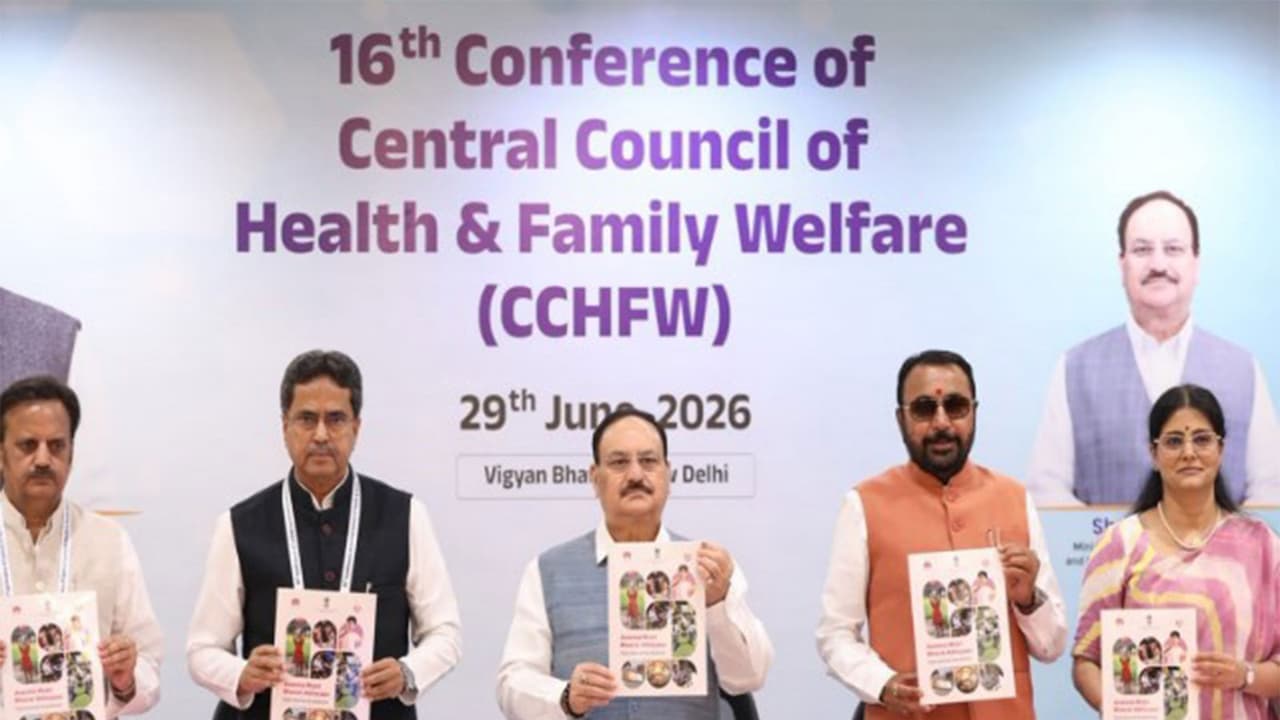
The 16th conference of the Central Council of Health and Family Welfare (CCHFW) was held on Monday under the chairmanship of Union Health and Family Welfare Minister Jagat Prakash Nadda, with a focus on strengthening India’s public health system and enhancing centre-state cooperation.
Tension between center and state
Union Minister JP Nadda had recently criticized the Chief Minister Sukhwinder Singh Sukhu-led administration, calling it “directionless” and accusing it of failing to utilize central funds extensively. The Center highlighted that under the Prime Minister Ayushman Bharat Health Infrastructure Mission (PM-ABHIM), several infrastructure projects, including 15 critical care blocks and several integrated public health laboratories, remain incomplete even as the deadline approaches.
In contrast, state cabinet ministers of Himachal Pradesh have repeatedly hit back at the Centre, accusing it of ignoring the unique financial constraints of the hill state. The state has strongly opposed the cut in Revenue Deficit Grant (RDG), claiming it leads to a loss of over ₹8,100 crore annually, and has demanded delayed disaster rehabilitation funds.
According to an official statement from the Health Ministry, the conference serves as an important platform to review the progress of key national health programmes, deliberate on emerging public health priorities and further strengthen coordination between the Center and states to improve healthcare delivery across the country.
‘Developed India’ is not possible without ‘Healthy India’: Nadda
Addressing the conference, Union Minister Nadda said that under the leadership of Prime Minister Narendra Modi, India has set a vision of becoming a “developed India” by 2047, when the country will complete 100 years of independence. He emphasized that a developed India cannot be achieved without a healthy population, and described health as one of the most important pillars of national development.
The Union Health Minister highlighted that there have been transformational changes in India’s healthcare sector in the last twelve years. He said the National Health Policy, 2017 marked a paradigm shift in the country’s healthcare approach, shifting the focus from primarily curative care to a holistic, inclusive and comprehensive health system, encompassing preventive, promotive, curative, palliative and rehabilitative care.
Nadda said that to provide quality healthcare to approximately 1.5 billion people, the government has focused on strengthening the foundation of the healthcare system. He informed that around 1.85 lakh Ayushman Arogya Mandirs have been established across the country, serving as the first point of contact for the citizens, as well as creating a strong linkage between primary, secondary and tertiary healthcare. He also said that the tertiary healthcare infrastructure has been significantly strengthened with the establishment of 23 new AIIMS and more than 157 medical colleges, with a focus on aspirational and deprived districts.
Many new health initiatives launched in the conference
On this occasion, the Union Health Minister launched several landmark policy documents and program initiatives aimed at strengthening healthcare delivery across the country.
Guidelines on National Ambulance Services
Among the key initiatives launched was the National Operational Guidelines on Ambulance Services (NAS), 2026, which is a comprehensive framework that establishes uniform national standards for emergency medical transport services across all states and union territories. These guidelines strive to enhance the quality, accessibility and efficiency of pre-hospital emergency care by standardizing ambulance infrastructure, staffing, equipment, response protocols, digital integration and quality assurance mechanisms.
Suman Roadmap 2030
Nadda also released the SUMAN Roadmap 2030, a comprehensive strategic framework designed to strengthen maternal and newborn health services across the country. The roadmap outlines targeted interventions to improve service quality, ensure dignified maternal care, reduce preventable maternal and newborn deaths, and accelerate India’s progress towards achieving the Sustainable Development Goals related to maternal and child health.
Samagra Shishu Bal Swasthya Karyakram (SSBSK)
The conference also launched the Samagra Shishu Bal Swasthya Karyakram (SSBSK), an integrated program that integrates Home-Based Newborn Care (HBNC) and Home-Based Young Child Care (HBYC) into a seamless continuum of care. The program aims to strengthen community-based healthcare for children from birth to five years of age through regular home visits, early identification of diseases, counseling on nutrition and child development, and timely referral whenever necessary.
Anemia Free India Campaign
Another major initiative launched during the conference was the Anemia Free India campaign, which marks the next phase of India’s efforts to eliminate anemia as a public health concern. Building on the achievements of the Anemia Mukt Bharat programme, this revised initiative expands its scope through saturation-based screening, digital beneficiary tracking, case-based management, robust nutrition interventions and a strong emphasis on dietary diversification and behavior change communication across all beneficiary groups.
The conference concluded with a fresh resolve by the Center and states to work together to achieve the vision of a healthy India through stronger public health systems, better service delivery and people-centric health reforms. (ANI)
(Except for the headline, this story has not been edited by Asianetnews Editorial staff and is published from a syndicated feed.)