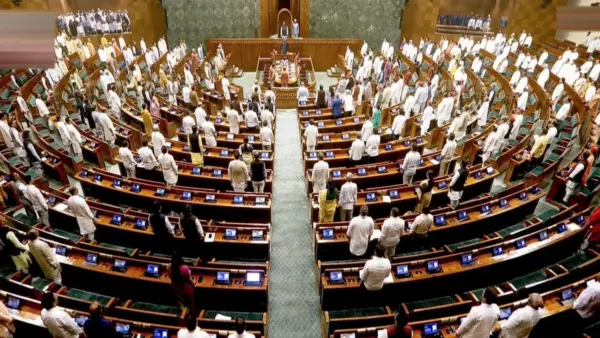
Parliament’s Monsoon Session ended its proceedings on August 13. Yet, more than two weeks later, it has not been formally prorogued.
That gap has raised a question in political circles: is this simply a delay in the usual procedure, or could the ruling party BJP-led NDA be keeping the option open to call MPs back for a special sitting in the Parliament?
Both the Lok Sabha and Rajya Sabha were adjourned sine die on August 13. In simple terms, that meant the Houses stopped meeting without setting a date for their next sitting. But that does not automatically mean the parliamentary session itself has ended.
A session is formally brought to an end only when the President prorogues it. That distinction is now attracting attention because of the continuing political debate over delimitation, the proposed expansion of the Lok Sabha and the implementation of women’s reservation.
What Happens When Parliament Is Adjourned Sine Die?
When the Speaker of the Lok Sabha or the Chairman of the Rajya Sabha adjourns the House sine die, it means there is no date fixed for the next sitting.
It is effectively the end of the scheduled proceedings.
But the session remains technically alive until it is prorogued.
This is different from a House simply being adjourned for a day or for a specified period. An adjournment sine die means the House does not have another sitting scheduled at that point.
So, When Does A Parliament Session Actually End?
That happens through prorogation.
Under Article 85(2)(a) of the Constitution, the President has the power to prorogue either House of Parliament. The President does so on the advice of the government.
The process generally follows the completion of the scheduled business. Once the government advises prorogation, the President issues the formal order bringing the session to an end.
Until that happens, the session technically continues.
That is why the Monsoon Session can be described as having been adjourned sine die, but not yet formally prorogued.
Why Is The Delay Being Watched Closely?
The delay is unusual enough to attract attention, but it is not unprecedented.
Parliament has, in the past, remained unprorogued for several days after being adjourned sine die. In 2015, the Monsoon Session was formally prorogued 28 days after it was adjourned sine die. In 2021, the gap was around 20 days.
So, an 18-day gap this time does not, by itself, establish that the ruling party is preparing something unusual.
What has caught everyone’s attention is the unresolved debate over delimitation. The ruling party and the Opposition remain divided over how the exercise should be carried out and how it could affect the representation of states.
Could The Ruling Party Call MPs Back?
Yes. As long as the session has not been prorogued, the government can advise the President to summon Parliament again. MPs could then return for another sitting of the existing session, rather than Parliament having to begin an entirely new session.
This is the procedural reason behind speculation about a possible special sitting.
However, there is no official confirmation that the ruling party is planning to use this option to revive the Delimitation Bill. Sources have also indicated that NDA allies have not been asked to remain in Delhi for any last-minute summoning.
Why Is The Delimitation Bill Important?
The speculation is closely linked to the ruling party’s wider plans on delimitation and women’s reservation.
A Constitution Amendment Bill connected to delimitation and the implementation of women’s reservation was defeated in the Lok Sabha during the Budget Session on April 17.
Of the 528 MPs who voted, 298 supported the Bill and 230 opposed it.
The proposal needed the support of two-thirds of the members present and voting. On that vote, 352 votes were required.
Its defeat highlighted the numbers challenge the ruling party would face if it attempts to bring a similar constitutional amendment again. It would need sufficient support in the Lok Sabha, including from its allies.
Congress leader Jairam Ramesh questioned why the session had not yet been formally closed, calling the delay “mystifying” and saying it could fuel suspicion about the ruling party’s intentions.
Congress president Mallikarjun Kharge wrote to Prime Minister Narendra Modi on August 27, reiterating the Congress position on delimitation. He has demanded that the Lok Sabha’s current strength of 543 seats remain unchanged for another 15 years. He has also called for women’s reservation to be implemented in the 2029 Lok Sabha election.
Kharge has also sought an all-party meeting before any legislation is introduced, arguing that political parties and state governments should be given adequate time to study the proposals and their implications.
Is A Special Sitting Really On The Cards?
That remains the key political question.
The ruling party has the procedural option of calling Parliament back before the Monsoon Session is prorogued. But whether it intends to exercise that option for the Delimitation Bill is not known.
The earlier defeat of the Constitution Amendment Bill also means that any fresh attempt would require the ruling party to secure the numbers needed to cross the constitutional threshold.