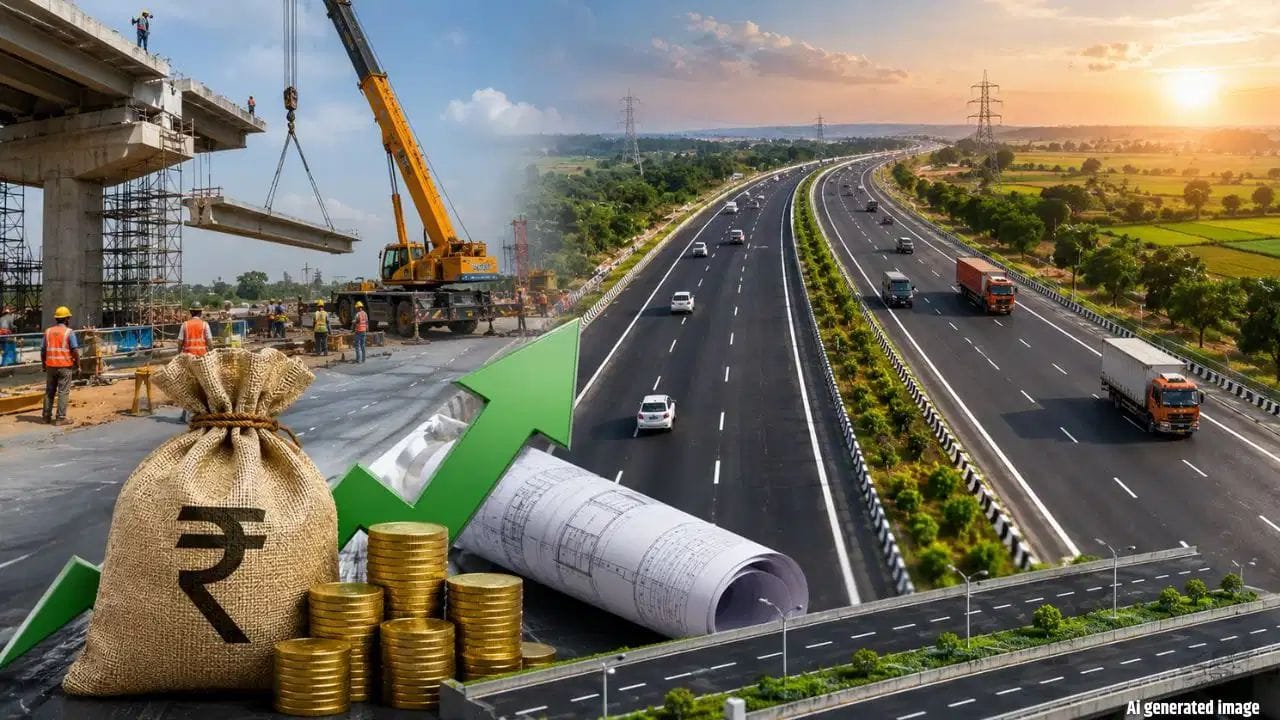
The government seems to be once again returning to the old model of earning.
The Ministry of Road Transport and Highways is considering increasing its highway monetization target to Rs 15,000-20,000 crore for financial year 2027 (FY27) after deciding to include private investment raised through ‘Build-Operate-Transfer’ (BoT) projects in its monetization programme. The move could take highway monetization revenue to more than Rs 50,000 crore in FY27, much higher than the ministry’s current target of Rs 35,000 crore and in better line with the government’s ‘National Monetization Pipeline’ (NMP) 2.0 framework.
The National Monetization Pipeline 2.0 envisages a total monetization potential of Rs 16.72 lakh crore over the five-year period till FY30, which includes investments of Rs 5.8 lakh crore from the private sector under the Asset Monetization Pipeline of Central Ministries and Public Sector Entities. This also includes monetization of greenfield assets like highway projects under the BoT route.
The first phase of the National Monetization Pipeline was launched by NITI Aayog in August 2021, with the aim of leasing underutilized brownfield public infrastructure assets to private companies. It achieved almost 90 per cent of its target and raised about Rs 5.3 lakh crore to raise funds for new infrastructure projects. The Ministry of Road Transport and Highways (MoRTH) earned around Rs 29,000 crore from monetization in FY26.
The decision will mark a change in the government’s traditional approach towards highway monetization, which has largely relied on monetization of current assets through ‘toll-operate-transfer’ (ToT) bundles and Infrastructure Investment Trusts (InvITs). Since highway monetization began in 2018, earnings have mainly come from transferring revenue rights for already built roads, rather than counting investments in new projects.
According to Mint report, quoting sources, investment brought by the private sector to build highways under the BoT model is now being seen as a form of monetization as it reduces the capital burden of the government and also brings private capital into public infrastructure.
Here’s the plan
The ministry plans to award about 10,000 km of national highway projects in FY27, of which about one-fourth is expected to be put up for bid under the BoT (toll) model. Although the total value of these projects is estimated to be around Rs 2 lakh crore, only Rs 15,000-20,000 crore is expected to be invested during FY27 and will be counted as monetization earnings.
However, the actual investment during the year will depend on the pace of investment in projects during the financial year. The Mint report quoted sources as saying that since in BoT projects, capital is usually invested in different phases at the time of construction, only the investment made in that year is expected to be counted as monetization earnings in that particular year.
Why the renewed emphasis on BoT projects?
The renewed emphasis on BoT projects is because the government wants to increase the share of private capital in highway development and reduce dependence on budget support. Officials hope that as investor confidence increases and project risks become easier to manage, the share of BoT projects in the projects awarded annually will further increase.
India’s national highway network now exceeds 146,000 kilometres, making it one of the largest road networks in the world. Over the past decade, the government has relied heavily on engineering, procurement and construction (EPC) and hybrid annuity model (HAM) projects to accelerate highway construction. However, policymakers now see more scope for reviving the BoT model, which shifts traffic and revenue risks to private companies.
What are the experts saying?
According to Kuljeet Singh, partner and national infrastructure leader at EY India, BoT projects remain attractive for the government as they eliminate fiscal exposure (burden on the exchequer). Singh said that from the government’s point of view, BoT projects are ideal because these projects do not entail any capital expenditure (capex) or subsidy risk on the government.
However, the market view is different as the base traffic risk in such projects is considered high and they also require high equity, which is much higher than the EPC margin. As a result, investor interest in BoT toll projects has historically been lower than in HAM or TOT projects, and this trend may continue in the future, he said.
The Ministry has attempted to address some of these concerns through recent changes to concession agreements, which include provisions to improve risk sharing and increase bankability. According to Kushal Kumar Singh, partner, Deloitte India, the inclusion of BoT projects in the monetization calculation represents a major policy change under the updated monetization framework.
He said that NMP 2.0 has included projects developed under BoT model as a method of monetization to the extent of investment made by the private sector. Therefore, the Ministry’s inclusion of BoT as a means of monetization is in line with the existing policy.
BoT withdrawal
BoT was once the main model for building highways in India. Between 2007 and 2014, almost all national highway projects were awarded under the BoT model. In 2011-12, 96% of the total projects were awarded under this model. This model later became less popular as aggressive bidding, lack of funds and lower than expected traffic led to low returns for developers.
No project was awarded under BoT route in FY19 and FY20. Although the National Highway Authority of India tried to restart this model in 2020, but after a long delay the project could be awarded only in 2021.
Along with BoT-related investments, the ministry is expected to continue monetizing current assets through ToT bundles and InvITs in FY27 also. Officials say that the scope of these programs may be equal to or more than the FY26 level, which will help in attracting domestic and global capital in the long run.