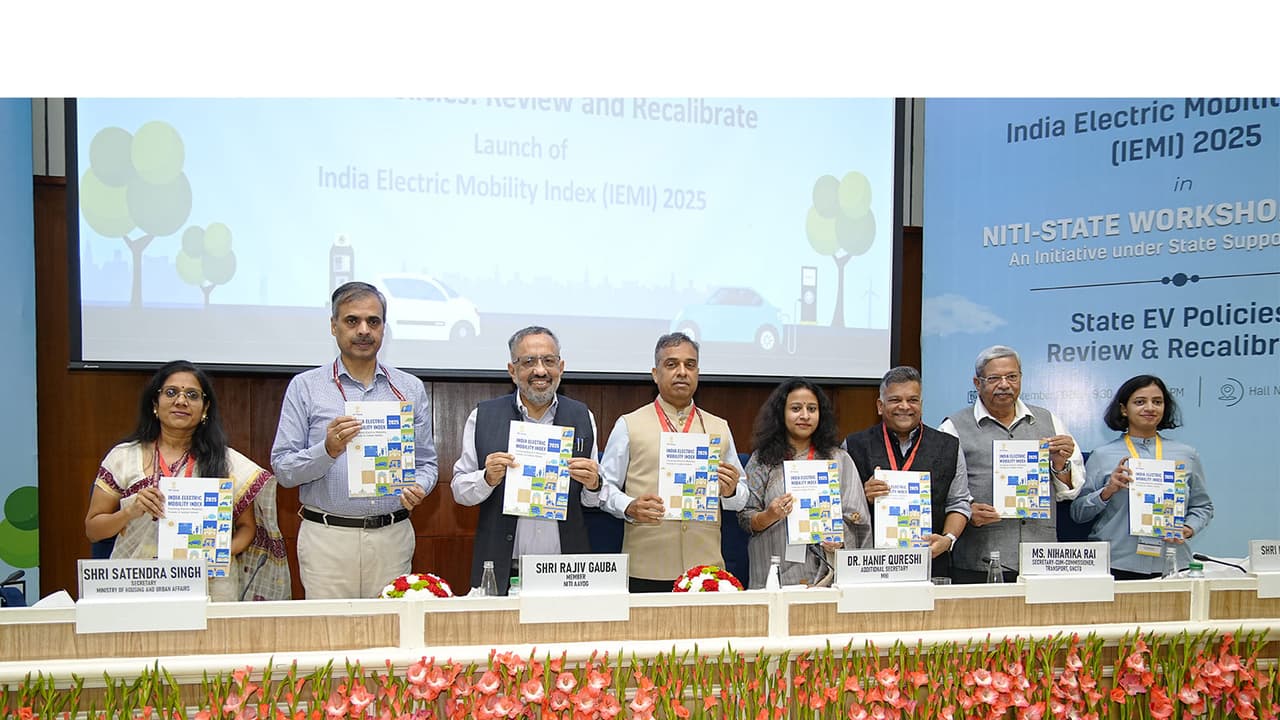
NITI Aayog’s Rajiv Gauba calls electric mobility a ‘strategic imperative’ for the Viksit Bharat 2047 vision, highlighting it as an economic and environmental necessity. Geopolitical friction could hasten the transition, he said at the IEMI launch.
Describing electric mobility as a “strategic imperative” for the Viksit Bharat 2047 vision, NITI Aayog Member Rajiv Gauba stated that the global shift toward cleaner transport is well underway and represents an economic and environmental necessity for the country. Speaking at the NITI Aayog Workshop on State EV Policies, where the government think tank launched the second edition of the India Electric Mobility Index (IEMI) report, Gauba pointed out that geopolitical friction could rapidly hasten this transition.
He noted that the recent West Asia crisis could become a major inflection point for electric mobility, mirroring the 1970s oil crises that accelerated the global push toward greater fuel efficiency.
Global Adoption Trends
Gauba pointed to international sales data to underline the pace of adoption abroad. In 2025, electric cars accounted for roughly one-tenth of new car sales in the United States, over a quarter in the European Union, and more than half in China, with these market shares projected to climb higher worldwide.
India’s Imperative for EV Adoption
For India, Gauba highlighted heavy import vulnerability as a core reason to transition quickly, noting that the country relies on foreign suppliers for nearly 89 per cent of its crude oil requirements. He cautioned that this dependence is poised to rise alongside growing vehicle ownership unless electric vehicles gain wider domestic adoption.
He underscored that the domestic automotive sector contributes approximately 7.1 per cent of the national gross domestic product and supports nearly 1.9 crore jobs. He stressed the importance of keeping the industry aligned with worldwide electric trends while addressing the substantial public health costs tied to vehicular pollution in cities such as Delhi.
Government Initiatives and Support
Detailing the central government’s fiscal commitment, Gauba noted that over Rs 92,000 crore in financial support is already deployed across initiatives including FAME, PM E-DRIVE, and PM E-bus Sewa. He added that two production-linked incentive schemes targeting Automobiles and Auto Components, as well as Advanced Chemistry Cell battery storage, are actively supporting manufacturing.
Gauba also noted the expansion of charging infrastructure led by oil marketing companies and private firms, observing that the newly launched Unified Bharat e-Charge app will improve public access and convenience.
State-Level Progress and Strategies
At the sub-national level, 29 out of 36 States and Union Territories have now notified dedicated EV policies. Data from the IEMI showed that the highest State score climbed from 77 to 84 over the past year, while the median score moved up from 36 to 40.
Gauba emphasized that differing strategies across states, shaped by distinct industrial bases, fiscal room, and geographical factors, serve as an advantage rather than an obstacle if administrations learn from one another. He urged states to prioritize electrifying urban public transport, build spatially balanced and reliable charging networks, and allocate capital toward local research and innovation. (ANI)
(Except for the headline, this story has not been edited by Asianet Newsable English staff and is published from a syndicated feed.)