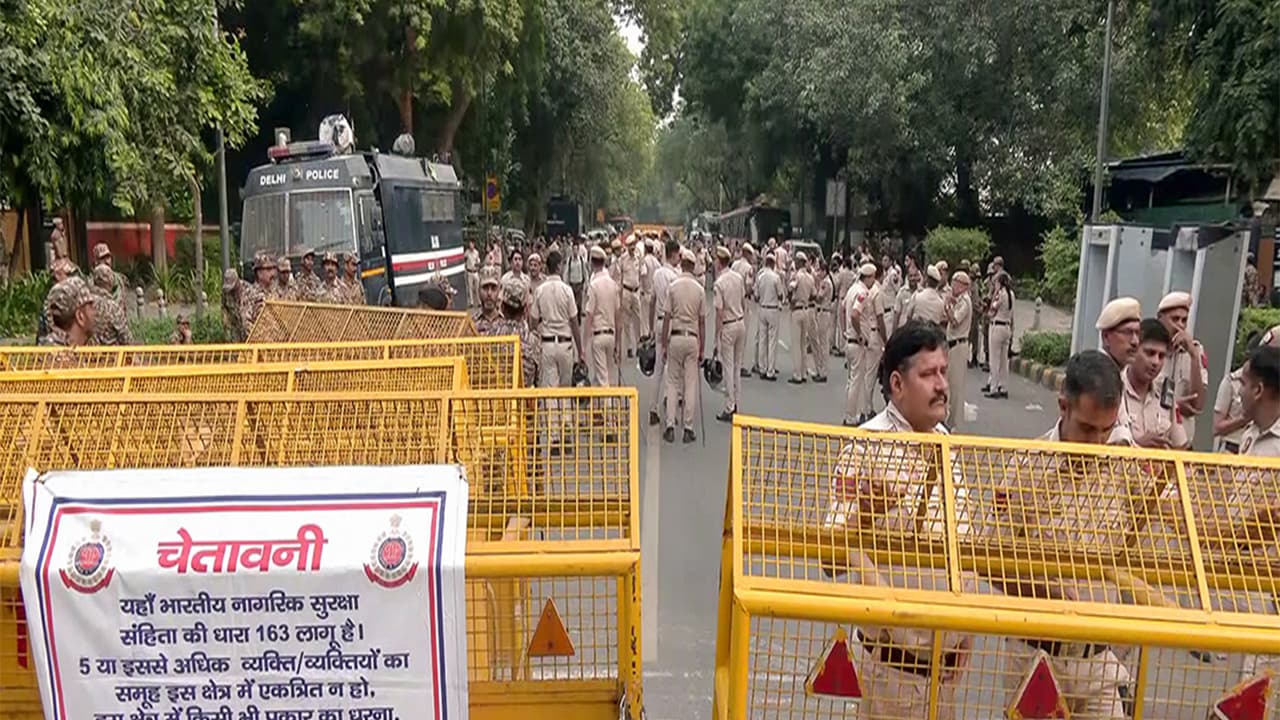
The Delhi Police told the Supreme Court that Jantar Mantar was denotified as a protest site due to public safety, traffic congestion, and residential convenience, following recommendations from an official Ministry of Home Affairs committee.
Delhi Police Rationale for Denotifying Jantar Mantar
The Delhi Police has told the Supreme Court that its decision to denotify Jantar Mantar as a designated protest venue was based primarily on the recommendations of a Ministry of Home Affairs committee and was taken after considering the changed ground situation, including traffic obstruction, crowd management and the impact of protests on residents, government offices and emergency services. In a counter-affidavit in journalist Swaty Singh’s plea challenging the denotification, Delhi Police Commissioner Anurag Kumar said it was incorrect to suggest that Jantar Mantar was denotified pursuant to the Supreme Court’s October 9 order in the M.A. Baby case.
The police said the proposal to change the notified protest venue had been under consideration by it and the Central government for a considerable period. The MHA had constituted a committee on August 26 to examine whether Jantar Mantar should continue as a designated protest site and to suggest alternative venues. The committee’s report was received by the Ministry of Home Affairs in September and forwarded to the Delhi Police on September 14, well before the Supreme Court’s October 9 order, the affidavit said.
Legal Basis and Court Observations
The police have, however, relied on the October 9 order to submit that the court had itself recognised the need to identify suitable alternative sites for peaceful and lawful protests. According to the affidavit, the Supreme Court had observed that alternative sites capable of providing basic amenities to protesters should be identified and designated and directed the competent authority to consider the suggestion and take an appropriate decision. The police said this observation further supported its decision to consider alternative venues, but maintained that the denotification was not a consequence of the October 9 order.
The Delhi Police also relied on the Supreme Court’s 2018 judgment concerning protests at Jantar Mantar Road, saying the court had directed the police to frame guidelines to regulate protests so that they did not disturb residents or offices in the vicinity. The police said the judgment recognised peaceful protest as a fundamental right but also required it to be balanced against the rights of other citizens. It said the Supreme Court had also clarified that the right to protest at a particular location was not itself a fundamental right and that the competent authority was not barred from shifting the venue.
Safety and Public Order Concerns
According to the police, the situation around Jantar Mantar had changed substantially since the 2018 judgment. It cited concerns over public order and safety, traffic regulation, crowd management, protection of sensitive and vital installations and the convenience of residents and commercial establishments. The police have also questioned the very character of Jantar Mantar, saying it is a public road rather than a conventional protest site. It said the road continued to be used, though with difficulty, for the movement of the public and that its designation as a permanent protest venue had resulted in obstruction of free movement.
The affidavit said Jantar Mantar sees more than 1,300 protests and demonstrations every year, while its assessed capacity is only around 1,500 persons. The police said emergency services, including fire brigades and ambulances, face constraints and that large gatherings can spill over towards Janpath and Connaught Place, creating traffic and crowd-management problems. It cited the presence of 78 foreign embassies, diplomatic missions and international organisations within a 3-4 km radius of Jantar Mantar and 99 Central government offices and institutions in the area. These offices, according to the police, have a daily footfall of around 1.46 lakh people, making uninterrupted movement in the area important.
Impact on Residents and Infrastructure
The police also said around 7,017 private residential housing units and 5,349 government residential units, together housing more than 64,000 people, are situated within the same radius. It said residents are directly affected by traffic congestion, disruption of normal movement and disturbances arising from protests. The affidavit further referred to shops and commercial establishments in the vicinity whose operations are allegedly affected by traffic congestion and disruption of vehicular and pedestrian movement. It also cited the proximity of Ram Manohar Lohia Hospital, saying protests and resulting traffic congestion have on several occasions obstructed the movement of patients and ambulances.
It was against this backdrop that the MHA committee was constituted to examine the suitability of Jantar Mantar Road for protests, demonstrations and rallies. The committee, the police said, unanimously concluded that Jantar Mantar Road was no longer suitable for such activities after considering public safety, law and order, traffic management, emergency response, protection of vital installations and protected areas, convenience of residents and preservation of heritage and commercial areas. The committee identified Ramlila Maidan in Central Delhi, CBD Ground in East Delhi and Burari Ground in North-West Delhi as alternative venues. The police said these recommendations formed the principal basis for its decision to denotify Jantar Mantar and identify alternative protest sites. It also said that between August 1 and August 27, the stretch around Jantar Mantar accounted for about 250 distress calls, 109 FIRs relating to the area, more than 254 property-loss claims, 23 cases relating to public-order violations, rioting and defacement, and 14 cases under provisions of the Delhi Police Act relating to public nuisance. The police have maintained that the decision was an administrative and executive one taken in the larger public interest, and that protesters cannot claim a vested right to insist on exercising their right to protest at a particular location, particularly when the location is a public road intended for free movement of citizens.
(Except for the headline, this story has not been edited by Asianetnews Editorial staff and is published from a syndicated feed.)