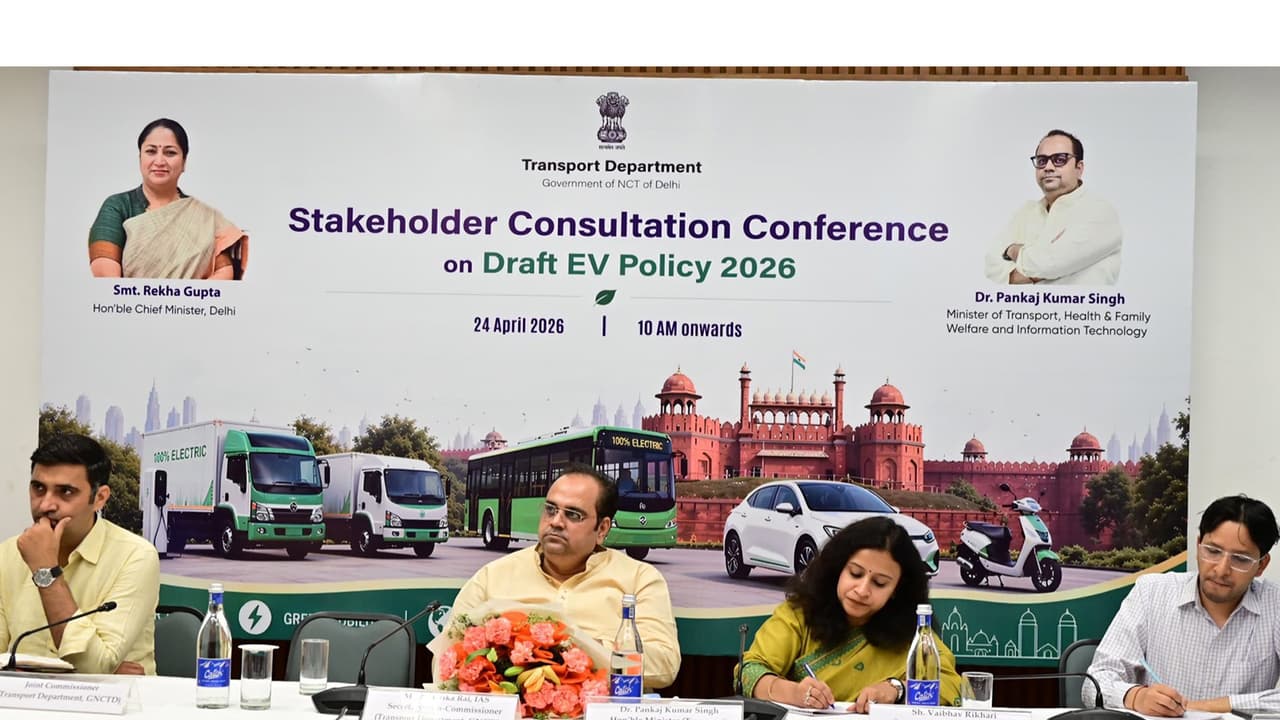
Delhi Transport Minister Pankaj Kumar Singh held a stakeholder meeting on the Draft Delhi EV Policy 2026. The policy aims to make Delhi India’s EV Capital by boosting EV adoption, expanding charging infrastructure, and cutting down on pollution.
Delhi Transport Minister Pankaj Kumar Singh on Friday convened a Stakeholder Consultation Conference on the Draft Delhi EV Policy 2026, said an official statement released on Friday. Senior officers from the Department also participated in the meeting. The consultation brought together key stakeholders across the electric mobility ecosystem to deliberate on actionable feedback and recommendations for strengthening the policy framework, it added.
Delhi’s EV Capital Ambition
Transport Minister Pankaj Kumar Singh reiterated the Government’s commitment to making Delhi a leader in electric mobility, stating: “We are working towards making Delhi the EV Capital of the country. The Delhi EV Policy 2026 when implemented will increase the EV vehicles as well as the supporting EV infrastructure ecosystem in the capital. This transition will significantly reduce pollution and ensure a healthier and better quality of life for our citizens.”
The consultation was designed to capture evidence-based recommendations from industry stakeholders to support the refinement and finalization of the Draft Delhi EV Policy 2026. The conference was structured into four sessions. During the session, it was opined that the stakeholders have a consultation with Delhi Transco Limited (DTL) to facilitate the adoption of EVs and the installation of a comprehensive public and private charging network.
Key Objectives of the Draft Policy
The Draft Delhi EV Policy 2026 outlines a comprehensive roadmap to scale electric mobility across the National Capital. The policy aims to accelerate EV adoption across vehicle segments while ensuring the development of a robust and future-ready ecosystem. Key objectives include accelerating the adoption of electric vehicles across all major segments, enabling the installation of a widespread public and private charging network, and strengthening the EV supply chain through battery recycling, servicing, and component recovery. The policy also emphasizes reducing dependence on Internal Combustion Engine (ICE) vehicles to improve air quality, while ensuring fiscal efficiency and transparent implementation mechanisms.
Stakeholder Discussions and Recommendations
Extensive discussions were held on critical aspects of EV ecosystem development. Stakeholders highlighted the importance of residential charging infrastructure, with a focus on involving Resident Welfare Associations (RWAs) to address parking constraints and ensure last-mile accessibility. An area of discussion was battery lifecycle management and recycling. The Minister emphasized that structured mechanisms for battery recycling would be actively explored to minimize environmental impact and promote a circular economy.
The consultation also underscored the need to integrate the EV Policy with Delhi’s Solar Policy, enabling cleaner energy usage for EV charging and enhancing sustainability outcomes.
Focus on Charging Infrastructure
Stakeholders discussed the expansion of charging infrastructure across categories, including public, residential, commercial, and fleet segments. It was highlighted that Delhi currently has around 9,000 charging points, with an additional 4,000-5,000 points under development, and a target to scale up to 32,000-36,000 charging points in the coming years. The need for mapping existing infrastructure in coordination with OEMs and operators was emphasized to ensure efficient deployment, it added.
Further discussions included enhancing charging infrastructure at DTC depots and ISBTs, with potential access for private interstate electric bus operators, as well as exploring retrofitment of existing ICE vehicles to electric powertrains.
The inputs received during the consultation will play a critical role in refining the Draft Delhi EV Policy 2026, ensuring it is inclusive, practical, and aligned with industry needs. The Government remains committed to building a scalable, sustainable, and citizen-centric EV ecosystem, positioning Delhi at the forefront of India’s clean mobility transition. (ANI)
(Except for the headline, this story has not been edited by Asianet Newsable English staff and is published from a syndicated feed.)