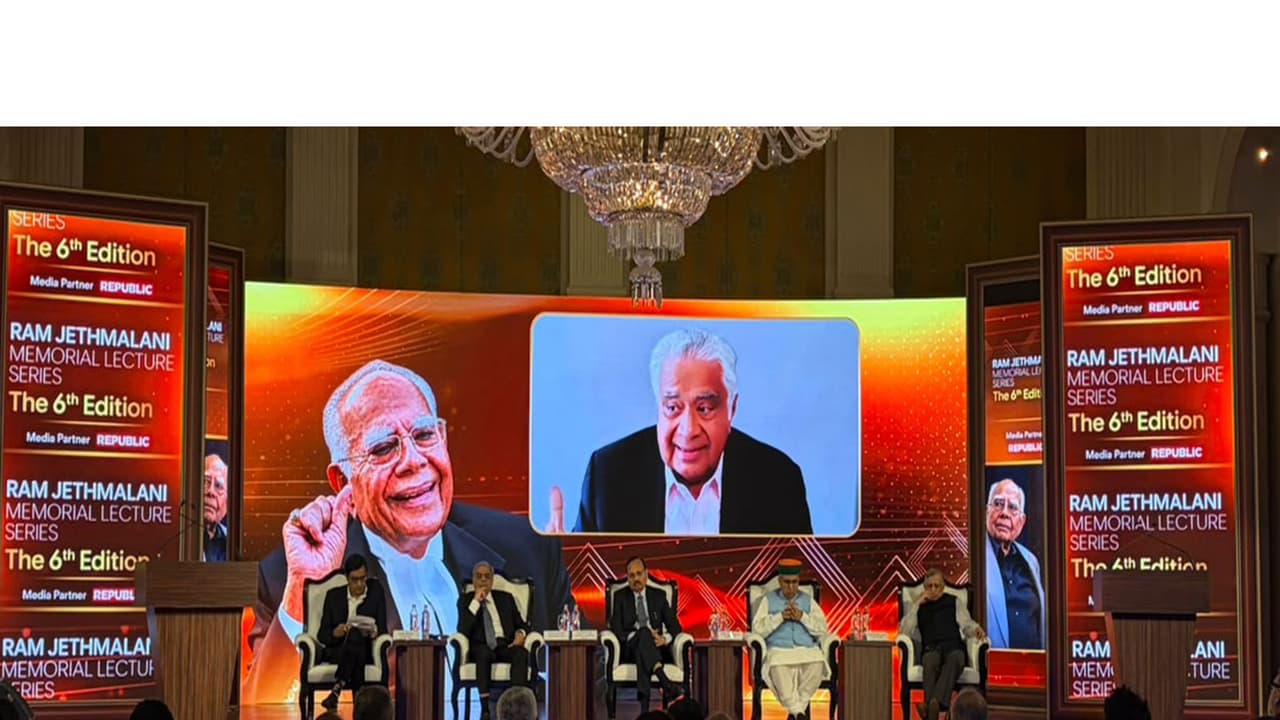
Senior Advocate Mahesh Jethmalani called on the Bar to introspect on its role in legal system delays and corruption, stating corruption in the judiciary is impossible without ‘fixer lawyers’ who facilitate bribery and game the system.
Role of ‘Fixer Lawyers’ in Corruption
“The Bar needs to seriously introspect on its own role in fomenting delay and corruption in our legal system. There cannot be corruption in the judiciary or tribunals without fixer lawyers who game the entire legal system by facilitating bribery. Everyone at the Bar knows who they are,” Jethmalani said.
He said the names of such lawyers were probably available with intelligence agencies and ought to be communicated to the Supreme Court Collegium, if this had not already been done, and called for exemplary action against such lawyer middlemen.
“Their names are probably available to intelligence agencies and ought to be communicated to the Supreme Court Collegium, if not already done so. Exemplary action needs to be initiated against such lawyer middlemen,” he said.
Jethmalani said the future of the Bar should instead belong to lawyers who win their cases on merits and rely on their knowledge of law.
“The future of the Bar should belong to lawyers who believe only in winning their case on merits. In other words, the Bar should be a repository of lawyers who know the law and not the judge,” he said.
The senior lawyer was speaking at the 6th Ram Jethmalani Memorial Lecture, held in memory of his late father and senior lawyer Ram Jethmalani. The lecture, titled “Justice Seen To Be Done: Transparency and Public Trust as Pillars of the Legal System”, was attended by eminent members of the legal fraternity including Union Minister of Law and Justice Arjun Ram Meghwal and by the Chief Justice of India (CJI) Surya Kant. The programme also featured speeches by Editor of Tughlaq magazine Swaminathan Gurumurthy and a lecture by Senior Advocate Harish Salve.
Irregularities in Bar Council of India Flagged
Jethmalani also flagged alleged irregularities in the functioning of the Bar Council of India (BCI), including delays in elections to various State Bar Councils and the subsequent reconstitution of the BCI.
“It is a crying shame that it was not until this year that, in a petition filed before the Supreme Court, it became public knowledge that elections across various State Bar Councils and the subsequent reconstitution of the Bar Council of India has been delayed for years and, in some States, for decades,” he said.
He also flagged an alleged attempt to perpetuate the tenure of BCI Chairman and senior advocate Manan Kumar Mishra for five years, up to 2030, instead of the prescribed two-year tenure under the Act.
“It is also a crying shame that there was an attempt to perpetuate the Chairman of the Bar Council of India for a period of five years, up to 2030, instead of the prescribed two-year tenure under the Act,” Jethmalani said.
He said the petition before the Supreme Court also alleges nepotism and corruption by BCI officers and an attempt to control a trust vested with important functions in perpetuity.
“They may cease to be Bar Council members, but they can continue to be on this very valuable trust,” he said.
Call for Transparency in Judiciary
Jethmalani also spoke about the Justice Yashwant Varma episode while addressing the need for institutional transparency and public trust in the judiciary.
He referred to the fire in the outhouse of Justice Varma’s Delhi residence, following which a sack containing cash in Rs 500 denomination was discovered. He said the episode had caused damage to the judiciary.
Jethmalani referred to the findings of the three-judge inquiry committee, including that the judge had control over the outhouse and said the Supreme Court had done the right thing by making the inquiry report public and allowing the country to see the evidence directly.
He said the episode raised a larger question about transparency in the legal system. “How much should be made public, to what extent, and where does opacity begin?” he asked.
Jethmalani also referred to the fact that no FIR had been registered and that the judge had ceased to be in public service. He questioned who would set the process in motion and whether the CJI would have to convince the President that the judge needed to be investigated. He said an expeditious probe was the compelling need of the hour.
Jethmalani also emphasised the negligible outcomes of complaints against judges and raised concerns over misconduct in the subordinate judiciary. He said opaqueness in the system carried risks of favouritism.
Corruption in Tribunals and Need for Transparency
Jethmalani also raised concerns over alleged rampant corruption and delays in justice in tribunals. He referred to the need for a National Tribunal Data Grid, on the lines of the National Judicial Data Grid, including cases and complaints against tribunal members. Such a database, he said, would bring transparency to the functioning of tribunals. He also pointed out that the Rs 7,000 crore expenditure on e-Courts was for courts and not tribunals.
Jethmalani’s speech also stressed the need for a fearless Bar, built not only on professional excellence but also on ethical standards, and greater public and media scrutiny of legal institutions. (ANI)
(Except for the headline, this story has not been edited by Asianetnews Editorial staff and is published from a syndicated feed.)