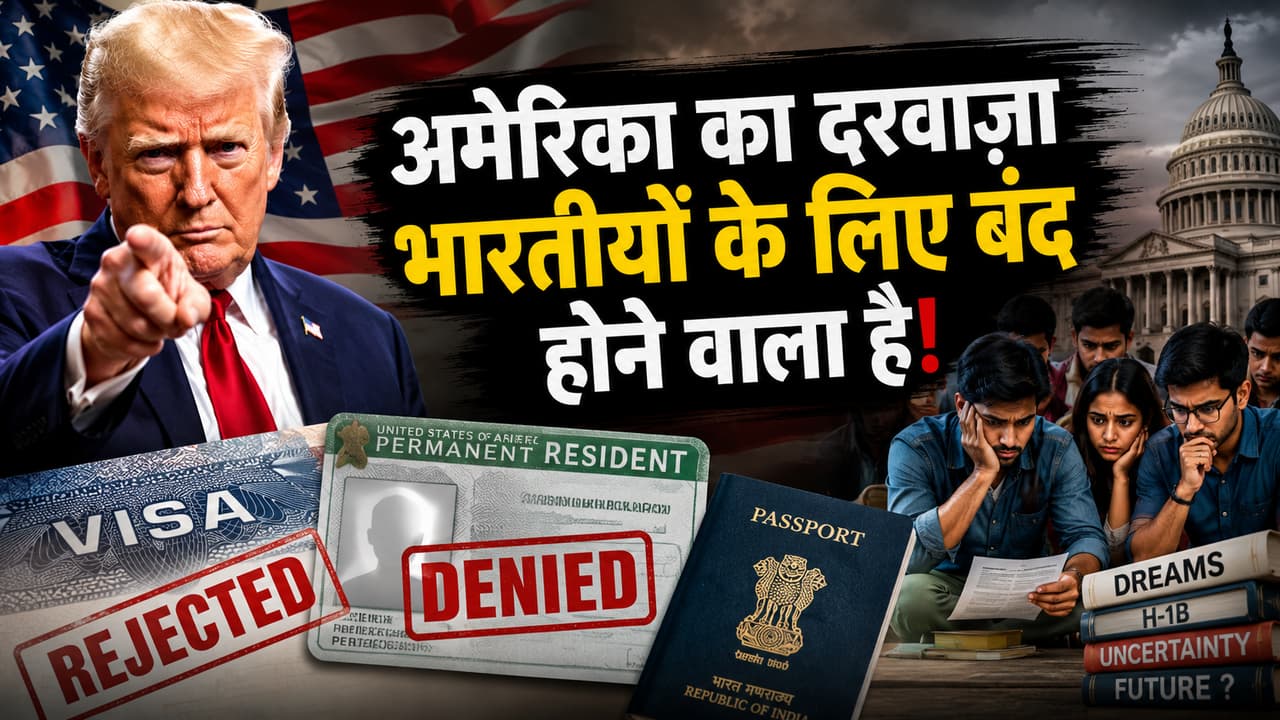
From August 2026, the rules for H-1B visa, Green Card, student visa and H-4 EAD may become stricter. If the Trump administration’s proposals are implemented, problems for Indian professionals, students and IT companies may increase.
Washington/New Delhi: A new sword of uncertainty hangs over the heads of millions of Indian professionals, students and their families who dream of making a career and settling on American soil. The Trump administration is preparing new immigration rules that may make many important provisions related to H-1B visa, green card, student visa and H-4 visa holders more stringent than before. If these proposals get the green signal, the costs for Indians looking to the US will skyrocket, the scrutiny walls will get higher, and the legal complexities will increase manifold. This is not just an administrative change, but an overhaul of the US immigration system, the most direct and profound impact of which is going to be on the Indian migrant group.
‘Final Agenda’ leaked: New blueprint for American immigration prepared behind closed doors
This is not a simple speculation, but a bitter truth emerging from the latest ‘Unified Regulatory Agenda’ issued by the US Homeland Security (DHS), Department of Labor (DOL) and Department of State (DOS). Although these proposals have not yet become law, they have made the intention of the administration completely clear. Under this new roadmap, it will not only become expensive for companies to hire foreign employees, but the paperwork will also increase so much that corporate houses may be forced to distance themselves from foreign talent. Since Indians have the largest share in the American tech industry, student community and the green card queues, Indians are going to get trapped the most in this ‘Chakravyuh’.
The biggest change on H-1B visas?
Among the proposed changes, the most discussed is the H-1B visa program. This is the visa through which thousands of Indian IT engineers, software developers and other specialists get jobs in American companies every year. If the proposal is implemented, the H-1B cap exemption available to universities and research institutions could be limited. Also, strict monitoring will be maintained on those companies which deploy H-1B employees at third-party client sites. Companies may have to prove that the employee is actually working under their supervision and that their employment relationship is completely legitimate.
August deadline and ‘third-party’ trap: Preparation to break the back of IT companies
There is a preparation to completely change the rules for 85,000 H-1B visas available under the annual limit in August. The biggest attack is going to be on the ‘third-party placement model’ on the basis of which India’s leading IT and consulting companies run their empire in America. Under the new rules, employers will now have to prove that they have a genuine ’employer-employee’ relationship with the employee. They will need to provide solid documentation through voluminous documentation as to the specific work the employee will perform at the client’s site. Not only this, the files of companies which have even a little history of violation of rules will now be put under a microscope.
There may be a big impact on Indian IT companies
Indian IT and consulting companies have been working on the client site model for a long time. They may be required to submit additional documentation and provide more detailed evidence for each appointment once the proposed rules come into effect. Companies that have a past record of violating H-1B rules may face more scrutiny in the future.
The bomb of hidden fees: a financial blow to employers with more than half of the workforce
There is another dangerous twist involved in this plan to increase costs. DHS is increasing the supplemental fees it applies to employers who have more than 50 employees in their total workforce and more than half of whom are on H-1B or L-1 visas. The surprising thing is that this huge fee will now be charged not only on initial petition or change of employer, but also on visa extension applications. Due to this, the budget of Indian tech companies dependent on outsourcing will completely collapse and for them, staying in America can prove to be a financially loss-making deal.
Unprecedented surge in ‘salary levels’: A conspiracy to make green card sponsorship extremely expensive
The Department of Labor (DOL) has made up its mind to raise the minimum economic threshold for hiring foreign workers so high that companies cannot sponsor them even if they want to. As part of the changes to the PERM labor certification process, the entry-level minimum wage is proposed to increase directly from the 17th percentile to the 34th percentile. In addition, there will be significant increases in higher pay levels. The result will be that American employers will have to pay very high salaries to foreign workers. Fed up with rising costs, stringent anti-discrimination measures and an endless backlog of green cards, many top Indian professionals are now abandoning the lure of America and moving to the United Kingdom (UK) in search of a secure and secure future.
End of ‘Duration of Status’: Future of 3.6 lakh Indian students in limbo?
India is today the largest source for US universities, sending about 3.6 lakh students in the 2024-25 academic year. But now roads are being closed for them too. DHS is eliminating the traditional “duration of status” system for students. This means that now students will not be able to stay in America as long as their course is going on, but they will be given a fixed deadline. Once that time is over, you will have to go through the difficult extension process again and again to continue your studies. Additionally, another proposal coming in February 2027 will significantly tighten the rules for ‘Optional Practical Training’ (OPT) and CPT, which could put the two-year STEM OPT extension after studies in jeopardy.
Can H-4 visa holders also get a shock?
The most painful impact of this immigration crisis is going to be on the spouses of H-1B workers (H-4 visa holders), the majority of whom are Indian women. Under a final rule coming this month, the automatic extension of ‘Employment Authorization Documents’ (EADs) that was available under an interim rule through October 2025 could be eliminated. The direct impact of this will be that even if an H-4 holder has applied for renewal 180 days before the expiry, they may lose their jobs due to lack of valid work authorization due to slow processing by the US Department of Immigration (USCIS). According to attorney Mitch Wexler of the Fragomen immigration firm, the agenda is a clear “roadmap” of the administration’s priorities, which will bring a long period of court battles and uncertainty for foreign professionals in the coming days.
Is there a need to panic now?
At present all these changes are at the proposed stage. These must go through a formal rule-making process, public comments, final approval, and potential legal challenges before they can be implemented. Therefore, these cannot be considered as final rules right now.
Why is this entire incident important for Indians?
India is the largest source of H-1B visa holders, employment-based green card applicants, and international students studying in US universities. In such a situation, if these proposals are implemented, the biggest impact may be on Indian professionals, students and their families. Rising costs, strict scrutiny, and lengthy processes can make the dream of working or settling in the US more challenging than ever. In the coming months, the world will be watching the next step of the Trump administration.