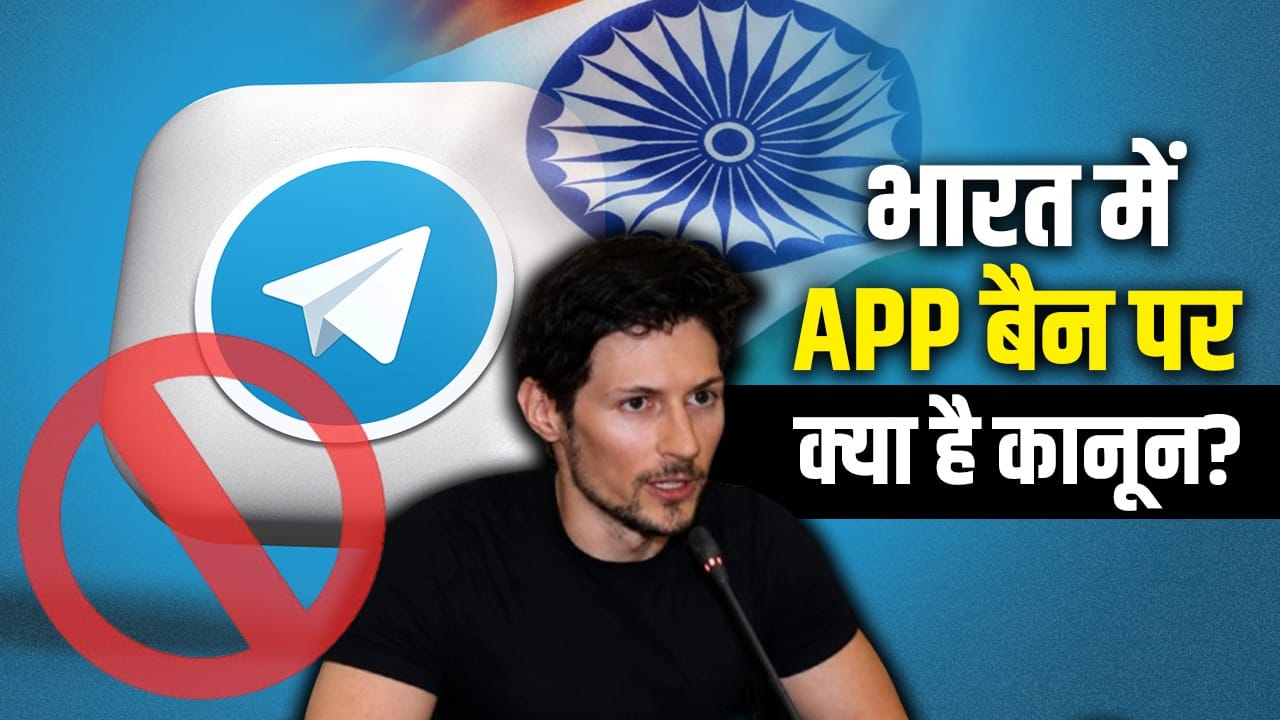
After the Telegram app was banned, its CEO has made many serious allegations.
The Government of India has temporarily banned the social media platform Telegram in the country for a week before the NEET-UG exam. After the paper is out, NEET-UG is being conducted again. This examination will be held on 21st June and the ban has been imposed till 22nd June. As soon as this information became public, people are raising questions. Telegram has also raised questions. He says that there are many platforms from where it is possible to share such things, so why stop at Telegram alone?
Founder and CEO of Telegram app Pavel Durov has made serious allegations. They claim that telecom company Reliance Industries is interfering in the internet connectivity of our app. This is not limited to India only, users in many countries are facing its impact. Come, let us know on this pretext whether the government can block any app in India, how and under which law? What is its complete process? Can Telegram go to court against the government’s decision?
Can Telegram challenge the government?
Not only Telegram, any app company can challenge the government order in court. Users can also claim violation of their rights. The company may say that shutting down the entire platform is a more drastic step. The government can say that it was necessary to protect the security of the examination and protect students from cheating. The court hears both sides. Then it sees whether the order is legal, necessary and balanced or not.
Under which law can the government block the app?
Supreme Court Advocate Ashwini Kumar Dubey says that the main law for blocking any website, app or online content in India is the Information Technology Act, 2000. In common language it is called IT Act. Section 69A of this law gives the government the power to block access to online content or platforms. Under this, the central government can order blocking of any website, app, link, channel or online information. But this power is not unlimited. The government has to use it only on fixed legal grounds.

Pavel Durov, Founder and CEO of Telegram App
What does Section 69A say?
Under Section 69A of the IT Act, the government can block online content or apps when it feels that it is necessary to do so. This step is taken to protect the sovereignty and integrity of India, for the security of the country, to maintain good relations with other countries, to maintain public order and to prevent incitement to any crime, etc. In a case like NEET-UG, the government can usually cite grounds like public order, fairness of the examination and preventing fraud. If fake paper leak, fraud or copying gangs are active on any app, then the government can take action.
Introduction of Blocking Rules 2009
For this, IT Act alone is not enough. For this, help is also taken under IT Rules 2009. The Blocking Rules explain how the government will order blocking. Which officer will give the orders? At what level will the investigation be conducted and how will the order be reviewed?
Advocate Dubey says that under this, when officers or concerned agencies consider an app to be a threat to the country’s security, law and order or organized fraud, then they send a formal recommendation to the Ministry of Electronics and Information Technology. After this an inter-ministerial committee investigates the allegations. If the committee is satisfied that the information available on the app or website is against the country or outside the scope of the law, then it issues a blocking order with the approval of the IT Secretary.
A temporary ban has been imposed on Telegram.
What happens in an emergency?
Sometimes the matter is very important. Like riot, terrorism, exam leak, cyber fraud or national security threat. In such a situation, the government can immediately issue an interim blocking order. This is called emergency blocking, but later review of this order is necessary. The government has to see whether the order was correct or not. Therefore, even an emergency order is not permanent. It can be tested on legal criteria.
Is it necessary to close the entire app?
This is the biggest legal question. In law this is called the principle of proportionality. This means that government action should be according to the threat. If the problem is limited to a few channels, then action should be taken on those channels first. If the problem is very widespread and the platform is not cooperating, then bigger steps can be taken. Closing the entire app is considered a serious step. Millions of ordinary users are also affected by this.
question of freedom of expression
Article 19(1)(a) of the Constitution of India gives freedom of expression to the citizens. People communicate through apps. Share information. Let’s study. Do business. When an app is closed, this right is affected. But this right is not absolute. Under Article 19(2) the government can impose appropriate restrictions. Such restrictions can be imposed on grounds such as public order, security, crime prevention and national interest. Nevertheless the restrictions should be reasonable, necessary and limited.
What is Section 69A in the eyes of the Supreme Court?
The Supreme Court had considered Section 69A valid in the case Shreya Singhal vs. Union of India. The court had said that there are procedures and security measures in place. But the court also accepted that the blocking order cannot be arbitrary. The government will have to follow the legal basis and procedure, that is, Section 69A gives power to the government but this power comes with accountability.
What can be the government’s argument in the NEET case?
There are 22 lakh students enrolled in NEET. Rumors of paper leaks harm students. Gangs selling fake question papers can extort money from students and parents. The government can also say that the ban is temporary i.e. it is not a permanent ban. Its purpose is to prevent cheating during the examination period.
In simple words, the government in India can close any app, but this work should be done only as per law and procedure. Section 69A of the IT Act and Blocking Rules 2009 give authority to the government in this matter. The case of temporary ban on Telegram is an example of the balance between exam security and digital freedom. If the government’s aim is to stop paper leaks and fraud, then it can be legitimate. Security is also important in the digital age. Civil rights are also important. The right path is where there is a balance between the two.
Also read: How many times did Shiv Sena break? From Bal Thackeray to Uddhav, the story of party disintegration