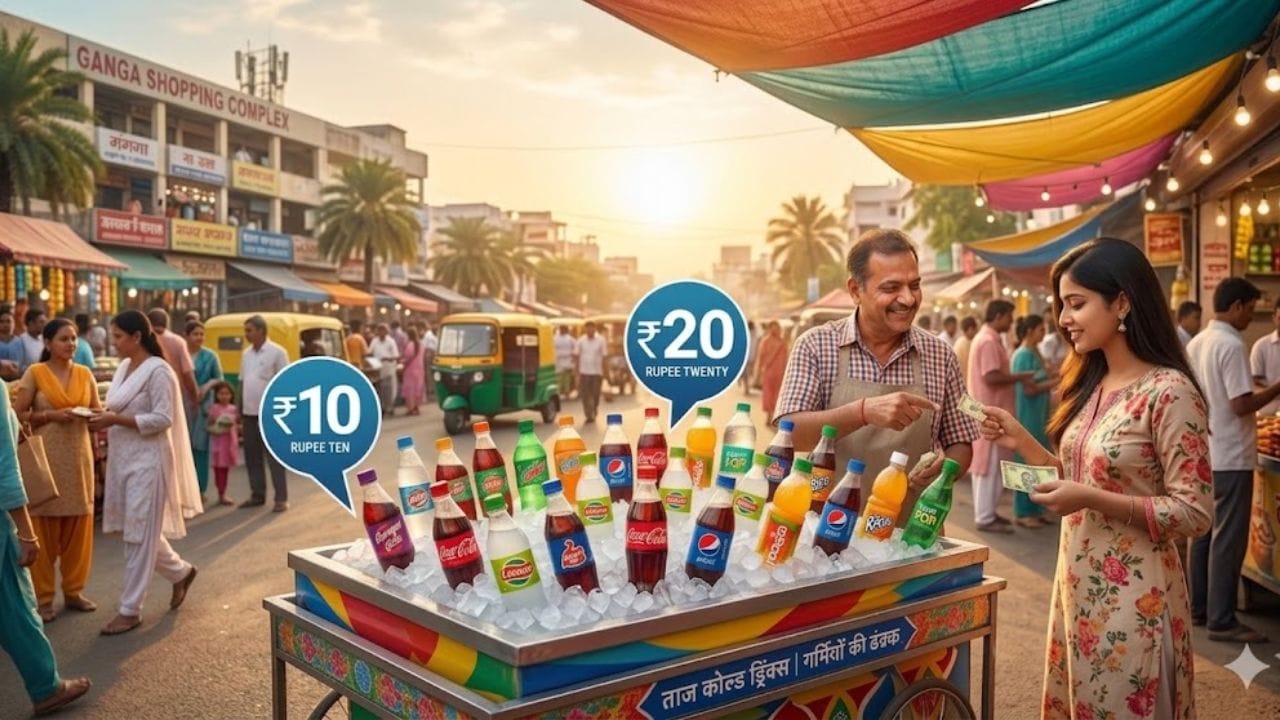
Price war has started in the soft drink market this summer.Image Credit source: Google Gemini
This summer the competition in the soft drinks category is intensifying. According to a report by Crisil Ratings, the market share of new players, which are targeting impulse purchases through popular price points like Rs 10 and Rs 20 bottles, has increased to an estimated 6-7 per cent in the last financial year, from 2 per cent in FY2024. Given the increasing competition, it is expected that already existing multinational companies will increase their marketing and distribution expenditure, as well as expand their production capacity and distribution infrastructure.
Prabhu Gandhi Kumar, founder of food and beverage manufacturing company TABP, said in a media report that taste in India is largely regional and cultural. What is successful in one state may not necessarily be successful in another state. Being a homegrown brand, we understand the nuances that multinational companies often struggle to replicate on a larger scale. He explained that we are getting tremendous response in key regions and we are increasing our market share. In a diversified market like India, being local is both an advantage for us and our main strategy.
Earnings may increase
According to the CRISIL report released on Tuesday, even though the competition between already existing multinational companies and new players is intensifying, soft drink bottlers are expected to see a jump in their earnings again in this financial year. After the sluggishness of the last financial year, this time earnings may reach their long-term average growth rate of 15 percent. The main reason for this is excessive heat. 40 percent of total sales come in the summer months. The huge rise in crude oil prices due to the ongoing conflict in West Asia has also increased the cost of packaging. This may have a negative impact on the profits of this industry, which may reduce profits by up to 250 basis points (bps).
Whose earnings will not be affected?
Bottlers having a presence across the country will be less affected because they have more power to set prices and can keep costs down by producing on a larger scale. The cash flow of these companies will remain strong, due to which their credit profile will also remain stable. These findings of CRISIL are based on the analysis of 13 bottlers in the non-alcoholic beverage industry. This industry includes carbonated soft drinks (70 percent of the market), juices (12 percent) and packaged water (18 percent). Shaunak Chakraborty, director, CRISIL Ratings, said the companies have not only increased their bottling capacity by 30-35 per cent in the last two financial years, but also expanded their distribution network and cold chain infrastructure. This will result in a substantial double digit increase in volume. Higher volumes, coupled with a 2-4 per cent price increase in a competitive environment, will help companies return to their long-term revenue growth path.
Less possibility of price hike
Rucha Narkar, Associate Director, Crisil Ratings, further said that increasing competition, which has reduced the scope for price movement amid rising crude oil-related packaging costs (20-22 per cent of the total cost), may lead to some decline in profits this financial year. However, modest price increases and increased focus on zero-sugar varieties may limit the overall impact to 200-250 basis points, keeping margins healthy at 15-16 per cent. Additionally, bottlers with a pan-India presence are expected to be able to negotiate better pricing terms with suppliers and distributors by purchasing raw materials in bulk and lifting larger volumes, which will offset some of the impact on profits.
Capex will remain
Overall, cash flow will remain healthy for the companies, which will allow them to continue spending on increasing bottling capacity and increasing the number of visi-coolers at outlets, which will keep capex levels high. However, this level of capex—which had increased significantly in the last financial year due to acquisitions—will be slightly lower this financial year. As a result, the total loan/EBITDA and interest coverage ratio of companies may improve to 0.9-1.0x and 10-11x respectively this financial year, from 1.1x and 9x in the last financial year.