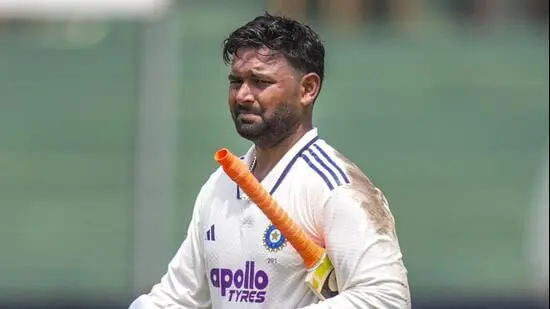
Kolkata: It wasn’t a delivery that took Rishabh Pant by surprise. In fact, when the short ball from Lahiru Kumara-bowling the 39th over-climbed on him, Pant calmly wore the bouncer on his back, waited for the umpire to call it a dead ball and simply reset himself.
Next delivery, short again. This time Pant swivelled inside its line to pull it fine for a boundary. Next ball was back of the length, prompting Pant to switch from trying to pull and instead run the ball towards third man. Instead, the ball grazed the face of his bat to balloon over the fielder running back from gully, leaving Kumara seething with frustration.
It was the kind of exchange that explained why India had suddenly found a way through a Sri Lankan attack that had spent much of the day making batting look like an exercise in patience and survival. The pitch was not offering the clean, predictable bounce that batters crave. The ball was stopping, the spinners were extracting turn and the seamers were hitting awkward lengths. Runs were available, but rarely on the batter’s terms. But Pant had already decided that the terms were negotiable.
By the time he was dismissed for 66 from 69 balls, India had acquired the momentum that had seemed distinctly difficult earlier in the innings. The seventh-wicket partnership with Ravindra Jadeja added 54 from just 60 balls, Jadeja contributing only eight of those. Pant supplied the rest of the argument. His innings was a strong reminder of exactly why India need Pant in these situations.
Pant’s first six, off Lahiru Kumara, came when he stepped out to a good-length delivery and, moving towards the leg side, freed his arms enough to send it over wide long-off. It wasn’t a conventional response to a bowler operating with a new ball. It was Pant deciding that the best defence was to change the question.
Against spin, he kept manufacturing possibilities. The reverse sweep appeared repeatedly. There were pulls, sweeps, improvised nudges and the occasional charge down the pitch. Keshara Nuwantha was turning the ball sharply at times, beating the outside edge and squaring Pant up.
Yet the next loose fraction of length disappeared through the leg side or behind square.
The contrast with Jadeja was striking. While Jadeja played the supporting role, Pant kept attacking the geometry of the field. India didn’t need both batters to dominate. They had Pant, and that was more than enough to make the Sri Lankan bowlers sweat. Pant reached his fifty with a six, his 100th in Test cricket, but the number was almost incidental. More important was what the shot represented. Kumara had been banging the ball into the pitch, asking Pant to negotiate the discomfort. Pant responded by getting inside the line and pulling it over long leg.
Regardless of how Pant treated them, Sri Lanka had undoubtedly bowled superbly. But Pant’s excellence was in refusing to allow their discipline to dictate the tempo indefinitely. There were moments when the strategy looked reckless. He survived an outside edge off Nuwantha that went to slip and burst out of a fielder’s hands. A few overs later, he survived another uncomfortable passage against Kumara. The final dismissal was almost inevitable in its method-another short, wide delivery, another attempted pull, but this time Pant was poorly positioned and could only top-edge the ball behind the keeper.
Pant lay on the ground, watching Niroshan Dickwella take the catch that ended an innings which had transformed India’s position. That’s the gift Pant brings to Test cricket. Audacity is often confused with aggression, but the two are not quite the same. And even though Pant’s aggression has often been misunderstood, India have largely benefited from him remaining unperturbed. Case in point again is this Galle pitch that was in no way easy to bat on. Pant still changed the pace of the contest.