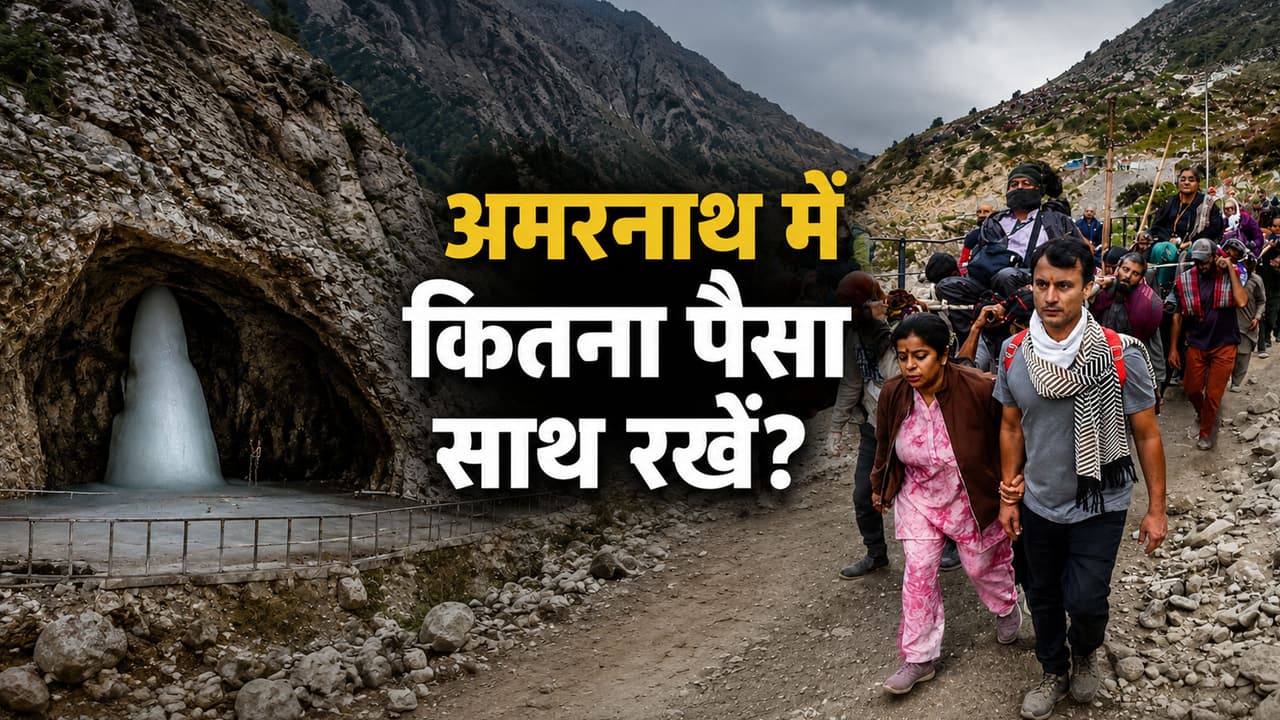
Where is the maximum expenditure in Amarnath? Know the complete travel budget, how much cash should be carried with you, why UPI may not work and important tips for first-time travelers.
Amarnath Yatra Budget: Like every year, this time too there is tremendous enthusiasm among the devotees of Baba Barfani. Till now more than 3.90 lakh devotees have registered. This 57 day long journey has started today, 3rd July 2026. If you are also preparing to have darshan of Baba Barfani, then just getting registration and health certificate made is not enough. The biggest question comes that how much money should be in the pocket? Phone and UPI do not work everywhere, so how much cash is it necessary to carry and where is most of the money spent while travelling? Let us know the complete budget and expenses so that there is no problem in your journey.
When does Amarnath Yatra start?
The journey has already started from Friday, July 3. On the very first day, 4,822 devotees left from the base camps of Baltal and Pahalgam. The second batch will leave tomorrow Saturday morning. This will include 3,865. Meanwhile, Prime Minister Narendra Modi has also written a special letter to the devotees, in which he described the journey as a ‘great privilege’ and said that ‘this journey of faith should not be limited to just darshan, but should also become a collective resolution towards cleanliness, security, livelihood of the local people and saving the environment.’ In his two-page message, PM Modi greeted the devotees with ‘Har Har Mahadev’ and ‘Jai Baba Barfani’, and described the yatra as a living example of India’s cultural-spiritual tradition.
Where does the money go in Amarnath Yatra?
1. Registration expenses
Before starting the yatra, every devotee has to register through the website of Shri Amarnathji Shrine Board (SASB) or authorized bank branch. For this a fee of Rs 150 has to be paid, after which a Yatra Card is obtained. This expense is small, but without it the journey cannot begin, so keep it first in your plan.
2. Coming and going
This is the part where your budget can change the most, because there are three ways to travel and the cost of all three varies greatly.
Walking tour
If you are physically fit and want to walk, this is the cheapest option. In this, only the cost of food and accommodation is included, there is no separate fare for the journey.
mule, palanquin or pithu
Those who cannot cover the entire distance on foot take the help of mules or palanquins. The fare for a mule is around Rs 4,000, whereas if you buy a palanquin, the cost can go up to Rs 8,000. These rates have been decided by the Shrine Board itself, so that there is no arbitrary collection from the devotees.
helicopter
This is the fastest but most expensive method. The helicopter does not go directly to the cave. It leaves only till Panchtarni, from there onwards about 6 kilometers have to be covered on foot, mule or palanquin. The helicopter fare from Baltal to Panchtarni is around Rs 3,250, while the fare from Pahalgam to Panchtarni is higher, around Rs 4,900. Apart from this, about Rs 3,250 more have to be paid separately for the last distance from Panchtarni to the cave. This means that more than half of your budget can be spent just on commuting, if you choose the helicopter route.
3. Local Travel
To reach the base camp, buses and share taxis run on Srinagar, Jammu, Baltal and Pahalgam routes and the administration has also fixed their fares, so that there is no overcharging from the passengers. The rate is fixed for local autos also. Around Rs 26 for the first one kilometre, then Rs 20 for every kilometre. So if you have to roam around the base camp, add this expense also in the budget.
4. Food and accommodation
The good news is that there are free langars at various places on the way, where devotees can get food. This saves food expenses to a great extent. For accommodation, there are arrangements for tents and shelters in the base camp and on the way, the rent for which is available at fixed rates. If you want more comfort and want to stay in a hotel or better camp, then this expense will be added separately.
What should be the budget for Amarnath Yatra?
If you do the entire journey on foot and stay in langar and basic tents, the cost per person can be around Rs 10,000 to Rs 15,000. If you choose palanquin, mule or some comfortable stay, then this expense can go up to Rs 15,000 to Rs 25,000 and if you do the entire journey by helicopter, then this figure can reach Rs 25,000 to 45,000. That means the budget completely depends on the instrument you choose.
Should cash be carried during Amarnath Yatra or not?
The route to Amarnath passes through high hilly areas, where the network condition is not at all like that of cities. In this hilly area only postpaid mobile network works properly, prepaid SIM often leaves the network. This is the reason why the administration has set up special counters of telecom companies at the base camp, where devotees can get a postpaid SIM by showing their identity card. In such a situation, being completely dependent on UPI payment can be risky. Mule vendors, palanquin vendors, small dhabas and local shopkeepers mostly transact in cash and there is always a risk of payment getting stuck due to network glitches. In such a situation, if you do not have cash, you can get completely trapped in difficult times.
How much cash should one carry during Amarnath Yatra?
At least 60-70% of your total estimated budget should be kept in the form of cash and the rest can be kept in the form of card or digital backup for emergencies. It is better to keep money in small notes, because it is not easy to get loose change in big notes in remote areas.
Do this before leaving for Amarnath Yatra
- Decide in advance which travel option (foot, mule, helicopter) to choose. Taking decisions at the last moment can be costly
- Carry a little more cash than required so that you do not face any problems in case of bad weather or travel delay.
- Take a postpaid SIM at the base camp as soon as you reach, so that you can remain connected if needed.
- Make payment only as per the authorized rate list. To avoid overcharging, know the fixed fare and rates in advance.
Disclaimer: This article is based on general travel information and available reports. Fares, rates and rules may change, so before traveling, please check the latest information from the official website of SASB.